
Integrated DFT, DOS, and molecular docking study of oxazine derivatives as promising scaffolds for Anti-HMPV drug design
IF 4.3
Q2 CHEMISTRY, PHYSICAL
引用次数: 0
Abstract
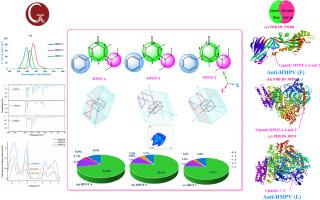
Oxazine derivatives 1–3 was investigated through density functional theory (DFT at B3LYP/6–311 G basis set, time-dependent DFT (TD-DFT) in this study and the molecular Hirshfeld surface analysis (HSA), molecular electrostatic potential (MEP) mapping, and molecular docking analyses were utilized to evaluate the electronic, structural and computationally predicted binding affinity. DFT and TD-DFT calculations revealed that the derivatives behave as semiconductors with tunable HOMO–LUMO gaps energies with values ranging from 3.09 to 5.36 eV, dominated by intramolecular charge-transfer interactions that modulate their absorption properties. Moreover, Band structure and DOS analysis confirmed their semiconducting behavior, through direct band gaps ranging between 1.78 eV to 2.21 eV and sulfur p-orbital contributions to conduction and valence states. MEP analysis highlighted heteroatom-rich regions as electrophilic/nucleophilic centers, supporting their potential to engage in favorable protein–ligand interactions. Hirshfeld surface analysis confirmed that crystal stability is primarily driven by π–π stacking, hydrogen bonding and Van der Waals forces, underlining the cooperative role of weak non-covalent interactions. Molecular docking with Human Metapneumovirus (HMPV) F fusion protein (PDB ID: 5WB0) and L polymerase (PDB IDs: 8FPI and 8FPJ) demonstrated strong binding affinities (–8.0 to –9.8 kcal·mol⁻¹) and stable hydrogen bonding, π–π, and hydrophobic contacts with catalytically relevant residues. The convergence of quantum-chemical insights with docking outcomes underscores the promising role of oxazine derivatives as computationally investigated scaffolds for anti-HMPV drug design, warranting further in vitro and in vivo investigations.
结合DFT, DOS和分子对接研究恶嗪衍生物作为抗hmpv药物设计的有前途的支架
通过B3LYP/ 6-311 G基集的密度泛函理论(DFT)、时间依赖DFT (TD-DFT)以及分子Hirshfeld表面分析(HSA)、分子静电势(MEP)作图和分子对接分析对恶嗪衍生物1-3的电子、结构和计算预测的结合亲和力进行了研究。DFT和TD-DFT计算表明,这些衍生物表现为具有可调谐HOMO-LUMO间隙能量的半导体,其值在3.09 ~ 5.36 eV之间,主要受分子内电荷转移相互作用的影响,这些相互作用调节了它们的吸收特性。此外,带结构和DOS分析证实了它们的半导体行为,通过直接带隙范围在1.78 eV到2.21 eV之间,以及硫的p轨道对电导和价态的贡献。MEP分析强调,富含杂原子的区域是亲电/亲核中心,支持它们参与有利的蛋白质-配体相互作用的潜力。Hirshfeld表面分析证实了晶体稳定性主要由π -π堆叠、氢键和范德华力驱动,强调了弱非共价相互作用的协同作用。与人偏肺病毒(HMPV) F融合蛋白(PDB ID: 5WB0)和L聚合酶(PDB ID: 8FPI和8FPJ)的分子对接显示出很强的结合亲和力(-8.0至-9.8 kcal·mol⁻(-9.8 kcal·mol⁻))和稳定的氢键、π -π和与催化相关残基的疏水接触。量子化学见解与对接结果的融合强调了恶嗪衍生物作为抗hmpv药物设计的计算研究支架的有希望的作用,需要进一步的体外和体内研究。
本文章由计算机程序翻译,如有差异,请以英文原文为准。
求助全文
约1分钟内获得全文
求助全文
来源期刊
Chemical Physics Impact
Materials Science-Materials Science (miscellaneous)
CiteScore
2.60
自引率
0.00%
发文量
65
审稿时长
46 days
 求助内容:
求助内容: 应助结果提醒方式:

 京公网安备 11010802042870号


