Wei Wei Ng, Ijaz Binti Hallaj Rahmatullah, Norasyikin Binti A Wahab, Chee Xian Tan, Anilah Binti Abdul Rahim
{"title":"Prevalence of Anaemia and Related Micronutrient Deficiencies After Bariatric Surgery.","authors":"Wei Wei Ng, Ijaz Binti Hallaj Rahmatullah, Norasyikin Binti A Wahab, Chee Xian Tan, Anilah Binti Abdul Rahim","doi":"10.17476/jmbs.2025.14.3.210","DOIUrl":null,"url":null,"abstract":"<p><strong>Purpose: </strong>Anaemia and micronutrient deficiencies are common complications following bariatric surgery. This study aimed to determine the prevalence of anaemia after Roux-en-Y gastric bypass (RYGB) and sleeve gastrectomy (SG), and to identify anaemia associated risk factors.</p><p><strong>Materials and methods: </strong>A cross-sectional study was conducted among 100 adults who underwent RYGB or SG between 2016 and 2022 at Hospital Raja Permaisuri Bainun, Ipoh. Demographics, biochemical parameters, and multivitamin (MVT) adherence data were analysed according to the type of surgery.</p><p><strong>Results: </strong>Among the participants, 44 underwent RYGB and 56 underwent SG, with a mean follow-up of 3 years. Most were female and over half were still menstruating. The overall prevalence of anaemia increased from 14% pre-surgery to 47% post-surgery. Anaemia increased from 9.1% to 47.7% in the RYGB group and from 17.9% to 46.4% in the SG group, with no significant difference in severity of anaemia (P=0.897). Postoperatively iron, folate and vitamin B12 deficiencies were observed in 44%, 14%, and 9% of patients, respectively. Folate deficiency was higher after SG (23.2% vs. 2.3%, P=0.003), while vitamin B12 deficiency occurred only after RYGB (20.5% vs. 0%, P<0.001). Iron deficiency was slightly higher in the RYGB group but not statistically significant (P=0.547). Menstruating females had higher risk of iron deficiency (P=0.001). Only 46% showed good adherence to MVT intake.</p><p><strong>Conclusion: </strong>Anaemia affected nearly half of post-bariatric surgery patients, with menstruating women at highest risk. Lifelong monitoring and prophylactic iron supplementation are essential to prevent anaemia and related micronutrient deficiencies.</p>","PeriodicalId":73828,"journal":{"name":"Journal of metabolic and bariatric surgery","volume":"14 3","pages":"210-219"},"PeriodicalIF":0.0000,"publicationDate":"2025-12-01","publicationTypes":"Journal Article","fieldsOfStudy":null,"isOpenAccess":false,"openAccessPdf":"https://www.ncbi.nlm.nih.gov/pmc/articles/PMC12817809/pdf/","citationCount":"0","resultStr":null,"platform":"Semanticscholar","paperid":null,"PeriodicalName":"Journal of metabolic and bariatric surgery","FirstCategoryId":"1085","ListUrlMain":"https://doi.org/10.17476/jmbs.2025.14.3.210","RegionNum":0,"RegionCategory":null,"ArticlePicture":[],"TitleCN":null,"AbstractTextCN":null,"PMCID":null,"EPubDate":"2025/12/15 0:00:00","PubModel":"Epub","JCR":"","JCRName":"","Score":null,"Total":0}
引用次数: 0
Abstract
Purpose: Anaemia and micronutrient deficiencies are common complications following bariatric surgery. This study aimed to determine the prevalence of anaemia after Roux-en-Y gastric bypass (RYGB) and sleeve gastrectomy (SG), and to identify anaemia associated risk factors.
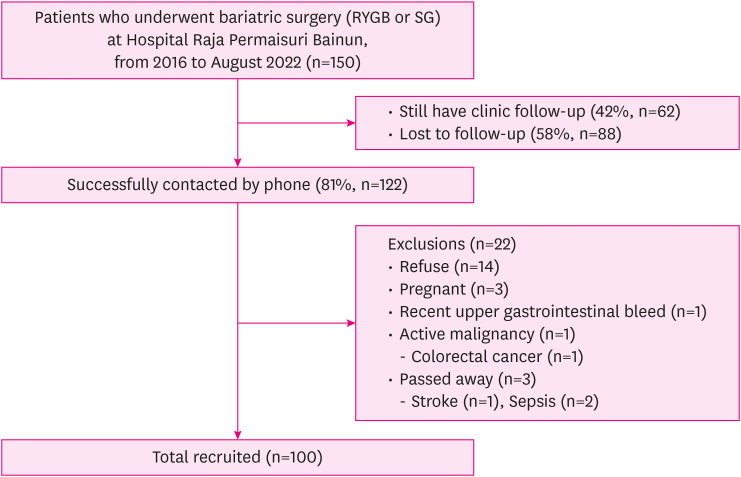
Materials and methods: A cross-sectional study was conducted among 100 adults who underwent RYGB or SG between 2016 and 2022 at Hospital Raja Permaisuri Bainun, Ipoh. Demographics, biochemical parameters, and multivitamin (MVT) adherence data were analysed according to the type of surgery.
Results: Among the participants, 44 underwent RYGB and 56 underwent SG, with a mean follow-up of 3 years. Most were female and over half were still menstruating. The overall prevalence of anaemia increased from 14% pre-surgery to 47% post-surgery. Anaemia increased from 9.1% to 47.7% in the RYGB group and from 17.9% to 46.4% in the SG group, with no significant difference in severity of anaemia (P=0.897). Postoperatively iron, folate and vitamin B12 deficiencies were observed in 44%, 14%, and 9% of patients, respectively. Folate deficiency was higher after SG (23.2% vs. 2.3%, P=0.003), while vitamin B12 deficiency occurred only after RYGB (20.5% vs. 0%, P<0.001). Iron deficiency was slightly higher in the RYGB group but not statistically significant (P=0.547). Menstruating females had higher risk of iron deficiency (P=0.001). Only 46% showed good adherence to MVT intake.
Conclusion: Anaemia affected nearly half of post-bariatric surgery patients, with menstruating women at highest risk. Lifelong monitoring and prophylactic iron supplementation are essential to prevent anaemia and related micronutrient deficiencies.
目的:贫血和微量营养素缺乏是减肥手术后常见的并发症。本研究旨在确定Roux-en-Y胃旁路术(RYGB)和袖式胃切除术(SG)后贫血的发生率,并确定贫血相关的危险因素。材料和方法:对2016年至2022年期间在怡保Raja permanisuri Bainun医院接受RYGB或SG治疗的100名成年人进行了横断面研究。根据手术类型分析人口统计学、生化参数和多种维生素(MVT)依从性数据。结果:44例接受RYGB, 56例接受SG,平均随访3年。大多数是女性,超过一半的人仍在经期。贫血的总体患病率从术前的14%上升到术后的47%。RYGB组贫血从9.1%增加到47.7%,SG组贫血从17.9%增加到46.4%,贫血严重程度无显著差异(P=0.897)。术后出现铁、叶酸和维生素B12缺乏症的患者分别为44%、14%和9%。SG术后叶酸缺乏症发生率较高(23.2% vs. 2.3%, P=0.003),而维生素B12缺乏症仅发生在RYGB术后(20.5% vs. 0%)。结论:近一半的减肥手术后患者存在贫血,经期妇女的风险最高。终生监测和预防性补铁对于预防贫血和相关微量营养素缺乏症至关重要。




 求助内容:
求助内容: 应助结果提醒方式:

 京公网安备 11010802042870号


