Dennis M Ssemakula, Sheila N Balinda, Yunia Mayanja, Onesmus Kamacooko, Andrew Abaasa, Janet Seeley
{"title":"Adherence to antiretroviral therapy among female sex workers in Kampala, Uganda.","authors":"Dennis M Ssemakula, Sheila N Balinda, Yunia Mayanja, Onesmus Kamacooko, Andrew Abaasa, Janet Seeley","doi":"10.4102/jphia.v16i1.1376","DOIUrl":null,"url":null,"abstract":"<p><strong>Background: </strong>Increased access to antiretroviral therapy (ART) for key populations who bear a disproportionate burden of human immunodeficiency virus (HIV) and acquired immunodeficiency syndrome (AIDS), including female sex workers (FSWs), reduces onwards transmission. This is, however, dependent on achieving high levels of adherence to ART.</p><p><strong>Aim: </strong>To determine the level of adherence to ART and associated factors among FSWs.</p><p><strong>Setting: </strong>An urban HIV clinic in Kampala, Uganda.</p><p><strong>Methods: </strong>This cross-sectional study enrolled 226 FSWs accessing HIV care between May 2017 and June 2017. We assessed self-reported adherence using interviewer-administered questionnaires and reviewing medical records. We defined high-level adherence as those who scored ≥ 95% at assessment. Using multivariable logistic regression, we identified factors independently associated with adherence.</p><p><strong>Results: </strong>Overall, 59.2% of participants were adherent to ART. Major reasons for non-adherence were being away from home (40.8%) and forgetfulness (26.7%). In the multivariable model, owning a phone (adjusted odds ratios [AOR]: 2.90; 95% confidence intervals [CI]: 1.07, 7.88), a 10-year increase in age (AOR: 1.60; 95% CI: 1.00, 2.60) and being a widow (AOR: 0.22; 95% CI: 0.05, 0.87) were independently associated with adherence.</p><p><strong>Conclusion: </strong>This baseline assessment builds a case for the development and scale-up of targeted intervention strategies to increase ART adherence among FSWs. Incorporating information and communication technology in routine adherence counselling could be scaled up among FSWs.</p><p><strong>Contribution: </strong>Our study highlights the possibility of integrating mobile phone-based adherence support in routine HIV care and informs the design of targeted interventions to curtail HIV transmission.</p>","PeriodicalId":44723,"journal":{"name":"Journal of Public Health in Africa","volume":"16 1","pages":"1376"},"PeriodicalIF":0.8000,"publicationDate":"2025-12-18","publicationTypes":"Journal Article","fieldsOfStudy":null,"isOpenAccess":false,"openAccessPdf":"https://www.ncbi.nlm.nih.gov/pmc/articles/PMC12816999/pdf/","citationCount":"0","resultStr":null,"platform":"Semanticscholar","paperid":null,"PeriodicalName":"Journal of Public Health in Africa","FirstCategoryId":"1085","ListUrlMain":"https://doi.org/10.4102/jphia.v16i1.1376","RegionNum":0,"RegionCategory":null,"ArticlePicture":[],"TitleCN":null,"AbstractTextCN":null,"PMCID":null,"EPubDate":"2025/1/1 0:00:00","PubModel":"eCollection","JCR":"Q4","JCRName":"PUBLIC, ENVIRONMENTAL & OCCUPATIONAL HEALTH","Score":null,"Total":0}
引用次数: 0
Abstract
Background: Increased access to antiretroviral therapy (ART) for key populations who bear a disproportionate burden of human immunodeficiency virus (HIV) and acquired immunodeficiency syndrome (AIDS), including female sex workers (FSWs), reduces onwards transmission. This is, however, dependent on achieving high levels of adherence to ART.
Aim: To determine the level of adherence to ART and associated factors among FSWs.
Setting: An urban HIV clinic in Kampala, Uganda.
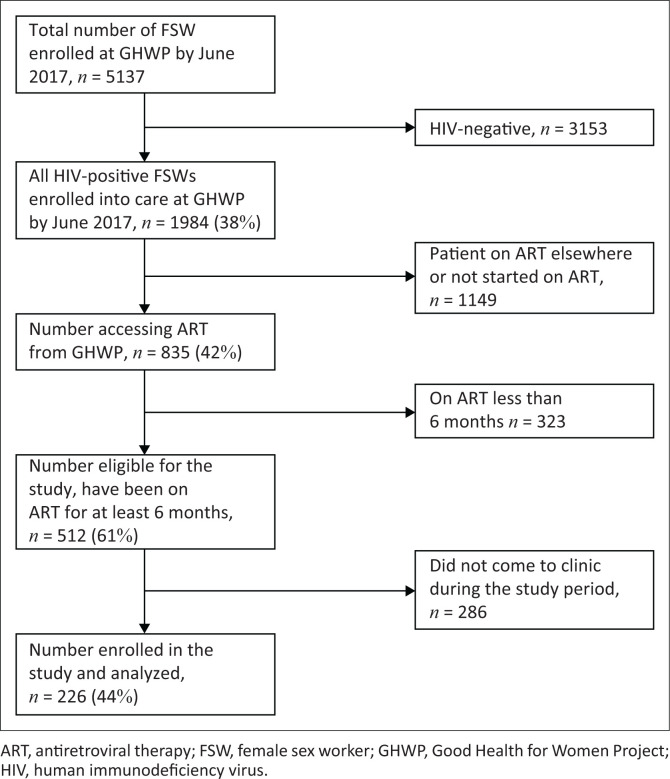
Methods: This cross-sectional study enrolled 226 FSWs accessing HIV care between May 2017 and June 2017. We assessed self-reported adherence using interviewer-administered questionnaires and reviewing medical records. We defined high-level adherence as those who scored ≥ 95% at assessment. Using multivariable logistic regression, we identified factors independently associated with adherence.
Results: Overall, 59.2% of participants were adherent to ART. Major reasons for non-adherence were being away from home (40.8%) and forgetfulness (26.7%). In the multivariable model, owning a phone (adjusted odds ratios [AOR]: 2.90; 95% confidence intervals [CI]: 1.07, 7.88), a 10-year increase in age (AOR: 1.60; 95% CI: 1.00, 2.60) and being a widow (AOR: 0.22; 95% CI: 0.05, 0.87) were independently associated with adherence.
Conclusion: This baseline assessment builds a case for the development and scale-up of targeted intervention strategies to increase ART adherence among FSWs. Incorporating information and communication technology in routine adherence counselling could be scaled up among FSWs.
Contribution: Our study highlights the possibility of integrating mobile phone-based adherence support in routine HIV care and informs the design of targeted interventions to curtail HIV transmission.
期刊介绍:
The Journal of Public Health in Africa (JPHiA) is a peer-reviewed, academic journal that focuses on health issues in the African continent. The journal editors seek high quality original articles on public health related issues, reviews, comments and more. The aim of the journal is to move public health discourse from the background to the forefront. The success of Africa’s struggle against disease depends on public health approaches.



 求助内容:
求助内容: 应助结果提醒方式:

 京公网安备 11010802042870号


