
Interactions between brown adipose tissue activity and exercise modality on metabolic kinetics: a crossover study in trained individuals
IF 2.9
2区 生物学
Q2 BIOLOGY
Journal of thermal biology
Pub Date : 2026-02-01
Epub Date: 2026-01-18
DOI:10.1016/j.jtherbio.2026.104392
引用次数: 0
Abstract
This study aimed to investigate the interactions between basal brown adipose tissue (BAT) activity and exercise modality on energy expenditure and substrate oxidation kinetics in trained individuals. Thirty-five trained males were stratified into high (HBAT, n = 15: 26.5 ± 4.3 years, 25.5 ± 1.8 kg/m2) and low (LBAT, n = 20: 27.0 ± 4.1 years, 26.0 ± 1.7 kg/m2) BAT activity groups based on infrared thermography evaluation. In a crossover design, each participant performed two experimental sessions: continuous aerobic exercise (AERO: 30 min at 70–80 % HRreserve) and high-intensity interval exercise (HIIE: 4 × 4 min at 90–95 % HRmax with 3-min active recovery), separated by 7 days. energy expenditure and substrate oxidation including carbohydrate, lipid and protein were continuously measured by indirect calorimetry during exercise and throughout a 30-min recovery period. Polynomial regression modeling of temporal trajectories revealed a significantly higher total energy expenditure in the HBAT group compared to the LBAT group (+25 %, p < 0.01), with the peak energy expenditure rate observed during HIIE in the HBAT group (3.7 ± 0.2 kcal min−1 versus 2.9 ± 0.3 kcal min−1 in AERO-LBAT; p = 0.004). Carbohydrate oxidation displayed a characteristic biphasic decline but showed no significant differences between groups. In contrast, lipid oxidation peaked later and was substantially higher in the HBAT groups, with the most pronounced effect following HIIE. Protein oxidation remained minimal and consistent across all conditions. These findings demonstrate that elevated BAT activity is associated with increased exercise-induced energy expenditure and enhanced lipid utilization during the latter stages of exercise, with HIIE showing the most robust metabolic associations in individuals with high BAT activity.
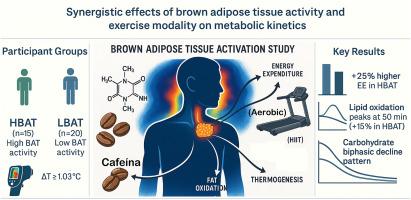
代谢动力学中棕色脂肪组织活动和运动方式之间的相互作用:一项训练个体的交叉研究。
本研究旨在探讨基础棕色脂肪组织(BAT)活性和运动方式对训练个体能量消耗和底物氧化动力学的相互作用。根据红外热成像评价,将35名训练男性分为BAT活性高组(HBAT, n = 15: 26.5±4.3年,25.5±1.8 kg/m2)和BAT活性低组(LBAT, n = 20: 27.0±4.1年,26.0±1.7 kg/m2)。在交叉设计中,每个参与者进行两个实验:连续有氧运动(AERO: 30分钟,70- 80% HRmax)和高强度间歇运动(HIIE: 4 × 4分钟,90- 95% HRmax, 3分钟主动恢复),间隔7天。在运动期间和整个30分钟的恢复期,通过间接量热法连续测量能量消耗和底物氧化,包括碳水化合物、脂质和蛋白质。时间轨迹的多项式回归模型显示,与LBAT组相比,HBAT组的总能量消耗显著更高(+ 25%,p -1,而AERO-LBAT组为2.9±0.3 kcal min-1, p = 0.004)。碳水化合物氧化表现出典型的双相下降,但组间差异不显著。相比之下,脂质氧化在HBAT组中达到峰值较晚,并且在HIIE组中明显更高,效果最明显。在所有条件下,蛋白质氧化保持最小且一致。这些发现表明,在运动后期,BAT活性升高与运动引起的能量消耗增加和脂质利用增强有关,HIIE在BAT活性高的个体中显示出最强大的代谢关联。
本文章由计算机程序翻译,如有差异,请以英文原文为准。
求助全文
约1分钟内获得全文
求助全文
来源期刊
Journal of thermal biology
生物-动物学
CiteScore
5.30
自引率
7.40%
发文量
196
审稿时长
14.5 weeks
期刊介绍:
The Journal of Thermal Biology publishes articles that advance our knowledge on the ways and mechanisms through which temperature affects man and animals. This includes studies of their responses to these effects and on the ecological consequences. Directly relevant to this theme are:
• The mechanisms of thermal limitation, heat and cold injury, and the resistance of organisms to extremes of temperature
• The mechanisms involved in acclimation, acclimatization and evolutionary adaptation to temperature
• Mechanisms underlying the patterns of hibernation, torpor, dormancy, aestivation and diapause
• Effects of temperature on reproduction and development, growth, ageing and life-span
• Studies on modelling heat transfer between organisms and their environment
• The contributions of temperature to effects of climate change on animal species and man
• Studies of conservation biology and physiology related to temperature
• Behavioural and physiological regulation of body temperature including its pathophysiology and fever
• Medical applications of hypo- and hyperthermia
Article types:
• Original articles
• Review articles
 求助内容:
求助内容: 应助结果提醒方式:

 京公网安备 11010802042870号


