
Dimorphic enantiostyly and its function for pollination by carpenter bees in a pollen-rewarding Caribbean bloodwort

IF 2.7 2区 生物学 Q2 PLANT SCIENCES
Steven D. Johnson, Jeremy J. Midgley, Luis G. Bocourt-Hernandez, F. G. Loiret, Patricia Ortega-Rodés, Nicola Illing
{"title":"Dimorphic enantiostyly and its function for pollination by carpenter bees in a pollen-rewarding Caribbean bloodwort","authors":"Steven D. Johnson,&nbsp;Jeremy J. Midgley,&nbsp;Luis G. Bocourt-Hernandez,&nbsp;F. G. Loiret,&nbsp;Patricia Ortega-Rodés,&nbsp;Nicola Illing","doi":"10.1002/ajb2.70148","DOIUrl":null,"url":null,"abstract":"<div>\n \n \n <section>\n \n <h3> Premise</h3>\n \n <p>Flowers that present their anthers and stigma in close proximity can achieve precise animal-mediated pollen transfer, but risk self-pollination. One evolutionary solution is reciprocal herkogamy. Reciprocity of anther and style positions among different plants (i.e., a genetic dimorphism) is common in distylous plants, but very rare in enantiostylous plants. We investigated the pollination and reproductive system of the enantiostylous Caribbean plant <i>Cubanicula xanthorrhizos</i> (Haemodoraceae).</p>\n </section>\n \n <section>\n \n <h3> Methods</h3>\n \n <p>We assessed stylar orientation of flowers and conducted controlled pollination experiments. We used videography of flower visitors and pollen load analysis to determine the pollination mechanism. We also measured floral morphology, pollen production, spectral reflectance, and volatile emissions.</p>\n </section>\n \n <section>\n \n <h3> Results</h3>\n \n <p><i>Cubanicula xanthorrhizos</i> exhibits dimorphic enantiostyly with c. 50:50 left- to right-styled morphs. Plants are self-compatible, but pollinator dependent for seed production. Intra- and intermorph crosses are equally fertile. The nectarless flowers are pollinated by female carpenter bees (<i>Xylocopa cubaecola</i>) that collect pollen, often by sonication, from two centrally positioned yellow feeding anthers. An inconspicuous deflected pollinating anther deposits pollen on the side of the bee thorax, which contacts the stigma of the mirror-image morph. A yellow-orange “guide” on the white tepals appears to be a visual attractant. Flowers emit methoxy benzenoid volatiles that may also attract bees.</p>\n </section>\n \n <section>\n \n <h3> Conclusions</h3>\n \n <p>Reciprocity of the style with a single pollinating stamen in <i>C. xanthorrhizos</i> appears to promote intermorph pollen export via “safe sites” on pollen-collecting bees. This novel case of dimorphic enantiostyly contributes to understanding of the evolution of floral polymorphisms.</p>\n </section>\n </div>","PeriodicalId":7691,"journal":{"name":"American Journal of Botany","volume":"113 2","pages":""},"PeriodicalIF":2.7000,"publicationDate":"2026-01-22","publicationTypes":"Journal Article","fieldsOfStudy":null,"isOpenAccess":false,"openAccessPdf":"https://www.ncbi.nlm.nih.gov/pmc/articles/PMC12918842/pdf/","citationCount":"0","resultStr":null,"platform":"Semanticscholar","paperid":null,"PeriodicalName":"American Journal of Botany","FirstCategoryId":"99","ListUrlMain":"https://bsapubs.onlinelibrary.wiley.com/doi/10.1002/ajb2.70148","RegionNum":2,"RegionCategory":"生物学","ArticlePicture":[],"TitleCN":null,"AbstractTextCN":null,"PMCID":null,"EPubDate":"","PubModel":"","JCR":"Q2","JCRName":"PLANT SCIENCES","Score":null,"Total":0}
引用次数: 0

Abstract

Premise

Flowers that present their anthers and stigma in close proximity can achieve precise animal-mediated pollen transfer, but risk self-pollination. One evolutionary solution is reciprocal herkogamy. Reciprocity of anther and style positions among different plants (i.e., a genetic dimorphism) is common in distylous plants, but very rare in enantiostylous plants. We investigated the pollination and reproductive system of the enantiostylous Caribbean plant Cubanicula xanthorrhizos (Haemodoraceae).

Methods

We assessed stylar orientation of flowers and conducted controlled pollination experiments. We used videography of flower visitors and pollen load analysis to determine the pollination mechanism. We also measured floral morphology, pollen production, spectral reflectance, and volatile emissions.

Results

Cubanicula xanthorrhizos exhibits dimorphic enantiostyly with c. 50:50 left- to right-styled morphs. Plants are self-compatible, but pollinator dependent for seed production. Intra- and intermorph crosses are equally fertile. The nectarless flowers are pollinated by female carpenter bees (Xylocopa cubaecola) that collect pollen, often by sonication, from two centrally positioned yellow feeding anthers. An inconspicuous deflected pollinating anther deposits pollen on the side of the bee thorax, which contacts the stigma of the mirror-image morph. A yellow-orange “guide” on the white tepals appears to be a visual attractant. Flowers emit methoxy benzenoid volatiles that may also attract bees.

Conclusions

Reciprocity of the style with a single pollinating stamen in C. xanthorrhizos appears to promote intermorph pollen export via “safe sites” on pollen-collecting bees. This novel case of dimorphic enantiostyly contributes to understanding of the evolution of floral polymorphisms.

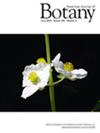
Abstract Image

加勒比海一种赏花血草的二态对映体及其对木蜂授粉的作用。
前提:接近花药和柱头的花可以实现精确的动物介导的花粉传递,但有自花授粉的风险。一个进化的解决方案是互惠异族通婚。不同植物之间花药和花柱位置的互易性(即遗传二态性)在二花束植物中很常见,但在对映异花束植物中非常罕见。本文研究了加勒比海地区一种对形植物古巴黄根的传粉和生殖系统。方法:对花柱取向进行鉴定,并进行对照授粉试验。利用访花录像和花粉负荷分析来确定传粉机制。我们还测量了花形态、花粉产量、光谱反射率和挥发性排放物。结果:古巴黄根菌在对端花序上呈现二形性,其左型与右型的比例约为50:50。植物是自亲和的,但种子生产依赖传粉者。异种杂交和异种杂交的育性是一样的。无花蜜的花由雌性木蜂(Xylocopa cubaecola)授粉,通常通过声波从两个位于中心位置的黄色喂养花药中收集花粉。一个不显眼的授粉花药将花粉沉积在蜜蜂胸部的一侧,与镜像形态的柱头接触。白色花被片上的黄橙色“向导”似乎是一种视觉引诱剂。花散发的甲氧基苯挥发物也可能吸引蜜蜂。结论:黄茎菊花柱与单雄蕊的互易性似乎促进了花粉通过采集花粉蜜蜂的“安全位点”输出。这种二态对映体的新情况有助于理解花多态性的进化。
本文章由计算机程序翻译,如有差异,请以英文原文为准。
求助全文
约1分钟内获得全文 求助全文
来源期刊
American Journal of Botany
American Journal of Botany 生物-植物科学
CiteScore
4.90
自引率
6.70%
发文量
171
审稿时长
3 months
期刊介绍: The American Journal of Botany (AJB), the flagship journal of the Botanical Society of America (BSA), publishes peer-reviewed, innovative, significant research of interest to a wide audience of plant scientists in all areas of plant biology (structure, function, development, diversity, genetics, evolution, systematics), all levels of organization (molecular to ecosystem), and all plant groups and allied organisms (cyanobacteria, algae, fungi, and lichens). AJB requires authors to frame their research questions and discuss their results in terms of major questions of plant biology. In general, papers that are too narrowly focused, purely descriptive, natural history, broad surveys, or that contain only preliminary data will not be considered.
×
引用
GB/T 7714-2015
复制
MLA
复制
APA
复制
导出至
BibTeX EndNote RefMan NoteFirst NoteExpress
×
提示
您的信息不完整,为了账户安全,请先补充。
现在去补充
×
提示
您因"违规操作"
具体请查看互助需知
我知道了
×
提示
确定
请完成安全验证×
copy
已复制链接
快去分享给好友吧!
我知道了
右上角分享
点击右上角分享
0
联系我们:info@booksci.cn Book学术提供免费学术资源搜索服务,方便国内外学者检索中英文文献。致力于提供最便捷和优质的服务体验。 Copyright © 2023 布克学术 All rights reserved.
京ICP备2023020795号-1
ghs 京公网安备 11010802042870号
Book学术文献互助
Book学术文献互助群
群 号:604180095
Book学术官方微信
小红书



