
Epitaxial growth of highly stacked SiGe(:B)/Si multilayers without strain relaxation for vertically stacked device applications
IF 22
1区 材料科学
Q1 MATERIALS SCIENCE, MULTIDISCIPLINARY
引用次数: 0
Abstract
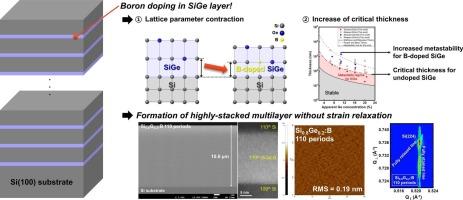
The increasing demand for vertically stacked semiconductor devices has necessitated the fabrication of highly stacked epitaxial multilayers of SiGe/Si without crystalline defects. We propose a scheme that incorporates boron atoms into SiGe layers, yielding SiGe/Si multilayers with misfit-dislocation-free structures and no strain relaxation. The boron atoms are introduced in situ using ultra-high vacuum chemical vapor deposition, obtaining epitaxial multilayers consisting of boron-doped SiGe layers and undoped Si layers. The microstructures and strain states of the multilayers are observed using X-ray diffractometry, atomic force microscopy, and transmission electron microscopy. The relaxation thresholds increased with increasing incorporation of boron in both the single layers and multilayers. Incorporation of 0.6 % boron into the Si0.8Ge0.2 layers realizes a fully strained 110-period multilayer with a total thickness of 10.6 μm. Based on the kinetically limited critical thickness derived from the single-layer results, we successfully interpret the observed metastability limit in multilayer structures. This physical interpretation explains the substantially higher metastability of boron-doped SiGe/Si multilayers than of their undoped counterparts. This study demonstrates that boron-doping approach clearly enhances the strain retention in high-period multilayers, highlighting its potential in vertically stacked device applications.
垂直堆叠器件应用中无应变松弛的高堆叠SiGe(:B)/Si多层外延生长
对垂直堆叠半导体器件的需求日益增加,使得制造高度堆叠的无晶体缺陷的SiGe/Si外延多层材料成为必要。我们提出了一种方案,将硼原子纳入SiGe层,产生具有无错配位错结构和无应变松弛的SiGe/Si多层膜。采用超高真空化学气相沉积技术原位引入硼原子,得到了由掺硼SiGe层和未掺杂Si层组成的外延多层膜。利用x射线衍射、原子力显微镜和透射电子显微镜观察了多层膜的微观结构和应变状态。随着硼在单层和多层中掺入量的增加,弛豫阈值均增加。在Si0.8Ge0.2层中掺入0.6%的硼,可获得全应变110周期的多层膜,总厚度为10.6 μm。基于单层结果得出的动力学极限临界厚度,我们成功地解释了多层结构中观察到的亚稳态极限。这种物理解释解释了掺硼的SiGe/Si多层膜比未掺硼的高得多的亚稳态。该研究表明,硼掺杂方法明显增强了高周期多层中的应变保留,突出了其在垂直堆叠器件应用中的潜力。
本文章由计算机程序翻译,如有差异,请以英文原文为准。
求助全文
约1分钟内获得全文
求助全文
来源期刊
Materials Today
工程技术-材料科学:综合
CiteScore
36.30
自引率
1.20%
发文量
237
审稿时长
23 days
期刊介绍:
Materials Today is the leading journal in the Materials Today family, focusing on the latest and most impactful work in the materials science community. With a reputation for excellence in news and reviews, the journal has now expanded its coverage to include original research and aims to be at the forefront of the field.
We welcome comprehensive articles, short communications, and review articles from established leaders in the rapidly evolving fields of materials science and related disciplines. We strive to provide authors with rigorous peer review, fast publication, and maximum exposure for their work. While we only accept the most significant manuscripts, our speedy evaluation process ensures that there are no unnecessary publication delays.
 求助内容:
求助内容: 应助结果提醒方式:

 京公网安备 11010802042870号


