
Carrier-free drugs as smart nanomaterials for cancer theranostics
IF 25.6
1区 化学
Q1 CHEMISTRY, INORGANIC & NUCLEAR
Coordination Chemistry Reviews
Pub Date : 2026-05-01
Epub Date: 2026-01-20
DOI:10.1016/j.ccr.2026.217601
引用次数: 0
Abstract
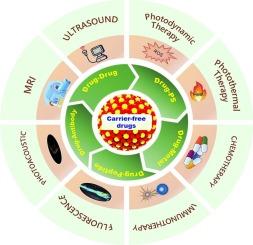
Nanocarriers have gained widespread applications in cancer theranostics by incorporating the fundamental concepts of nanotechnology. Drug delivery systems (DDS) based out of nanocarriers have outstanding prospects for biomedical applications due to their remarkable blood distribution, superior retention of drugs in tumors, and enhanced potential for combination therapy. However, two significant barriers have impeded the advancement of nanocarriers: the possibility of nanocarrier toxicity and poor loading of drugs into the nano DDS. Carrier-free drugs (CFDs) delivery nanosystems are an inventive alternative to these challenges and have drawn much interest in cancer therapy and stand out as an achievable solution to these obstacles. CFDs are developed on a nanoscale, without any requirement of additional excipients, and consequently have excellent pharmacokinetics and intracellular delivery. The key highlights of this review include preparation techniques, pharmacokinetics, covalent, non-covalent interactions and optimization of CFDs. The potential of CFDs in cancer theranostics is explored under specific interactions based on drugs, such as drug-drug, drug-photosensitizer, drug-metal, drug-antibody, and drug-peptide interactions. To the best of our knowledge, this review is the first to discuss the design of carrier-free drugs for cancer theranostics, with a prime focus on drug-based interactions that serve as the major basis for their self-assembly. Thus, by addressing the multifaceted aspects of CFDs, the review attempts to present a comprehensive perspective of CFDs and provide novel insights for more effective cancer therapeutics.
无载体药物作为癌症治疗的智能纳米材料
纳米载体结合了纳米技术的基本概念,在癌症治疗中得到了广泛的应用。基于纳米载体的药物传递系统(DDS)由于其显著的血液分布、在肿瘤中良好的药物保留和增强的联合治疗潜力,在生物医学应用中具有突出的前景。然而,有两个重要的障碍阻碍了纳米载体的发展:纳米载体的毒性和药物在纳米DDS中的装载能力差。无载体药物(cfd)递送纳米系统是应对这些挑战的一种创造性的替代方案,已经引起了人们对癌症治疗的极大兴趣,并且作为一种可实现的解决这些障碍的方案而脱颖而出。cfd是在纳米尺度上开发的,不需要任何额外的赋形剂,因此具有良好的药代动力学和细胞内递送。本综述的重点包括制备技术、药代动力学、共价、非共价相互作用和cfd的优化。cfd在基于药物的特定相互作用下,如药物-药物、药物-光敏剂、药物-金属、药物-抗体和药物-肽相互作用,探索了cfd在癌症治疗中的潜力。据我们所知,这篇综述首次讨论了用于癌症治疗的无载体药物的设计,主要关注基于药物的相互作用,这是它们自组装的主要基础。因此,通过解决差价合约的多面性,本文试图呈现差价合约的全面视角,并为更有效的癌症治疗提供新的见解。
本文章由计算机程序翻译,如有差异,请以英文原文为准。
求助全文
约1分钟内获得全文
求助全文
来源期刊
Coordination Chemistry Reviews
化学-无机化学与核化学
CiteScore
34.30
自引率
5.30%
发文量
457
审稿时长
54 days
期刊介绍:
Coordination Chemistry Reviews offers rapid publication of review articles on current and significant topics in coordination chemistry, encompassing organometallic, supramolecular, theoretical, and bioinorganic chemistry. It also covers catalysis, materials chemistry, and metal-organic frameworks from a coordination chemistry perspective. Reviews summarize recent developments or discuss specific techniques, welcoming contributions from both established and emerging researchers.
The journal releases special issues on timely subjects, including those featuring contributions from specific regions or conferences. Occasional full-length book articles are also featured. Additionally, special volumes cover annual reviews of main group chemistry, transition metal group chemistry, and organometallic chemistry. These comprehensive reviews are vital resources for those engaged in coordination chemistry, further establishing Coordination Chemistry Reviews as a hub for insightful surveys in inorganic and physical inorganic chemistry.
 求助内容:
求助内容: 应助结果提醒方式:

 京公网安备 11010802042870号


