
When metal nanoclusters meet reticular framework materials: A promising nanocomposites for boosting advanced biosensing
IF 25.6
1区 化学
Q1 CHEMISTRY, INORGANIC & NUCLEAR
Coordination Chemistry Reviews
Pub Date : 2026-05-01
Epub Date: 2026-01-20
DOI:10.1016/j.ccr.2026.217596
引用次数: 0
Abstract
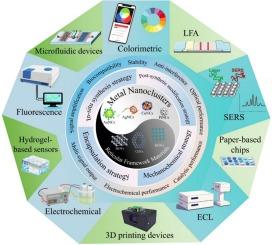
Metal nanoclusters (MNCs) with atomically precise structures, tunable fluorescence, and unique catalytic activities have attracted significant attention in the development and construction of biosensing platforms. However, their practical applications still suffer from some limits to a certain extent, such as instability, easy aggregation, and sensitivity to environmental interference. The emergence of reticular framework materials (RFMs), including metal organic frameworks (MOFs), covalent organic frameworks (COFs), and hydrogen bonded organic frameworks (HOFs), provides an effective platform to overcome these limitations. The integration of MNCs with RFMs not only prevents aggregation and enhances structural stability through spatial confinement but also enables synergistic modulation of electronic structures and interfacial charge transfer, leading to remarkable improvements in optical, catalytic, and electrochemical properties. Recently, plenty of MNCs@RFMs have been successfully developed and have obtained widespread applications in the field of biosensing. In this review, we systematically summarized the latest progresses in synthesis and properties of MNCs@RFMs and their promising applications in construction of biosensors. First of all, the synthesis strategies and properties of MNCs@RFMs were comprehensively summarized and discussed. Then, research hotspots in this emerging field (i.e., structure-property relationships, performance improvement, and exploration on new performances of MNCs@RFMs) were discussed. In addition, promising applications of MNCs@RFMs in the fields of biosensing (i.e., fluorescence, electrochemical, electrochemiluminescence, colorimetric, and surface-enhanced Raman scattering) and portable detection devices were also summarized and discussed. Finally, current challenges and future research perspectives in this emerging field were outlined.
当金属纳米团簇与网状框架材料相遇:一种促进先进生物传感的有前途的纳米复合材料
金属纳米团簇(MNCs)具有原子精确的结构、可调的荧光和独特的催化活性,在生物传感平台的开发和建设中引起了广泛的关注。但其实际应用仍存在一定的局限性,如不稳定、易聚集、对环境干扰敏感等。网状框架材料(rfm)的出现,包括金属有机框架(MOFs)、共价有机框架(COFs)和氢键有机框架(HOFs),为克服这些限制提供了有效的平台。MNCs与rfm的集成不仅可以防止聚集,通过空间限制增强结构稳定性,还可以实现电子结构和界面电荷转移的协同调制,从而显著改善光学、催化和电化学性能。近年来,大量的MNCs@RFMs已经开发成功,并在生物传感领域得到了广泛的应用。本文系统综述了MNCs@RFMs的合成、性质及其在生物传感器结构中的应用研究进展。首先,对MNCs@RFMs的合成策略和性质进行了全面的总结和讨论。然后讨论了这一新兴领域的研究热点(即结构-性能关系、性能改进以及MNCs@RFMs新性能的探索)。此外,还对MNCs@RFMs在生物传感(荧光、电化学、电化学发光、比色、表面增强拉曼散射)和便携式检测设备等领域的应用前景进行了总结和讨论。最后,对这一新兴领域面临的挑战和未来的研究前景进行了概述。
本文章由计算机程序翻译,如有差异,请以英文原文为准。
求助全文
约1分钟内获得全文
求助全文
来源期刊
Coordination Chemistry Reviews
化学-无机化学与核化学
CiteScore
34.30
自引率
5.30%
发文量
457
审稿时长
54 days
期刊介绍:
Coordination Chemistry Reviews offers rapid publication of review articles on current and significant topics in coordination chemistry, encompassing organometallic, supramolecular, theoretical, and bioinorganic chemistry. It also covers catalysis, materials chemistry, and metal-organic frameworks from a coordination chemistry perspective. Reviews summarize recent developments or discuss specific techniques, welcoming contributions from both established and emerging researchers.
The journal releases special issues on timely subjects, including those featuring contributions from specific regions or conferences. Occasional full-length book articles are also featured. Additionally, special volumes cover annual reviews of main group chemistry, transition metal group chemistry, and organometallic chemistry. These comprehensive reviews are vital resources for those engaged in coordination chemistry, further establishing Coordination Chemistry Reviews as a hub for insightful surveys in inorganic and physical inorganic chemistry.
 求助内容:
求助内容: 应助结果提醒方式:

 京公网安备 11010802042870号


