Jiaqi Lou, Hong Kong, Jiliang Li, Ziyi Xiang, Xiaoyu Zhu, Shengyong Cui, Neng Huang, Sida Xu, Guoying Jin, Xin Le, Youfen Fan
{"title":"Longitudinal biomarker trajectories and their prognostic utility for 21-day mortality in burn patients with sepsis: a retrospective cohort study.","authors":"Jiaqi Lou, Hong Kong, Jiliang Li, Ziyi Xiang, Xiaoyu Zhu, Shengyong Cui, Neng Huang, Sida Xu, Guoying Jin, Xin Le, Youfen Fan","doi":"10.1007/s00011-025-02178-2","DOIUrl":null,"url":null,"abstract":"<p><strong>Objective: </strong>To characterize the longitudinal trajectories of multi-category biomarkers and evaluate their association with 21-day all-cause mortality in critically ill burn patients with sepsis.</p><p><strong>Methods: </strong>In this retrospective single-center cohort study, we analyzed 943 adult burn patients with sepsis, defined per Sepsis-3.0 criteria. Serial measurements of 15 biomarkers across nutritional, immunoglobulin, lymphocyte subset, inflammatory, and other categories were collected over 21 days. We employed linear mixed-effects models (LME) to compare trajectories between survivors and non-survivors, Cox regression to assess associations with mortality, time-dependent ROC to evaluate predictive performance, and k-means clustering to identify patient phenotypes based on integrated ALB, IL-6, and IgG trajectories.</p><p><strong>Results: </strong>The 21-day mortality was 17.92%. LME revealed significantly different trajectories for 11 biomarkers between survivors and non-survivors (P < 0.05). Univariate Cox analysis identified multiple significant biomarkers, with transferrin (HR = 0.985, P = 6.84 × 10⁻<sup>11</sup>) and IgM (HR = 0.284, P = 1.24 × 10⁻<sup>5</sup>) as strong protective factors, and mitochondrial DNA (HR = 1.002, P = 1.89 × 10⁻⁹) as a risk factor. In multivariate analysis, only the Burn Index remained an independent risk factor (HR = 1.066, P < 0.001). Time-dependent ROC showed peak predictive accuracy at Day 7 (albumin AUC = 0.729). Clustering identified three distinct phenotypes-\"Rapid Recovery\" (mortality 5.2%), \"Persistent Inflammatory & Catabolic\" (mortality 38.0%), and \"Intermediate\" (mortality 18.7%; P < 0.001)-with starkly different biomarker trends and clinical profiles.</p><p><strong>Conclusions: </strong>The dynamic patterns of multi-category biomarkers are strongly associated with short-term survival in burn sepsis. While burn severity is a dominant baseline risk factor, longitudinal trajectory analysis captures the essence of the host's recovery or failure, effectively stratifying patients into prognostically distinct subgroups. This trajectory-based phenotyping highlights the potential of monitoring the host response over time to improve risk assessment and guide personalized management.</p>","PeriodicalId":13550,"journal":{"name":"Inflammation Research","volume":"75 1","pages":"20"},"PeriodicalIF":5.4000,"publicationDate":"2026-01-21","publicationTypes":"Journal Article","fieldsOfStudy":null,"isOpenAccess":false,"openAccessPdf":"https://www.ncbi.nlm.nih.gov/pmc/articles/PMC12823687/pdf/","citationCount":"0","resultStr":null,"platform":"Semanticscholar","paperid":null,"PeriodicalName":"Inflammation Research","FirstCategoryId":"3","ListUrlMain":"https://doi.org/10.1007/s00011-025-02178-2","RegionNum":3,"RegionCategory":"医学","ArticlePicture":[],"TitleCN":null,"AbstractTextCN":null,"PMCID":null,"EPubDate":"","PubModel":"","JCR":"Q2","JCRName":"CELL BIOLOGY","Score":null,"Total":0}
引用次数: 0
Abstract
Objective: To characterize the longitudinal trajectories of multi-category biomarkers and evaluate their association with 21-day all-cause mortality in critically ill burn patients with sepsis.
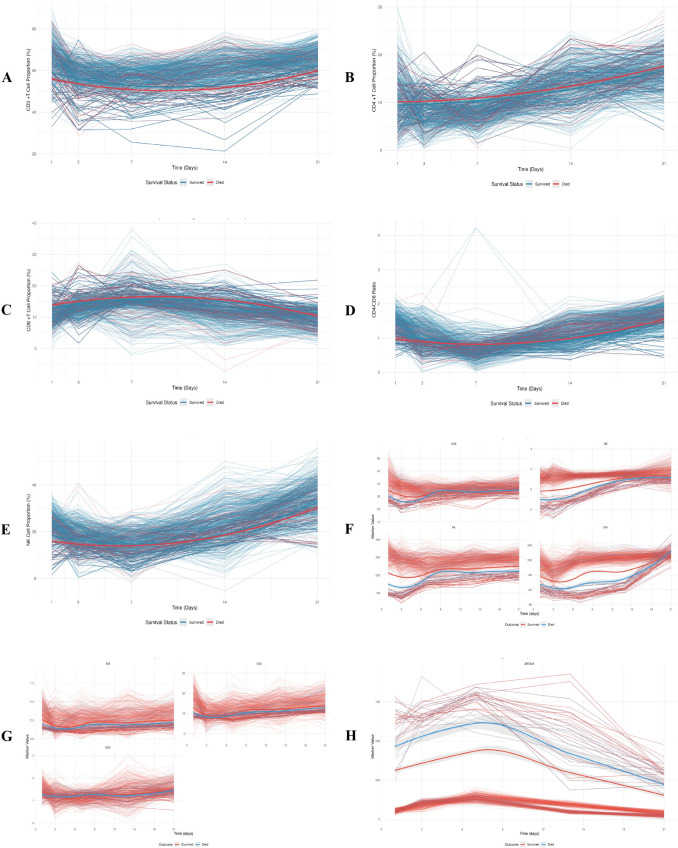
Methods: In this retrospective single-center cohort study, we analyzed 943 adult burn patients with sepsis, defined per Sepsis-3.0 criteria. Serial measurements of 15 biomarkers across nutritional, immunoglobulin, lymphocyte subset, inflammatory, and other categories were collected over 21 days. We employed linear mixed-effects models (LME) to compare trajectories between survivors and non-survivors, Cox regression to assess associations with mortality, time-dependent ROC to evaluate predictive performance, and k-means clustering to identify patient phenotypes based on integrated ALB, IL-6, and IgG trajectories.
Results: The 21-day mortality was 17.92%. LME revealed significantly different trajectories for 11 biomarkers between survivors and non-survivors (P < 0.05). Univariate Cox analysis identified multiple significant biomarkers, with transferrin (HR = 0.985, P = 6.84 × 10⁻11) and IgM (HR = 0.284, P = 1.24 × 10⁻5) as strong protective factors, and mitochondrial DNA (HR = 1.002, P = 1.89 × 10⁻⁹) as a risk factor. In multivariate analysis, only the Burn Index remained an independent risk factor (HR = 1.066, P < 0.001). Time-dependent ROC showed peak predictive accuracy at Day 7 (albumin AUC = 0.729). Clustering identified three distinct phenotypes-"Rapid Recovery" (mortality 5.2%), "Persistent Inflammatory & Catabolic" (mortality 38.0%), and "Intermediate" (mortality 18.7%; P < 0.001)-with starkly different biomarker trends and clinical profiles.
Conclusions: The dynamic patterns of multi-category biomarkers are strongly associated with short-term survival in burn sepsis. While burn severity is a dominant baseline risk factor, longitudinal trajectory analysis captures the essence of the host's recovery or failure, effectively stratifying patients into prognostically distinct subgroups. This trajectory-based phenotyping highlights the potential of monitoring the host response over time to improve risk assessment and guide personalized management.
期刊介绍:
Inflammation Research (IR) publishes peer-reviewed papers on all aspects of inflammation and related fields including histopathology, immunological mechanisms, gene expression, mediators, experimental models, clinical investigations and the effect of drugs. Related fields are broadly defined and include for instance, allergy and asthma, shock, pain, joint damage, skin disease as well as clinical trials of relevant drugs.



 求助内容:
求助内容: 应助结果提醒方式:

 京公网安备 11010802042870号


