Ameer Haider Cheema, Muhammad Hassan Waseem, Zain Ul Abideen, Muhammad Zubair Tahir, Fahad Saleem, Amna Nadeem, Urvah Tauseef, Tahreem Qasim, Sania Aimen, Muhammad Bilal Zahid, Pawan Kumar Thada
{"title":"Efficacy and Safety of Clopidogrel Versus Aspirin Monotherapy After Percutaneous Coronary Intervention: A Systematic Review and Meta-analysis.","authors":"Ameer Haider Cheema, Muhammad Hassan Waseem, Zain Ul Abideen, Muhammad Zubair Tahir, Fahad Saleem, Amna Nadeem, Urvah Tauseef, Tahreem Qasim, Sania Aimen, Muhammad Bilal Zahid, Pawan Kumar Thada","doi":"10.1177/11795468251414841","DOIUrl":null,"url":null,"abstract":"<p><strong>Background: </strong>Coronary artery disease (CAD) is the leading cause of death worldwide. After percutaneous coronary intervention (PCI), dual antiplatelet therapy (DAPT) is recommended to reduce thrombotic events. This meta-analysis assesses the effectiveness of clopidogrel compared to aspirin monotherapy following DAPT post-PCI.</p><p><strong>Methods: </strong>From inception to April 2025, an exhaustive literature search was conducted across electronic databases, including PubMed, Cochrane Library, ScienceDirect, EMBASE, and Web of Science. Risk ratios (RRs) along with 95% confidence intervals (CIs) were pooled using the random-effects model in Review Manager. Leave-one-out sensitivity analysis and funnel plots were used to evaluate heterogeneity and publication bias, respectively.</p><p><strong>Results: </strong>Six studies, including 3 RCTs and 3 observational studies, spanning over 19 494 patients, were included in our analysis. Clopidogrel significantly reduced major adverse cardiovascular events (MACE) (RR = 0.78; 95% CI: [0.69, 0.89]; <i>P</i> = .0002; <i>I</i> <sup>2</sup> = 0%) and myocardial infarction (MI) (RR = 0.73; 95% CI: [0.56, 0.94]; <i>P</i> = .02; <i>I</i> <sup>2</sup> = 21%) compared to aspirin. Likewise, the clopidogrel group demonstrated a substantial advantage in reducing the incidence of any stroke (RR = 0.66; 95% CI: [0.49, 0.89]; <i>P</i> = .006; <i>I</i> <sup>2</sup> = 14%), including ischemic stroke (RR = 0.69; 95% CI: [0.49, 0.97]; <i>P</i> = .04; <i>I</i> <sup>2</sup> = 0%). All other endpoints, including hemorrhagic stroke, all-cause mortality, cardiac death, major bleeding, stent thrombosis, repeat, and target vessel revascularization, were comparable between the 2 arms.</p><p><strong>Conclusion: </strong>Clopidogrel significantly reduced the incidence of MACE, MI, and stroke after DAPT following PCI compared to aspirin, indicating greater effectiveness. However, the main conclusion of this meta-analysis depends primarily on the estimates from RCTs. Additional randomized studies are necessary to confirm these results and support clinical decision-making.</p>","PeriodicalId":10419,"journal":{"name":"Clinical Medicine Insights. Cardiology","volume":"20 ","pages":"11795468251414841"},"PeriodicalIF":3.3000,"publicationDate":"2026-01-18","publicationTypes":"Journal Article","fieldsOfStudy":null,"isOpenAccess":false,"openAccessPdf":"https://www.ncbi.nlm.nih.gov/pmc/articles/PMC12813258/pdf/","citationCount":"0","resultStr":null,"platform":"Semanticscholar","paperid":null,"PeriodicalName":"Clinical Medicine Insights. Cardiology","FirstCategoryId":"1085","ListUrlMain":"https://doi.org/10.1177/11795468251414841","RegionNum":0,"RegionCategory":null,"ArticlePicture":[],"TitleCN":null,"AbstractTextCN":null,"PMCID":null,"EPubDate":"2026/1/1 0:00:00","PubModel":"eCollection","JCR":"Q2","JCRName":"CARDIAC & CARDIOVASCULAR SYSTEMS","Score":null,"Total":0}
引用次数: 0
Abstract
Background: Coronary artery disease (CAD) is the leading cause of death worldwide. After percutaneous coronary intervention (PCI), dual antiplatelet therapy (DAPT) is recommended to reduce thrombotic events. This meta-analysis assesses the effectiveness of clopidogrel compared to aspirin monotherapy following DAPT post-PCI.
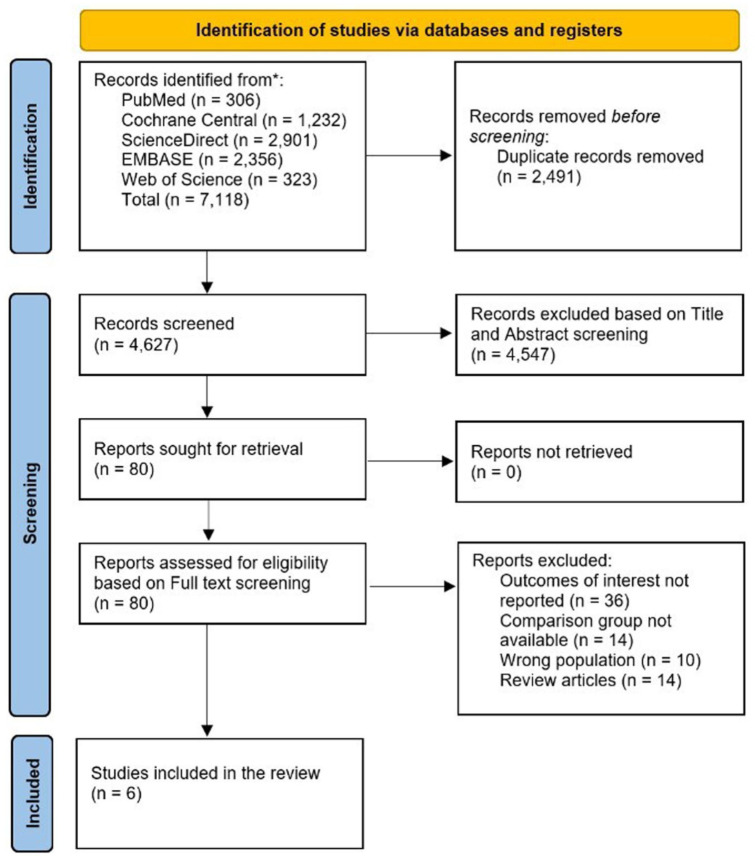
Methods: From inception to April 2025, an exhaustive literature search was conducted across electronic databases, including PubMed, Cochrane Library, ScienceDirect, EMBASE, and Web of Science. Risk ratios (RRs) along with 95% confidence intervals (CIs) were pooled using the random-effects model in Review Manager. Leave-one-out sensitivity analysis and funnel plots were used to evaluate heterogeneity and publication bias, respectively.
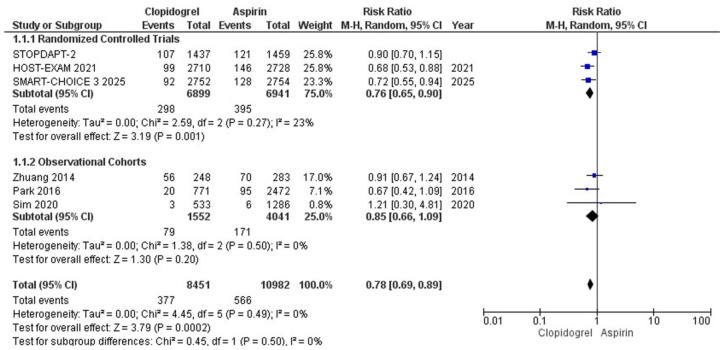
Results: Six studies, including 3 RCTs and 3 observational studies, spanning over 19 494 patients, were included in our analysis. Clopidogrel significantly reduced major adverse cardiovascular events (MACE) (RR = 0.78; 95% CI: [0.69, 0.89]; P = .0002; I2 = 0%) and myocardial infarction (MI) (RR = 0.73; 95% CI: [0.56, 0.94]; P = .02; I2 = 21%) compared to aspirin. Likewise, the clopidogrel group demonstrated a substantial advantage in reducing the incidence of any stroke (RR = 0.66; 95% CI: [0.49, 0.89]; P = .006; I2 = 14%), including ischemic stroke (RR = 0.69; 95% CI: [0.49, 0.97]; P = .04; I2 = 0%). All other endpoints, including hemorrhagic stroke, all-cause mortality, cardiac death, major bleeding, stent thrombosis, repeat, and target vessel revascularization, were comparable between the 2 arms.
Conclusion: Clopidogrel significantly reduced the incidence of MACE, MI, and stroke after DAPT following PCI compared to aspirin, indicating greater effectiveness. However, the main conclusion of this meta-analysis depends primarily on the estimates from RCTs. Additional randomized studies are necessary to confirm these results and support clinical decision-making.



 求助内容:
求助内容: 应助结果提醒方式:

 京公网安备 11010802042870号


