
Relationship between structure and function of the NADH oxidase from Lactobacillus brevis
IF 3
3区 生物学
Q2 BIOCHEMISTRY & MOLECULAR BIOLOGY
引用次数: 0
Abstract
Water-producing NADH oxidases catalyse the oxidation of NADH by molecular oxygen to generate NAD+ and water. These enzymes require FAD as cofactor to carry out their enzymatic activity and contribute to bacterial protection against oxidative stress. They have received considerable attention since their NAD+ recycling activity could make them candidates of choice for various industrial oxidoreductive processes. However, most of these enzymes are produced in recombinant hosts (e.g., E. coli) as apoenzymes and therefore require activation by incubation with FAD.
In this study, we describe the characterization of the NADH oxidase from Lactobacillus brevis (LbNOX), a homodimeric flavoenzyme containing one non-covalently bound FAD molecule per monomer. In this paper, we show that the production, purification and formulation of LbNOX result in a heterogeneous enzyme solution. The active dimeric form is pH dependent and correlates with the presence of FAD. We also performed a comprehensive bioinformatic analysis of the LbNOX structure, which highlights crucial residues for pH-dependent dimerisation and shows that FAD is tightly bound at the dimerisation interface.
This structural and functional characterization is crucial for a complete understanding of the enzyme's activation mechanism and will support the development of a robust and reproducible protocol for the production, purification and formulation of a fully active and homogeneous enzyme solution. More broadly, this work will contribute to the development of NADH oxidases based industrial applications and their FAD-dependent activation mechanism.
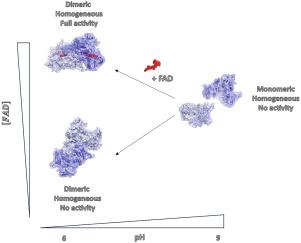
短乳杆菌NADH氧化酶结构与功能的关系。
产水NADH氧化酶通过分子氧催化NADH氧化生成NAD+和水。这些酶需要FAD作为辅助因子来发挥其酶活性,并有助于细菌抵抗氧化应激。它们受到了相当大的关注,因为它们的NAD+回收活性可以使它们成为各种工业氧化还原过程的候选物。然而,大多数这些酶是在重组宿主(如大肠杆菌)中作为载脂蛋白酶产生的,因此需要用FAD孵育激活。在这项研究中,我们描述了来自短乳杆菌(LbNOX)的NADH氧化酶的特性,这是一种同源二聚体黄酶,每个单体含有一个非共价结合的FAD分子。在本文中,我们证明了LbNOX的生产,纯化和配方导致异相酶溶液。活性二聚体形式依赖于pH值,并与FAD的存在相关。我们还对LbNOX结构进行了全面的生物信息学分析,突出了ph依赖性二聚化的关键残基,并表明FAD在二聚化界面紧密结合。这种结构和功能表征对于完全理解酶的激活机制至关重要,并将支持开发一种强大且可重复的方案,用于生产、纯化和配制完全活性和均质酶溶液。更广泛地说,这项工作将有助于基于NADH氧化酶的工业应用及其fad依赖的激活机制的发展。
本文章由计算机程序翻译,如有差异,请以英文原文为准。
求助全文
约1分钟内获得全文
求助全文
来源期刊
Biochimie
生物-生化与分子生物学
CiteScore
7.20
自引率
2.60%
发文量
219
审稿时长
40 days
期刊介绍:
Biochimie publishes original research articles, short communications, review articles, graphical reviews, mini-reviews, and hypotheses in the broad areas of biology, including biochemistry, enzymology, molecular and cell biology, metabolic regulation, genetics, immunology, microbiology, structural biology, genomics, proteomics, and molecular mechanisms of disease. Biochimie publishes exclusively in English.
Articles are subject to peer review, and must satisfy the requirements of originality, high scientific integrity and general interest to a broad range of readers. Submissions that are judged to be of sound scientific and technical quality but do not fully satisfy the requirements for publication in Biochimie may benefit from a transfer service to a more suitable journal within the same subject area.
 求助内容:
求助内容: 应助结果提醒方式:

 京公网安备 11010802042870号


