Zhu Hui Yeap, Rashed Sobhan, Sara L Bengtsson, Saber Sami, Allan B Clark, Ramesh Vishwakarma, James Boardman, Juliet High, Gabija Klyvyte, Mehmet Ergisi, Thomas Hummel, Carl M Philpott
{"title":"The APOLLO trial: a proof-of-concept study for vitamin A nasal drops in COVID-19-related postinfectious olfactory dysfunction.","authors":"Zhu Hui Yeap, Rashed Sobhan, Sara L Bengtsson, Saber Sami, Allan B Clark, Ramesh Vishwakarma, James Boardman, Juliet High, Gabija Klyvyte, Mehmet Ergisi, Thomas Hummel, Carl M Philpott","doi":"10.1093/chemse/bjag001","DOIUrl":null,"url":null,"abstract":"<p><p>Postinfectious olfactory dysfunction (PIOD) is common in COVID-19 patients. This 2-arm double-blinded randomized controlled trial (RCT) aimed to establish proof-of-concept for vitamin A versus placebo as a treatment modality for patients with PIOD. This study compared 9,000 IU daily self-administered vitamin A intranasal drops versus peanut oil drops over 12 wk in COVID-19 patients with PIOD. Outcome measures included: olfactory bulb volume (OBV), olfactory sulcus depth, cerebral functional MRI blood oxygen level dependent (BOLD) signal, Sniffin' Sticks TDI score, SSParoT, olfactory disorder questionnaire (ODQ) score, and brain-derived neurotropic factor (BDNF) levels were collected from participants at baseline and after trial intervention at 12 wk. Fifty-seven PIOD were recruited in the trial and allocated to vitamin A or placebo arm at a 2:1 ratio. After withdrawals and exclusions, 30 participants in the vitamin A arm and 15 in the placebo arm were analyzed. There was no significant difference in the change in OBV between both groups. Aside from an improvement in the quality-of-life component of ODQ questionnaire scores (P = 0.01), there were no significant differences in any of the other secondary outcome measures. This proof-of-concept trial has demonstrated no significant effect of intranasal vitamin A on olfactory function in COVID-19 PIOD patients. Further work is required to identify other therapeutic agents in the management of PIOD or evaluate a different PIOD cohort with non-COVID etiology.</p>","PeriodicalId":9771,"journal":{"name":"Chemical Senses","volume":" ","pages":""},"PeriodicalIF":1.9000,"publicationDate":"2026-03-02","publicationTypes":"Journal Article","fieldsOfStudy":null,"isOpenAccess":false,"openAccessPdf":"https://www.ncbi.nlm.nih.gov/pmc/articles/PMC13016870/pdf/","citationCount":"0","resultStr":null,"platform":"Semanticscholar","paperid":null,"PeriodicalName":"Chemical Senses","FirstCategoryId":"102","ListUrlMain":"https://doi.org/10.1093/chemse/bjag001","RegionNum":4,"RegionCategory":"心理学","ArticlePicture":[],"TitleCN":null,"AbstractTextCN":null,"PMCID":null,"EPubDate":"","PubModel":"","JCR":"Q1","JCRName":"BEHAVIORAL SCIENCES","Score":null,"Total":0}
引用次数: 0
Abstract
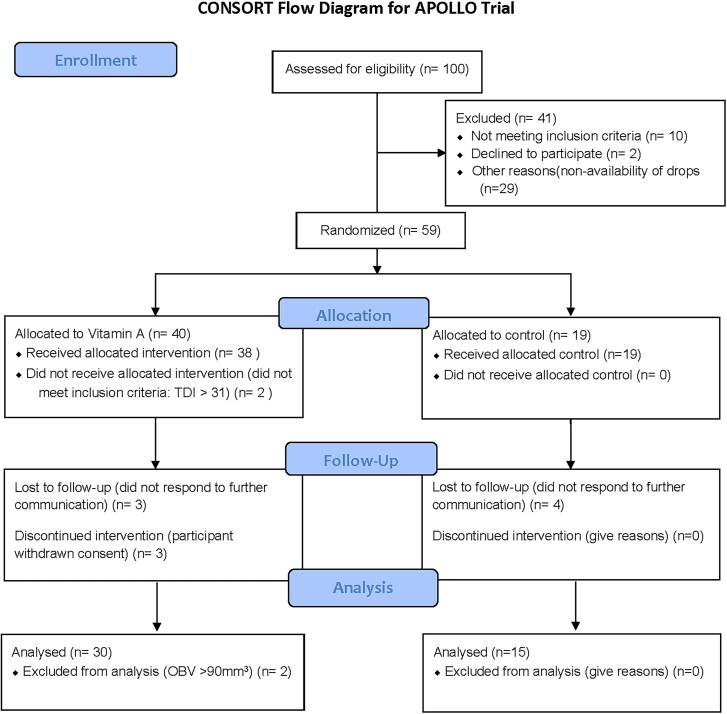
Postinfectious olfactory dysfunction (PIOD) is common in COVID-19 patients. This 2-arm double-blinded randomized controlled trial (RCT) aimed to establish proof-of-concept for vitamin A versus placebo as a treatment modality for patients with PIOD. This study compared 9,000 IU daily self-administered vitamin A intranasal drops versus peanut oil drops over 12 wk in COVID-19 patients with PIOD. Outcome measures included: olfactory bulb volume (OBV), olfactory sulcus depth, cerebral functional MRI blood oxygen level dependent (BOLD) signal, Sniffin' Sticks TDI score, SSParoT, olfactory disorder questionnaire (ODQ) score, and brain-derived neurotropic factor (BDNF) levels were collected from participants at baseline and after trial intervention at 12 wk. Fifty-seven PIOD were recruited in the trial and allocated to vitamin A or placebo arm at a 2:1 ratio. After withdrawals and exclusions, 30 participants in the vitamin A arm and 15 in the placebo arm were analyzed. There was no significant difference in the change in OBV between both groups. Aside from an improvement in the quality-of-life component of ODQ questionnaire scores (P = 0.01), there were no significant differences in any of the other secondary outcome measures. This proof-of-concept trial has demonstrated no significant effect of intranasal vitamin A on olfactory function in COVID-19 PIOD patients. Further work is required to identify other therapeutic agents in the management of PIOD or evaluate a different PIOD cohort with non-COVID etiology.
期刊介绍:
Chemical Senses publishes original research and review papers on all aspects of chemoreception in both humans and animals. An important part of the journal''s coverage is devoted to techniques and the development and application of new methods for investigating chemoreception and chemosensory structures.


 求助内容:
求助内容: 应助结果提醒方式:

 京公网安备 11010802042870号


