
Permeability of bone and cartilage, and stiffness of collagen within cartilage, influence osteochondral fluid transport during cyclic compression: A study in finite elements
IF 3.5
2区 医学
Q2 ENGINEERING, BIOMEDICAL
Journal of the Mechanical Behavior of Biomedical Materials
Pub Date : 2026-04-01
Epub Date: 2026-01-15
DOI:10.1016/j.jmbbm.2026.107350
引用次数: 0
Abstract
Osteochondral fluid transport likely plays a critical role in joint health and disease, yet the mechanical factors influencing this transport remain incompletely understood. This study established a finite element model of osteochondral fluid transport under cyclic compression, incorporating depth-dependent material properties and osmotic swelling. Using biphasic constitutive models for bone and cartilage, we simulated fluid flux across the osteochondral interface and performed a parametric sensitivity analysis of seven different mechanical properties. Results demonstrate that bone and cartilage permeability, as well as the stiffness of the collagen fiber network within cartilage, significantly affect net osteochondral fluid transport. Specifically, decreased cartilage permeability resulted in increased bone-to-cartilage ostechondral flow, and decreased collagen stiffness resulted in decreased net cartilage-to-bone fluid flow. Conversely, relatively high bone permeability reversed the direction of osteochondral flow. Other parameters, including bone modulus, bone solid volume fraction, cartilage shear modulus, and fixed charge density, had negligible effects. These findings highlight the importance of specific mechanical properties of both bone and cartilage in regulating osteochondral fluid transport and suggest that future studies should consider the complete osteochondral unit to better understand joint mechanobiology and osteoarthritis progression.
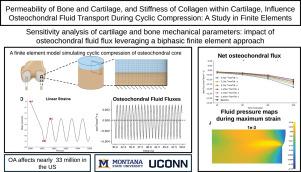
骨和软骨的渗透性以及软骨内胶原蛋白的刚度影响循环压缩期间骨软骨流体的输送:一项有限元研究。
骨软骨液体运输可能在关节健康和疾病中起关键作用,但影响这种运输的机械因素仍不完全清楚。本研究建立了循环压缩下骨软骨流体输运的有限元模型,考虑了材料的深度依赖特性和渗透膨胀。利用骨和软骨的双相本构模型,我们模拟了穿过骨软骨界面的流体通量,并对7种不同力学性能进行了参数敏感性分析。结果表明,骨和软骨的通透性以及软骨内胶原纤维网络的刚度显著影响净骨软骨液体的输送。具体来说,软骨通透性的降低导致骨与软骨之间的骨软骨流动增加,胶原硬度的降低导致软骨与骨之间的净液体流动减少。相反,相对较高的骨通透性逆转了骨软骨流动的方向。其他参数包括骨模量、骨实体体积分数、软骨剪切模量和固定电荷密度的影响可以忽略不计。这些发现强调了骨和软骨的特定力学特性在调节骨软骨液体运输中的重要性,并建议未来的研究应考虑完整的骨软骨单位,以更好地了解关节力学生物学和骨关节炎的进展。
本文章由计算机程序翻译,如有差异,请以英文原文为准。
求助全文
约1分钟内获得全文
求助全文
来源期刊
Journal of the Mechanical Behavior of Biomedical Materials
工程技术-材料科学:生物材料
CiteScore
7.20
自引率
7.70%
发文量
505
审稿时长
46 days
期刊介绍:
The Journal of the Mechanical Behavior of Biomedical Materials is concerned with the mechanical deformation, damage and failure under applied forces, of biological material (at the tissue, cellular and molecular levels) and of biomaterials, i.e. those materials which are designed to mimic or replace biological materials.
The primary focus of the journal is the synthesis of materials science, biology, and medical and dental science. Reports of fundamental scientific investigations are welcome, as are articles concerned with the practical application of materials in medical devices. Both experimental and theoretical work is of interest; theoretical papers will normally include comparison of predictions with experimental data, though we recognize that this may not always be appropriate. The journal also publishes technical notes concerned with emerging experimental or theoretical techniques, letters to the editor and, by invitation, review articles and papers describing existing techniques for the benefit of an interdisciplinary readership.
 求助内容:
求助内容: 应助结果提醒方式:

 京公网安备 11010802042870号


