Jeong Hun Shim, Seongjun Choe, Sukyung Kim, Dongsoo Ha, Soo Hyung Eo
{"title":"First record of 3 chewing louse species from the Oriental stork (Ciconia boyciana) in Korea: Insights into conservation of co-associated species.","authors":"Jeong Hun Shim, Seongjun Choe, Sukyung Kim, Dongsoo Ha, Soo Hyung Eo","doi":"10.3347/PHD.25070","DOIUrl":null,"url":null,"abstract":"<p><p>The Oriental stork (Ciconia boyciana Swinhoe, 1873) is an endangered species, with active restoration efforts ongoing in Korea. Despite the ecological importance of host-specific parasites, such as chewing lice (Phthiraptera), information on the chewing lice fauna associated with C. boyciana in Korea remains unclear. Previous records of 2 chewing louse species from the host have been questioned due to potential misidentification. To clarify the chewing lice fauna of the host, we conducted a survey of captive C. boyciana at Yesan Oriental Stork Park, Korea, in October 2022. Morphological identification of collected louse specimens revealed 3 species: Neophilopterus incompletes (Denny, 1842), Ardeicola ciconiae (Linnaeus, 1758) and Colpocephalum zebra Burmeister, 1838. These species are typical ectoparasites of Ciconiiform birds and represent the first verified louse records of chewing lice from C. boyciana in Korea. Unlike with a previous report, Cuclotogaster heterographus (Nitzsch, 1866) and Anaticola anseris (Linnaeus, 1758) were not detected. Our findings provide an updated checklist of chewing louse species for C. boyciana in Korea, contributing to a more accurate understanding of host-parasite associations and supporting future conservation efforts for both the host and its associated parasite fauna.</p>","PeriodicalId":74397,"journal":{"name":"Parasites, hosts and diseases","volume":" ","pages":"87-91"},"PeriodicalIF":1.3000,"publicationDate":"2026-01-01","publicationTypes":"Journal Article","fieldsOfStudy":null,"isOpenAccess":false,"openAccessPdf":"https://www.ncbi.nlm.nih.gov/pmc/articles/PMC12890558/pdf/","citationCount":"0","resultStr":null,"platform":"Semanticscholar","paperid":null,"PeriodicalName":"Parasites, hosts and diseases","FirstCategoryId":"1085","ListUrlMain":"https://doi.org/10.3347/PHD.25070","RegionNum":0,"RegionCategory":null,"ArticlePicture":[],"TitleCN":null,"AbstractTextCN":null,"PMCID":null,"EPubDate":"2026/1/14 0:00:00","PubModel":"Epub","JCR":"0","JCRName":"PARASITOLOGY","Score":null,"Total":0}
引用次数: 0
Abstract
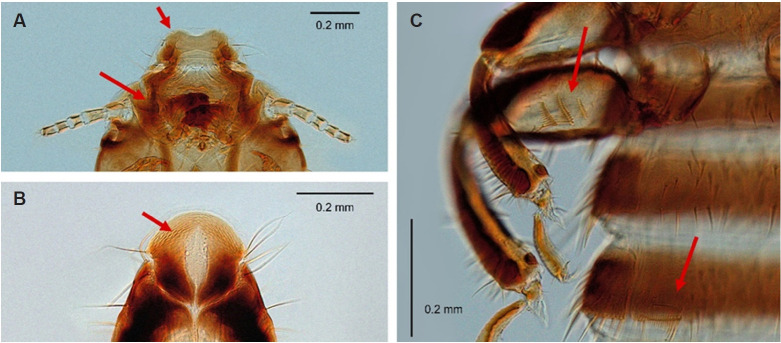
The Oriental stork (Ciconia boyciana Swinhoe, 1873) is an endangered species, with active restoration efforts ongoing in Korea. Despite the ecological importance of host-specific parasites, such as chewing lice (Phthiraptera), information on the chewing lice fauna associated with C. boyciana in Korea remains unclear. Previous records of 2 chewing louse species from the host have been questioned due to potential misidentification. To clarify the chewing lice fauna of the host, we conducted a survey of captive C. boyciana at Yesan Oriental Stork Park, Korea, in October 2022. Morphological identification of collected louse specimens revealed 3 species: Neophilopterus incompletes (Denny, 1842), Ardeicola ciconiae (Linnaeus, 1758) and Colpocephalum zebra Burmeister, 1838. These species are typical ectoparasites of Ciconiiform birds and represent the first verified louse records of chewing lice from C. boyciana in Korea. Unlike with a previous report, Cuclotogaster heterographus (Nitzsch, 1866) and Anaticola anseris (Linnaeus, 1758) were not detected. Our findings provide an updated checklist of chewing louse species for C. boyciana in Korea, contributing to a more accurate understanding of host-parasite associations and supporting future conservation efforts for both the host and its associated parasite fauna.



 求助内容:
求助内容: 应助结果提醒方式:

 京公网安备 11010802042870号


