{"title":"Comparison of neuro-metabolites in borderline and antisocial personality disorders: A study based on proton magnetic resonance spectroscopy.","authors":"Seyyede Sahar Asgari Ghalebin, Sajjad Bashrpour, Niloufar Mikaeili, Nader Hajloo, Fatemeh Gholipour","doi":"10.1017/pen.2025.10005","DOIUrl":null,"url":null,"abstract":"<p><p>The aim of this study was to investigate the neurochemical differences between borderline personality disorder (BPD) and antisocial personality disorder (ASPD) using proton magnetic resonance spectroscopy (¹H-MRS) in order to explore these disorders at a neurobiological level. In this cross-sectional study, 60 individuals with BPD and 60 individuals with ASPD participated. ¹H-MRS was performed using a Discovery MR 750 Magnetic Resonance Imaging (MRI) scanner with a 3.0 Tesla field strength to measure the levels of the metabolites GABA/Cr, N-acetylaspartate (NAA)/Cr, and glutamate (Glu)/Cr in the left anterior cingulate cortex (ACC) and the left orbitofrontal cortex (OFC) of the brain. The findings indicated that concentrations of GABA/Cr and Glu/Cr in the OFC were significantly higher in BPD patients compared to those with ASPD. In the ACC, GABA/Cr levels were elevated and NAA/Cr levels were reduced in the BPD group relative to the ASPD group. No significant differences were observed in Glu/Cr concentrations in the ACC or in NAA/Cr concentrations in the OFC. This study demonstrated significant neurochemical differences between BPD and ASPD in the ACC and OFC regions. These findings may enhance our understanding of the underlying neural mechanisms of these disorders and support the development of more targeted and effective therapeutic approaches.</p>","PeriodicalId":36424,"journal":{"name":"Personality Neuroscience","volume":"9 ","pages":"e1"},"PeriodicalIF":0.0000,"publicationDate":"2026-01-09","publicationTypes":"Journal Article","fieldsOfStudy":null,"isOpenAccess":false,"openAccessPdf":"https://www.ncbi.nlm.nih.gov/pmc/articles/PMC12805192/pdf/","citationCount":"0","resultStr":null,"platform":"Semanticscholar","paperid":null,"PeriodicalName":"Personality Neuroscience","FirstCategoryId":"1085","ListUrlMain":"https://doi.org/10.1017/pen.2025.10005","RegionNum":0,"RegionCategory":null,"ArticlePicture":[],"TitleCN":null,"AbstractTextCN":null,"PMCID":null,"EPubDate":"2026/1/1 0:00:00","PubModel":"eCollection","JCR":"Q3","JCRName":"Medicine","Score":null,"Total":0}
引用次数: 0
Abstract
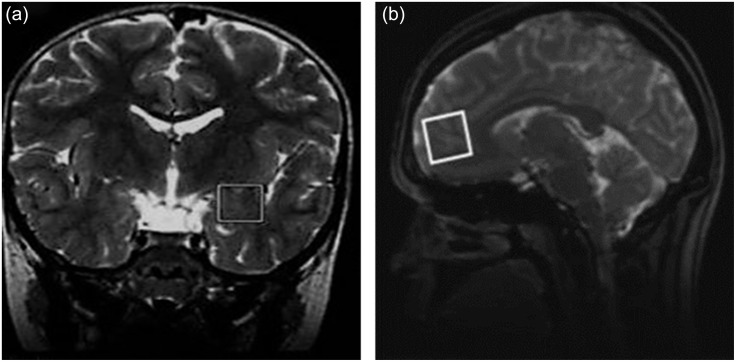
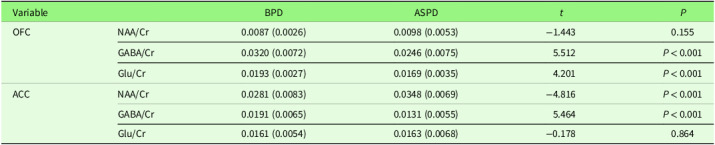
The aim of this study was to investigate the neurochemical differences between borderline personality disorder (BPD) and antisocial personality disorder (ASPD) using proton magnetic resonance spectroscopy (¹H-MRS) in order to explore these disorders at a neurobiological level. In this cross-sectional study, 60 individuals with BPD and 60 individuals with ASPD participated. ¹H-MRS was performed using a Discovery MR 750 Magnetic Resonance Imaging (MRI) scanner with a 3.0 Tesla field strength to measure the levels of the metabolites GABA/Cr, N-acetylaspartate (NAA)/Cr, and glutamate (Glu)/Cr in the left anterior cingulate cortex (ACC) and the left orbitofrontal cortex (OFC) of the brain. The findings indicated that concentrations of GABA/Cr and Glu/Cr in the OFC were significantly higher in BPD patients compared to those with ASPD. In the ACC, GABA/Cr levels were elevated and NAA/Cr levels were reduced in the BPD group relative to the ASPD group. No significant differences were observed in Glu/Cr concentrations in the ACC or in NAA/Cr concentrations in the OFC. This study demonstrated significant neurochemical differences between BPD and ASPD in the ACC and OFC regions. These findings may enhance our understanding of the underlying neural mechanisms of these disorders and support the development of more targeted and effective therapeutic approaches.



 求助内容:
求助内容: 应助结果提醒方式:

 京公网安备 11010802042870号


