{"title":"The frozen elephant trunk technique.","authors":"Masato Mutsuga","doi":"10.18999/nagjms.87.4.597","DOIUrl":null,"url":null,"abstract":"<p><p>The frozen elephant trunk (FET) technique, which was an advanced version of the elephant trunk technique, is now the gold standard for distal aortic arch repair. The major advantage is that the distal anastomosis is fixed by the stent; therefore, anastomosis that has been used to be performed in the descending aorta can be performed on the more proximal side of the aortic arch. The FET technique has become widely used, causing the increased risk of spinal cord injury (SCI) to become a major concern. As the FET fixes the distal side, the risk of SCI increases depending on its landing zone and depth. To avoid SCI, stent length should be limited to about 10 cm, and the use stents of 15 cm in length or landing beyond Th8 should be avoided. Another problem after the FET technique is the distal site new entry (d-SINE) in the mid- and long-term stages. d-SINE can also occur after thoracic endovascular aortic repair (TEVAR), mainly due to its oversizing. The spring-back-force, which is also related to the stent strength, is also said to be a cause of d-SINE after the FET technique. I herein review the FET technique, its surgical outcomes, and complications.</p>","PeriodicalId":49014,"journal":{"name":"Nagoya Journal of Medical Science","volume":"87 4","pages":"597-606"},"PeriodicalIF":0.9000,"publicationDate":"2025-11-01","publicationTypes":"Journal Article","fieldsOfStudy":null,"isOpenAccess":false,"openAccessPdf":"https://www.ncbi.nlm.nih.gov/pmc/articles/PMC12805123/pdf/","citationCount":"0","resultStr":null,"platform":"Semanticscholar","paperid":null,"PeriodicalName":"Nagoya Journal of Medical Science","FirstCategoryId":"3","ListUrlMain":"https://doi.org/10.18999/nagjms.87.4.597","RegionNum":4,"RegionCategory":"医学","ArticlePicture":[],"TitleCN":null,"AbstractTextCN":null,"PMCID":null,"EPubDate":"","PubModel":"","JCR":"Q4","JCRName":"MEDICINE, RESEARCH & EXPERIMENTAL","Score":null,"Total":0}
引用次数: 0
Abstract
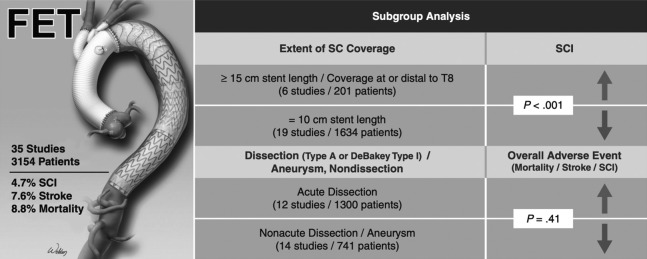
The frozen elephant trunk (FET) technique, which was an advanced version of the elephant trunk technique, is now the gold standard for distal aortic arch repair. The major advantage is that the distal anastomosis is fixed by the stent; therefore, anastomosis that has been used to be performed in the descending aorta can be performed on the more proximal side of the aortic arch. The FET technique has become widely used, causing the increased risk of spinal cord injury (SCI) to become a major concern. As the FET fixes the distal side, the risk of SCI increases depending on its landing zone and depth. To avoid SCI, stent length should be limited to about 10 cm, and the use stents of 15 cm in length or landing beyond Th8 should be avoided. Another problem after the FET technique is the distal site new entry (d-SINE) in the mid- and long-term stages. d-SINE can also occur after thoracic endovascular aortic repair (TEVAR), mainly due to its oversizing. The spring-back-force, which is also related to the stent strength, is also said to be a cause of d-SINE after the FET technique. I herein review the FET technique, its surgical outcomes, and complications.
期刊介绍:
The Journal publishes original papers in the areas of medical science and its related fields. Reviews, symposium reports, short communications, notes, case reports, hypothesis papers, medical image at a glance, video and announcements are also accepted.
Manuscripts should be in English. It is recommended that an English check of the manuscript by a competent and knowledgeable native speaker be completed before submission.


 求助内容:
求助内容: 应助结果提醒方式:

 京公网安备 11010802042870号


