
Intense green upconversion and temperature sensing properties of GdAl3(BO3)4: Er3+ and Er3+/Yb3+ phosphors
IF 3.6
3区 物理与天体物理
Q2 OPTICS
Journal of Luminescence
Pub Date : 2026-05-01
Epub Date: 2026-01-19
DOI:10.1016/j.jlumin.2026.121763
引用次数: 0
Abstract
GdAl3(BO3)4: Er3+ and Er3+/Yb3+ phosphors were prepared through solid state reaction method and characterized. The crystalline phase was studied by powder X-ray diffraction technique, the occurrence of several vibrational bonds was recognized by Fourier transform infrared spectroscopy and the surface morphology was verified by scanning electron microscopy. The down and up conversion emission spectra reveal three emission bands related to 2H11/2 → 4I15/2 (∼521 nm), 4S3/2 → 4I15/2 (∼547 nm) and 4F9/2 → 4I15/2 (∼658 nm) transitions up on 377 nm and 980 nm excitation, respectively. An effective sensitization of Yb3+ ions improves the intensity of green emission upon 980 nm upconversion. The GdAl3(BO3)4: 1 %Er3+/3 %Yb3+ phosphor exhibited a noteworthy thermal stability with an activation energy of 0.314 eV. The same was more potential for not only the design of green LEDs, but also for non-contact temperature sensing devices. It possesses an absolute sensitivity of 0.00415 K−1 at 473 K and relative sensitivity of 0.576 % K−1 at 373 K with an excellent thermal cycling repeatability.
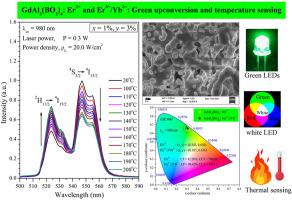
GdAl3(BO3)4: Er3+和Er3+/Yb3+荧光粉的强绿色上转换和温度传感性能
采用固相反应法制备了GdAl3(BO3)4: Er3+和Er3+/Yb3+荧光粉,并对其进行了表征。采用粉末x射线衍射技术研究了晶相,傅里叶变换红外光谱识别了几个振动键的存在,扫描电镜对表面形貌进行了验证。上下转换发射光谱分别显示了377 nm和980 nm激发下2H11/2→4I15/2 (~ 521 nm)、4S3/2→4I15/2 (~ 547 nm)和4F9/2→4I15/2 (~ 658 nm)三个发射带。Yb3+离子的有效敏化提高了980 nm上转换时的绿色发射强度。GdAl3(BO3) 4:1 %Er3+/ 3% Yb3+荧光粉表现出良好的热稳定性,活化能为0.314 eV。不仅绿色led的设计潜力巨大,而且非接触式温度传感设备的设计潜力也很大。在473 K时的绝对灵敏度为0.00415 K−1,在373 K时的相对灵敏度为0.576 K−1,具有良好的热循环重复性。
本文章由计算机程序翻译,如有差异,请以英文原文为准。
求助全文
约1分钟内获得全文
求助全文
来源期刊
Journal of Luminescence
物理-光学
CiteScore
6.70
自引率
13.90%
发文量
850
审稿时长
3.8 months
期刊介绍:
The purpose of the Journal of Luminescence is to provide a means of communication between scientists in different disciplines who share a common interest in the electronic excited states of molecular, ionic and covalent systems, whether crystalline, amorphous, or liquid.
We invite original papers and reviews on such subjects as: exciton and polariton dynamics, dynamics of localized excited states, energy and charge transport in ordered and disordered systems, radiative and non-radiative recombination, relaxation processes, vibronic interactions in electronic excited states, photochemistry in condensed systems, excited state resonance, double resonance, spin dynamics, selective excitation spectroscopy, hole burning, coherent processes in excited states, (e.g. coherent optical transients, photon echoes, transient gratings), multiphoton processes, optical bistability, photochromism, and new techniques for the study of excited states. This list is not intended to be exhaustive. Papers in the traditional areas of optical spectroscopy (absorption, MCD, luminescence, Raman scattering) are welcome. Papers on applications (phosphors, scintillators, electro- and cathodo-luminescence, radiography, bioimaging, solar energy, energy conversion, etc.) are also welcome if they present results of scientific, rather than only technological interest. However, papers containing purely theoretical results, not related to phenomena in the excited states, as well as papers using luminescence spectroscopy to perform routine analytical chemistry or biochemistry procedures, are outside the scope of the journal. Some exceptions will be possible at the discretion of the editors.
 求助内容:
求助内容: 应助结果提醒方式:

 京公网安备 11010802042870号


