
Small-molecule fluorescent probes for the aminergic GPCRs – What new tool compounds do we have post-2014 and what can they do?
IF 5.9
2区 医学
Q1 CHEMISTRY, MEDICINAL
European Journal of Medicinal Chemistry
Pub Date : 2026-03-05
Epub Date: 2026-01-16
DOI:10.1016/j.ejmech.2026.118579
引用次数: 0
Abstract
Aminergic G protein-coupled receptors (GPCRs) are heavily involved in the physiological functions of the human body and represent prominent drug targets for numerous diseases. Despite extensive work over the years, knowledge gaps persist as not all aminergic GPCRs are currently drugged. This gap could be addressed by using small-molecule fluorescent probes across a range of assay formats and experiments to obtain deeper insights into the molecular pharmacology of these receptors. This review highlights key developments from 2014 to 2024 in the design and application of fluorescent probes targeting aminergic GPCRs, featuring a total of 36 fluorescent probes spanning all prominent aminergic GPCR subfamilies: adrenergic, dopaminergic, histaminergic, muscarinic, and serotonergic receptors. This review provides a detailed overview of the approaches to probe design, their pharmacological profiles and their reported utilities in ligand binding assays and imaging studies. In recent years, these applications have expanded to include ex vivo and in vivo studies in both mice and human tissue models. With the integration of cutting-edge image processing and artificial intelligence-driven image recognition technologies, fluorescent probes will remain indispensable tools for investigating the molecular pharmacology of aminergic GPCRs, playing a crucial role in driving forward drug discovery in this field.
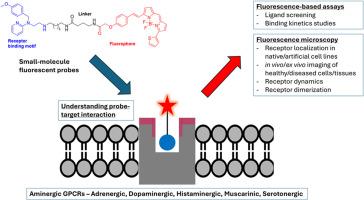
用于胺类gpcr的小分子荧光探针——2014年后我们有哪些新的工具化合物?它们能做什么?
氨基G蛋白偶联受体(gpcr)广泛参与人体的生理功能,是许多疾病的重要药物靶点。尽管多年来进行了广泛的工作,但知识差距仍然存在,因为目前并非所有胺能gpcr都被药物治疗。这一差距可以通过在一系列分析格式和实验中使用小分子荧光探针来解决,以更深入地了解这些受体的分子药理学。本文综述了2014年至2024年针对胺能GPCR的荧光探针的设计和应用的主要进展,包括36个荧光探针,涵盖了所有主要的胺能GPCR亚家族:肾上腺素能、多巴胺能、组胺能、毒菌碱和血清素能受体。这篇综述提供了探针设计方法的详细概述,它们的药理学特征和它们在配体结合分析和成像研究中的应用。近年来,这些应用已经扩展到包括小鼠和人体组织模型的离体和体内研究。随着先进的图像处理和人工智能驱动的图像识别技术的融合,荧光探针将继续成为研究氨基gpcr分子药理学不可或缺的工具,在推动该领域的药物发现方面发挥着至关重要的作用。
本文章由计算机程序翻译,如有差异,请以英文原文为准。
求助全文
约1分钟内获得全文
求助全文
来源期刊
CiteScore
11.70
自引率
9.00%
发文量
863
审稿时长
29 days
期刊介绍:
The European Journal of Medicinal Chemistry is a global journal that publishes studies on all aspects of medicinal chemistry. It provides a medium for publication of original papers and also welcomes critical review papers.
A typical paper would report on the organic synthesis, characterization and pharmacological evaluation of compounds. Other topics of interest are drug design, QSAR, molecular modeling, drug-receptor interactions, molecular aspects of drug metabolism, prodrug synthesis and drug targeting. The journal expects manuscripts to present the rational for a study, provide insight into the design of compounds or understanding of mechanism, or clarify the targets.
 求助内容:
求助内容: 应助结果提醒方式:

 京公网安备 11010802042870号


