
The role of ultrasound in the nucleation kinetics and Modification of product properties of 3-Nitro-1,2,4-triazol-5-one
IF 9.7
1区 化学
Q1 ACOUSTICS
Ultrasonics Sonochemistry
Pub Date : 2026-02-01
Epub Date: 2026-01-18
DOI:10.1016/j.ultsonch.2026.107744
引用次数: 0
Abstract
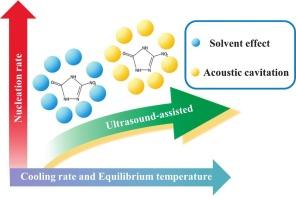
3-Nitro-1,2,4-triazol-5-one (NTO), a well-known energetic material, is extensively employed in the field of insensitive munitions. However, its irregular crystal morphology and broad particle-size distribution hinder its wider application. Ultrasonic-assisted crystallization offers an innovative approach to enhance the overall particle performance of NTO. In this study, NTO was subjected to ultrasound-assisted cooling crystallization using water as the solvent to control the crystal size and morphology, as well as remove adhered nitric acid and ensure environmentally production. The metastable zone width (MSZW) of NTO in aqueous solution was subsequently measured to understand the nucleation kinetics, revealing a significant reduction under ultrasonic irradiation. Employing Sangwal’s three-dimensional nucleation theory, the nucleation kinetic parameters were calculated. The results indicate that ultrasound affects the MSZW through reduction of the solid–liquid interfacial tension, promotion of burst nucleation, and suppression of particle agglomeration. Characterization of the ultrasound-processed NTO demonstrated a more regular morphology, disrupted agglomerates, reduced particle size, and a narrower particle-size distribution without altering the crystal polymorph. Compared with NTO raw material, the material demonstrates enhanced flowability and a 60% reduction in impact sensitivity.
超声对3-硝基-1,2,4-三唑-5-酮的成核动力学及产物性质的影响
3-硝基-1,2,4-三唑-5-酮(NTO)是一种众所周知的高能材料,广泛应用于不敏感弹药领域。但其晶体形态不规则、粒径分布较宽,阻碍了其广泛应用。超声辅助结晶为提高NTO的整体颗粒性能提供了一种创新的方法。本研究以水为溶剂,对NTO进行超声辅助冷却结晶,控制结晶尺寸和形貌,去除黏附的硝酸,保证环保生产。随后测量了水溶液中NTO的亚稳区宽度(MSZW),以了解成核动力学,结果表明超声辐照显著降低了NTO的成核动力学。采用Sangwal的三维成核理论,计算了成核动力学参数。结果表明,超声波通过降低固液界面张力、促进破裂形核和抑制颗粒团聚等方式影响了MSZW。超声处理后的NTO具有更规则的形貌、破碎的团聚体、更小的粒径和更窄的粒径分布,而不改变晶体的多晶型。与NTO原料相比,该材料的流动性增强,冲击敏感性降低60%。
本文章由计算机程序翻译,如有差异,请以英文原文为准。
求助全文
约1分钟内获得全文
求助全文
来源期刊
Ultrasonics Sonochemistry
化学-化学综合
CiteScore
15.80
自引率
11.90%
发文量
361
审稿时长
59 days
期刊介绍:
Ultrasonics Sonochemistry stands as a premier international journal dedicated to the publication of high-quality research articles primarily focusing on chemical reactions and reactors induced by ultrasonic waves, known as sonochemistry. Beyond chemical reactions, the journal also welcomes contributions related to cavitation-induced events and processing, including sonoluminescence, and the transformation of materials on chemical, physical, and biological levels.
Since its inception in 1994, Ultrasonics Sonochemistry has consistently maintained a top ranking in the "Acoustics" category, reflecting its esteemed reputation in the field. The journal publishes exceptional papers covering various areas of ultrasonics and sonochemistry. Its contributions are highly regarded by both academia and industry stakeholders, demonstrating its relevance and impact in advancing research and innovation.
 求助内容:
求助内容: 应助结果提醒方式:

 京公网安备 11010802042870号


