
Unraveling gender disparities in teachers’ technological pedagogical and content knowledge: A large-scale meta-analytic review
IF 10.6
1区 教育学
Q1 EDUCATION & EDUCATIONAL RESEARCH
Educational Research Review
Pub Date : 2026-02-01
Epub Date: 2026-01-14
DOI:10.1016/j.edurev.2026.100765
引用次数: 0
Abstract
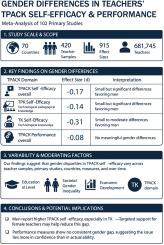
This large-scale meta-analytic review investigates gender disparities in pre- and in-service K-12 teachers' Technological Pedagogical and Content Knowledge (TPACK) self-efficacy and performance. Synthesizing 915 effect sizes from 102 primary studies and 420 teacher samples (N = 681,745 teachers) in 70 countries via multilevel meta-analyses, we found small but significant gender differences favoring male teachers in TPACK self-efficacy ( = −0.17), particularly in technological knowledge ( = −0.31) and technological pedagogical knowledge ( = −0.14). However, no significant gender disparities were observed in TPACK performance ( = −0.08). Our findings revealed considerable heterogeneity in these effects across samples, studies, countries, measures, and over time, which could be partly explained by factors such as educational level, country-level gender inequality, and economic development. These results do not support male teachers’ advantage in all aspects of technology-related teaching competencies. Our meta-analytic review further implies that gender disparities in TPACK vary across contexts or over time.
揭示教师技术教学知识和内容知识中的性别差异:一项大规模元分析综述
本研究调查了职前和在职K-12教师技术教学和内容知识(TPACK)自我效能和绩效的性别差异。通过多水平meta分析,综合了来自70个国家102项主要研究和420名教师样本(N = 681,745名教师)的915个效应大小,我们发现在TPACK自我效率(d形式= - 0.17),特别是在技术知识(d形式= - 0.31)和技术教学知识(d形式= - 0.14)方面,有利于男性教师的性别差异很小但很重要。然而,在TPACK表现中没有观察到明显的性别差异(d形式= - 0.08)。我们的研究结果显示,这些影响在样本、研究、国家、措施和时间上存在相当大的异质性,这在一定程度上可以用教育水平、国家层面的性别不平等和经济发展等因素来解释。这些结果并不支持男性教师在所有与技术相关的教学能力方面都具有优势。我们的荟萃分析进一步表明,TPACK中的性别差异在不同的背景下或随着时间的推移而变化。
本文章由计算机程序翻译,如有差异,请以英文原文为准。
求助全文
约1分钟内获得全文
求助全文
来源期刊
Educational Research Review
EDUCATION & EDUCATIONAL RESEARCH-
CiteScore
19.40
自引率
0.90%
发文量
53
审稿时长
57 days
期刊介绍:
Educational Research Review is an international journal catering to researchers and diverse agencies keen on reviewing studies and theoretical papers in education at any level. The journal welcomes high-quality articles that address educational research problems through a review approach, encompassing thematic or methodological reviews and meta-analyses. With an inclusive scope, the journal does not limit itself to any specific age range and invites articles across various settings where learning and education take place, such as schools, corporate training, and both formal and informal educational environments.
 求助内容:
求助内容: 应助结果提醒方式:

 京公网安备 11010802042870号


