
Association between body roundness index and incident stroke with different blood pressure status: A retrospective propensity score matched analysis of the CHARLS study
IF 3.7
3区 医学
Q2 CARDIAC & CARDIOVASCULAR SYSTEMS
Nutrition Metabolism and Cardiovascular Diseases
Pub Date : 2026-04-01
Epub Date: 2025-12-13
DOI:10.1016/j.numecd.2025.104523
引用次数: 0
Abstract
Background and aim
Body roundness index (BRI), an innovative anthropometric measure assessing visceral fat, has demonstrated utility in predicting cardiometabolic risk. However, its association with stroke risk across blood-pressure strata remains unclear.
Methods and results
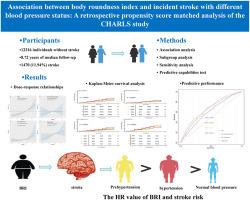
The sample comprised 12,316 CHARLS participants aged ≥45 years without prior stroke. The association between the BRI and incident stroke was evaluated using Cox proportional hazards models. To strengthen the validity of the findings, additional analyses were performed, including propensity score matching (PSM), subgroup analyses, and sensitivity tests. Furthermore, the discriminative capacity of BRI for predicting stroke events was assessed using receiver operating characteristic (ROC) curve analysis.
Increased stroke risk was significantly connected to a higher BRI. Following PSM, fully adjusted models indicated that a unit rise in log (BRI) was tied to a 19 % increase in stroke risk (HR = 1.79, 95 % CI: 1.37–2.34, P < 0.001). After stratification by blood pressure status, the association between BRI and stroke risk was most pronounced among individuals with prehypertension (HR = 2.60, 95 %CI: 1.49–4.54; P < 0.001) and those with hypertension (HR = 1.65, 95 %CI: 1.17–2.33; P = 0.004). By contrast, among participants with normal blood pressure (NBP), no statistically significant association was observed following PSM. The reliability of the findings was supported by subgroup and sensitivity analyses. The ROC analysis demonstrated that the BRI had moderate predictive accuracy for stroke, notably in individuals with NBP, with an area under the curve of 0.672.
Conclusions
Elevated BRI is independently associated with a greater risk of stroke, particularly in individuals with prehypertension or hypertension.
身体圆度指数与不同血压状态的卒中事件之间的关系:CHARLS研究的回顾性倾向评分匹配分析。
背景和目的:身体圆度指数(BRI)是一种评估内脏脂肪的创新人体测量指标,已被证明在预测心脏代谢风险方面具有实用价值。然而,其与各血压层中风风险的关系尚不清楚。方法和结果:样本包括12316 CHARLS参与者,年龄≥45岁,无卒中史。使用Cox比例风险模型评估BRI与突发卒中之间的关系。为了加强研究结果的有效性,我们进行了额外的分析,包括倾向评分匹配(PSM)、亚组分析和敏感性测试。此外,采用受试者工作特征(ROC)曲线分析评估BRI预测脑卒中事件的判别能力。卒中风险的增加与较高的BRI显著相关。在PSM之后,完全调整的模型表明,log (BRI)的单位升高与卒中风险增加19%相关(HR = 1.79, 95% CI: 1.37-2.34, P)结论:BRI升高与卒中风险增加独立相关,特别是在高血压前期或高血压患者中。
本文章由计算机程序翻译,如有差异,请以英文原文为准。
求助全文
约1分钟内获得全文
求助全文
来源期刊
CiteScore
6.80
自引率
2.60%
发文量
332
审稿时长
57 days
期刊介绍:
Nutrition, Metabolism & Cardiovascular Diseases is a forum designed to focus on the powerful interplay between nutritional and metabolic alterations, and cardiovascular disorders. It aims to be a highly qualified tool to help refine strategies against the nutrition-related epidemics of metabolic and cardiovascular diseases. By presenting original clinical and experimental findings, it introduces readers and authors into a rapidly developing area of clinical and preventive medicine, including also vascular biology. Of particular concern are the origins, the mechanisms and the means to prevent and control diabetes, atherosclerosis, hypertension, and other nutrition-related diseases.
 求助内容:
求助内容: 应助结果提醒方式:

 京公网安备 11010802042870号


