
Optimized cloning and expression workflow for Cry proteins from Bacillus wiedmannii biovar thuringiensis
IF 2.4
3区 生物学
Q1 ZOOLOGY
Journal of invertebrate pathology
Pub Date : 2026-06-01
Epub Date: 2026-01-13
DOI:10.1016/j.jip.2026.108531
引用次数: 0
Abstract
Efficient heterologous expression of insecticidal Cry proteins, such as those produced by the bacterium Bacillus thuringiensis (Bt), remains essential for their structural and functional characterization. This article describes an optimized workflow for the amplification, cloning, and expression of cry genes identified in Bacillus wiedmannii biovar thuringiensis (Bwt). The Bwt genome harbors multiple cry genes that display high sequence conservation, especially in their flanking regions, and feature a high adenine/thymine content organized in short domains surrounding the start and stop codons. These regions often share homology with other cry genes, pseudogenes, or chromosomal fragments, making targeted amplification and cloning challenging. To overcome these difficulties, a nested PCR strategy was implemented to ensure high sequence specificity and fidelity. As a proof of concept, the cry4Ea1 and cry4Fa1 genes were cloned into the pSTAB vector, which combines the sporulation-dependent cyt1Aa promoter with the STAB-SD stabilizing sequence, and expressed in the Bt-derived acrystalliferous strain 4Q7. For genes containing internal restriction sites, the ligation-independent AQUA method provided an efficient alternative to conventional cloning. Optimization of the culture conditions demonstrated that inoculum physiology and nutrient availability significantly influenced biomass accumulation and Cry protein production, using the recombinant Bacillus thuringiensis subsp. israelensis 4Q7 strain expressing Cry4Fa1 as a representative case. This article analyzes these findings and compares them with other Bt expression systems, highlighting similarities, limitations, and complementary advances reported in other studies. Altogether, these approaches expand the molecular toolbox for Cry protein expression and characterization, offering promising biotechnological applications.
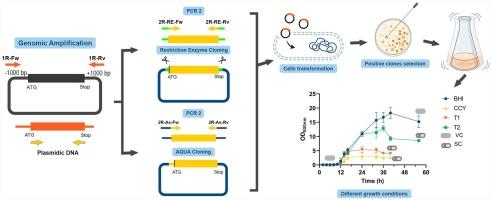
苏云金魏德曼芽孢杆菌Cry蛋白克隆及表达流程优化
苏云金芽孢杆菌(Bacillus thuringiensis, Bt)产生的杀虫Cry蛋白的高效异源表达对其结构和功能表征仍然至关重要。本文描述了苏云金芽孢杆菌(Bacillus wiedmannii biovar thuringiensis, Bwt)中cry基因扩增、克隆和表达的优化工作流程。Bwt基因组包含多个cry基因,这些基因表现出高度的序列保守性,特别是在它们的侧翼区域,并且在开始和停止密码子周围的短结构域中组织了高腺嘌呤/胸腺嘧啶含量。这些区域通常与其他哭泣基因、假基因或染色体片段具有同源性,这使得靶向扩增和克隆具有挑战性。为了克服这些困难,采用了巢式PCR策略,以确保高序列特异性和保真度。为了验证这一概念,我们将cry4Ea1和cry4Fa1基因克隆到pSTAB载体中,该载体结合了产孢依赖的cyt1Aa启动子和STAB-SD稳定序列,并在bt衍生的结晶菌株4Q7中表达。对于含有内切位点的基因,不依赖于结扎的AQUA方法提供了一种有效的替代方法。利用重组苏云金芽孢杆菌亚种优化培养条件,发现接种量生理和养分有效性显著影响生物量积累和Cry蛋白产量。以表达Cry4Fa1的以色列4Q7菌株为代表。本文分析了这些发现,并将其与其他Bt表达系统进行了比较,强调了其他研究报告的相似性、局限性和互补进展。总之,这些方法扩展了Cry蛋白表达和表征的分子工具箱,提供了有前途的生物技术应用。
本文章由计算机程序翻译,如有差异,请以英文原文为准。
求助全文
约1分钟内获得全文
求助全文
来源期刊
CiteScore
6.10
自引率
5.90%
发文量
94
审稿时长
1 months
期刊介绍:
The Journal of Invertebrate Pathology presents original research articles and notes on the induction and pathogenesis of diseases of invertebrates, including the suppression of diseases in beneficial species, and the use of diseases in controlling undesirable species. In addition, the journal publishes the results of physiological, morphological, genetic, immunological and ecological studies as related to the etiologic agents of diseases of invertebrates.
The Journal of Invertebrate Pathology is the adopted journal of the Society for Invertebrate Pathology, and is available to SIP members at a special reduced price.
 求助内容:
求助内容: 应助结果提醒方式:

 京公网安备 11010802042870号


