
Rest-activity rhythms and cardiovascular events in cardiovascular–kidney–metabolic syndrome: evidence from two nationwide cohorts
IF 5.9
Q1 CARDIAC & CARDIOVASCULAR SYSTEMS
American journal of preventive cardiology
Pub Date : 2026-04-01
Epub Date: 2026-01-10
DOI:10.1016/j.ajpc.2026.101414
引用次数: 0
Abstract
Background
Circadian rest–activity rhythm (CRAR) is a modifiable determinant of metabolic and cardiovascular health, yet its role in cardiovascular events and mortality among individuals with cardiovascular–kidney–metabolic (CKM) syndrome remains unclear.
Methods
Accelerometer-derived CRAR parameters were analyzed in two nationally representative cohorts. Primary outcomes included cardiovascular incidence among participants with CKM stages 0–3 and all-cause and cardiovascular mortality among those with stages 1–4. Multinomial logistic and Cox proportional hazards models assessed associations of CRAR with CKM progression and subsequent outcomes. Mediation analyses examined inflammatory biomarkers, and improvements in prediction were evaluated using changes in C-statistics.
Results
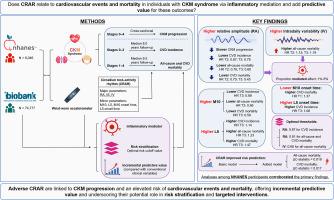
Among 74,777 participants, higher relative amplitude (RA) tertiles were associated with slower CKM progression and lower risks of cardiovascular incidence (T2: HR 0.87, 95% CI 0.82–0.93; T3: HR 0.79, 95% CI 0.73–0.85), all-cause mortality (T2: HR 0.70, 95% CI 0.64–0.77; T3: HR 0.60, 95% CI 0.54–0.67), and cardiovascular mortality (T2: HR 0.70, 95% CI 0.57–0.86; T3: HR 0.45, 95% CI 0.34–0.61). Higher intradaily variability (IV) was associated with increased all-cause mortality (T2: HR 1.12, 95% CI 1.02–1.22; T3: HR 1.19, 95% CI 1.08–1.30). Inflammatory biomarkers modestly mediated these associations (1%–5%). Optimal thresholds were RA = 0.87 for cardiovascular incidence, RA = 0.81 and IV = 0.68 for mortality. Adding CRAR to basic models improved prediction of all-cause and cardiovascular mortality (ΔC-statistic = 0.019 and 0.017). Results were validated in an independent cohort of 6046 participants.
Conclusion
Adverse CRAR is associated with CKM progression and elevated risks of cardiovascular events and mortality, highlighting its utility in identifying high-risk individuals and guiding targeted interventions through risk stratification and incremental prediction.
心血管-肾-代谢综合征的静息活动节律和心血管事件:来自两个全国性队列的证据
昼夜休息-活动节律(CRAR)是代谢和心血管健康的可改变决定因素,但其在心血管-肾-代谢(CKM)综合征患者心血管事件和死亡率中的作用尚不清楚。方法在两个具有全国代表性的队列中分析加速度计衍生的CRAR参数。主要结局包括0-3期CKM参与者的心血管发病率和1-4期参与者的全因死亡率和心血管死亡率。多项logistic和Cox比例风险模型评估了CRAR与CKM进展和后续结局的关系。中介分析检查炎症生物标志物,并使用c统计量的变化评估预测的改进。结果在74,777名参与者中,较高的相对振幅(RA)分位数与较慢的CKM进展、较低的心血管发病率风险(T2: HR 0.87, 95% CI 0.82-0.93; T3: HR 0.79, 95% CI 0.73-0.85)、全因死亡率(T2: HR 0.70, 95% CI 0.64-0.77; T3: HR 0.60, 95% CI 0.54-0.67)和心血管死亡率(T2: HR 0.70, 95% CI 0.57-0.86; T3: HR 0.45, 95% CI 0.34-0.61)相关。较高的每日变异性(IV)与全因死亡率增加相关(T2: HR 1.12, 95% CI 1.02-1.22; T3: HR 1.19, 95% CI 1.08-1.30)。炎症生物标志物适度介导了这些关联(1%-5%)。最佳阈值为心血管发病率RA = 0.87,死亡率RA = 0.81, IV = 0.68。在基础模型中加入CRAR可改善全因死亡率和心血管死亡率的预测(ΔC-statistic = 0.019和0.017)。结果在6046名参与者的独立队列中得到验证。结论CRAR不良反应与CKM进展、心血管事件和死亡风险升高相关,突出了其在识别高危人群和通过风险分层和增量预测指导有针对性干预方面的作用。
本文章由计算机程序翻译,如有差异,请以英文原文为准。
求助全文
约1分钟内获得全文
求助全文
来源期刊

American journal of preventive cardiology
Cardiology and Cardiovascular Medicine
CiteScore
6.60
自引率
0.00%
发文量
0
审稿时长
76 days
 求助内容:
求助内容: 应助结果提醒方式:

 京公网安备 11010802042870号


