
Timing and genesis of gold mineralization in the Kibaran Metallogenic Province, D.R. Congo: Constraints from zircon UPb geochronology, trace element chemistry, and LuHf isotopes
IF 3.3
2区 地球科学
Q1 GEOCHEMISTRY & GEOPHYSICS
Journal of Geochemical Exploration
Pub Date : 2026-04-01
Epub Date: 2026-01-07
DOI:10.1016/j.gexplo.2026.107972
引用次数: 0
Abstract
The Kibaran Metallogenic Province represents a world-class metallogenic system, hosting a diverse array of metal deposits, including significant gold mineralization. Despite its economic importance, the genesis and metallogenic evolution of gold mineralization in this region remain poorly understood. This knowledge gap is primarily due to the absence of comprehensive studies that can provide a coherent genetic model for its formation, making it challenging to contextualize the Kibaran gold deposits within the broader framework of global gold occurrences. In this study, we present new U![]() Pb geochronology, trace element chemistry, and Lu
Pb geochronology, trace element chemistry, and Lu![]() Hf isotopic data from zircons extracted from mafic and intermediate-felsic, and sedimentary rocks to elucidate the geodynamic processes and emplacement mechanisms of gold mineralization in the metallogenic province. Our zircon U
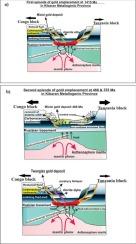
Hf isotopic data from zircons extracted from mafic and intermediate-felsic, and sedimentary rocks to elucidate the geodynamic processes and emplacement mechanisms of gold mineralization in the metallogenic province. Our zircon U![]() Pb data reveal two major episodes of gold mineralization: (a) an early Mesoproterozoic event ~1415 Ma associated with the end of Eburnean orogeny, marked by a rift-related magmatic system and dolerite dykes emplacement at Misisi gold field, and (b) a mid-Paleozoic event (~468-333 Ma) linked to the end of Pan-African orogeny, characterized by sedimentation at Misisi and diorite and feldspar porphyry intrusions at Twangiza. Lu
Pb data reveal two major episodes of gold mineralization: (a) an early Mesoproterozoic event ~1415 Ma associated with the end of Eburnean orogeny, marked by a rift-related magmatic system and dolerite dykes emplacement at Misisi gold field, and (b) a mid-Paleozoic event (~468-333 Ma) linked to the end of Pan-African orogeny, characterized by sedimentation at Misisi and diorite and feldspar porphyry intrusions at Twangiza. Lu![]() Hf isotopic signatures indicate that both magmatic episodes resulted from partial melting of the older Congo-Ruzizian basement, with juvenile crustal input. Zircon trace element compositions suggest that gold mineralization was generated under high-temperature, oxidizing fluid conditions, with magma migrating from the lower to the upper crust, where it interacted with reduced fluids from carbonaceous country rocks, facilitating gold deposition. These findings suggest that the gold mineralization events in the Kibaran Metallogenic Province coincided with failed rift systems during the breakup of the Columbia and Gondwana supercontinents. This study provides new insights into the temporal relationships between supercontinent cycles and gold mineralization events in the Democratic Republic of Congo.
Hf isotopic signatures indicate that both magmatic episodes resulted from partial melting of the older Congo-Ruzizian basement, with juvenile crustal input. Zircon trace element compositions suggest that gold mineralization was generated under high-temperature, oxidizing fluid conditions, with magma migrating from the lower to the upper crust, where it interacted with reduced fluids from carbonaceous country rocks, facilitating gold deposition. These findings suggest that the gold mineralization events in the Kibaran Metallogenic Province coincided with failed rift systems during the breakup of the Columbia and Gondwana supercontinents. This study provides new insights into the temporal relationships between supercontinent cycles and gold mineralization events in the Democratic Republic of Congo.
刚果(金)Kibaran成矿省金矿成矿时间和成因:锆石UPb年代学、微量元素化学和LuHf同位素的约束
基巴兰成矿省是一个世界级的成矿系统,拥有各种各样的金属矿床,包括重要的金矿化。尽管具有重要的经济意义,但对该区金矿化成因及成矿演化的认识尚不清楚。这种知识差距主要是由于缺乏全面的研究,无法为其形成提供连贯的遗传模型,因此很难将Kibaran金矿床置于更广泛的全球黄金赋存情况框架内。本文通过对基性、中长英质和沉积岩中提取的锆石进行UPb年代学、微量元素化学和LuHf同位素的研究,阐明了成矿省金矿化的地球动力学过程和侵位机制。我们的锆石UPb数据揭示了两个主要的金矿化时期:(a)与Eburnean造山末期有关的早中元古代事件(~ 1415 Ma),以裂谷相关的岩浆体系和米西西金矿的白云岩岩脉侵位为标志;(b)与泛非造山末期有关的中古生代事件(~468-333 Ma),以米西西的沉积和Twangiza的闪长岩和长石斑岩侵入为特征。LuHf同位素特征表明,这两次岩浆活动都是由较老的刚果-鲁齐济基底部分熔融引起的,并有幼年地壳的输入。锆石微量元素组成表明,金矿成矿发生在高温氧化流体条件下,岩浆由下地壳向上地壳迁移,并与碳质围岩还原流体相互作用,有利于金的沉积。这些发现表明,基巴兰成矿省的金矿化事件与哥伦比亚和冈瓦纳超大陆分裂期间的断裂系统失败相吻合。本研究为研究刚果民主共和国超大陆旋回与金矿化事件的时间关系提供了新的认识。
本文章由计算机程序翻译,如有差异,请以英文原文为准。
求助全文
约1分钟内获得全文
求助全文
来源期刊
Journal of Geochemical Exploration
地学-地球化学与地球物理
CiteScore
7.40
自引率
7.70%
发文量
148
审稿时长
8.1 months
期刊介绍:
Journal of Geochemical Exploration is mostly dedicated to publication of original studies in exploration and environmental geochemistry and related topics.
Contributions considered of prevalent interest for the journal include researches based on the application of innovative methods to:
define the genesis and the evolution of mineral deposits including transfer of elements in large-scale mineralized areas.
analyze complex systems at the boundaries between bio-geochemistry, metal transport and mineral accumulation.
evaluate effects of historical mining activities on the surface environment.
trace pollutant sources and define their fate and transport models in the near-surface and surface environments involving solid, fluid and aerial matrices.
assess and quantify natural and technogenic radioactivity in the environment.
determine geochemical anomalies and set baseline reference values using compositional data analysis, multivariate statistics and geo-spatial analysis.
assess the impacts of anthropogenic contamination on ecosystems and human health at local and regional scale to prioritize and classify risks through deterministic and stochastic approaches.
Papers dedicated to the presentation of newly developed methods in analytical geochemistry to be applied in the field or in laboratory are also within the topics of interest for the journal.
 求助内容:
求助内容: 应助结果提醒方式:

 京公网安备 11010802042870号


