
Environmental and circular economy-based characterisation of abandoned mine wastes in the Odiel River basin (southwestern Spain)
IF 3.3
2区 地球科学
Q1 GEOCHEMISTRY & GEOPHYSICS
Journal of Geochemical Exploration
Pub Date : 2026-04-01
Epub Date: 2026-01-14
DOI:10.1016/j.gexplo.2026.107988
引用次数: 0
Abstract
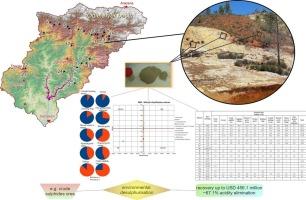
The Odiel River basin (southwestern Spain) is severely affected by acid mine drainage resulting from a long history of intensive mining, particularly during the 19th and 20th centuries. This legacy has left numerous abandoned mine wastes scattered across the basin, contributing to widespread contamination of the river system. Many of these materials also contain economically relevant concentrations of critical and high-tech metals. This study evaluates the acid-generation potential of several waste types and provides a preliminary assessment of their suitability for metal recovery. A detailed characterisation was conducted on wastes from 24 abandoned sites, including measurements of surface area, volume, tonnage, acid-generation capacity (via acid–base accounting), and pseudo-total concentrations of 33 elements. Crude sulphide ores, despite their limited volume, exhibit the highest acid generation potential, whereas mixed wastes in dumps pose the greatest environmental risk due to their large tonnage. Roasted pyrite wastes and roasted pyrite ashes are highly enriched in valuable metals, with a preliminary estimated gross recovery value of up to 0.9 billion USD based on the combined contents of the analysed elements. Environmental desulphurisation is proposed as an effective strategy to reduce acidity and enable metal recovery, with the potential to eliminate approximately 80% of the total acidity associated with the studied wastes. Overall, the findings support integrated remediation and resource-recovery approaches consistent with circular-economy principles.
基于环境和循环经济的Odiel河流域废弃矿山废物特征(西班牙西南部)
Odiel河流域(西班牙西南部)受到酸性矿井排水的严重影响,这是由于长期的密集采矿,特别是在19世纪和20世纪。这一遗产使大量废弃的矿山废料散落在盆地各处,导致河流系统受到广泛污染。许多这些材料还含有与经济相关的关键和高科技金属的浓度。本研究评估了几种废物类型的产酸潜力,并对其金属回收的适用性进行了初步评估。对来自24个废弃场址的废物进行了详细的特征描述,包括测量表面积、体积、吨位、产酸能力(通过酸碱计算)和33种元素的伪总浓度。粗硫化物矿石尽管体积有限,却显示出最大的产酸潜力,而倾倒场的混合废物由于吨位大而构成最大的环境风险。焙烧黄铁矿废物和焙烧黄铁矿灰烬中有价金属含量很高,根据分析元素的综合含量,初步估计总回收价值可达9亿美元。环境脱硫被认为是降低酸性和实现金属回收的有效策略,有可能消除与所研究废物相关的约80%的总酸度。总体而言,研究结果支持符合循环经济原则的综合修复和资源恢复方法。
本文章由计算机程序翻译,如有差异,请以英文原文为准。
求助全文
约1分钟内获得全文
求助全文
来源期刊
Journal of Geochemical Exploration
地学-地球化学与地球物理
CiteScore
7.40
自引率
7.70%
发文量
148
审稿时长
8.1 months
期刊介绍:
Journal of Geochemical Exploration is mostly dedicated to publication of original studies in exploration and environmental geochemistry and related topics.
Contributions considered of prevalent interest for the journal include researches based on the application of innovative methods to:
define the genesis and the evolution of mineral deposits including transfer of elements in large-scale mineralized areas.
analyze complex systems at the boundaries between bio-geochemistry, metal transport and mineral accumulation.
evaluate effects of historical mining activities on the surface environment.
trace pollutant sources and define their fate and transport models in the near-surface and surface environments involving solid, fluid and aerial matrices.
assess and quantify natural and technogenic radioactivity in the environment.
determine geochemical anomalies and set baseline reference values using compositional data analysis, multivariate statistics and geo-spatial analysis.
assess the impacts of anthropogenic contamination on ecosystems and human health at local and regional scale to prioritize and classify risks through deterministic and stochastic approaches.
Papers dedicated to the presentation of newly developed methods in analytical geochemistry to be applied in the field or in laboratory are also within the topics of interest for the journal.
 求助内容:
求助内容: 应助结果提醒方式:

 京公网安备 11010802042870号


