
Nutraceutical potential of low methylated pectin derived from pectin rich agrowaste

IF 3.6
Rajesh Kumar, Jagan Mohan Rao Tingirikari
{"title":"Nutraceutical potential of low methylated pectin derived from pectin rich agrowaste","authors":"Rajesh Kumar,&nbsp;Jagan Mohan Rao Tingirikari","doi":"10.1016/j.bcdf.2025.100518","DOIUrl":null,"url":null,"abstract":"<div><div>Increase in global population has led to significant rise in new diseases and bringing new challenges. The current treatment methods being employed are rather non-specific and have several side effects. There is a great need to find alternate, safe, prevention and treatment strategies to combat against various diseases. With global challenges such as food insecurity, increasing chronic diseases, and the pursuit of sustainable economic practices, the need for dietary fibres or nutraceuticals derived from plant waste is gaining importance. Recent studies performed on low methylated pectin (LMP) derived from pectin rich agro waste has displayed good functional properties in prevention and treatment of diseases. LMPs are generally recognized as safe, nontoxic and biocompatible. It was reported that LMPs bind to galactin-3 receptor to prevent cancer metastasis, exhibit anti-diabetic property by inhibiting α-glucosidase activity, promote anti-inflammatory activity by regulating TLR-2, IL-1β, and IL-6. LMPs exhibit antimicrobial activity by promoting the growth of beneficial bacteria, which neutralize toxins by producing short chain fatty acids. LMPs promote antioxidant activity by reducing the free radicles and reactive oxygen species. The functional properties of LMPs greatly depends on degree of methylation, source, structure, and sugar composition. Recently, LMPs are used in food industry as emulsifying, gelling, flocculation and foaming agent. This paper highlights the recent technological advancements in production, and functional properties of LMPs derived from pectin rich agro waste. In future, LMP based nutraceutical products can be developed by pharma and food industry.</div></div>","PeriodicalId":38299,"journal":{"name":"Bioactive Carbohydrates and Dietary Fibre","volume":"35 ","pages":"Article 100518"},"PeriodicalIF":3.6000,"publicationDate":"2026-05-01","publicationTypes":"Journal Article","fieldsOfStudy":null,"isOpenAccess":false,"openAccessPdf":"","citationCount":"0","resultStr":null,"platform":"Semanticscholar","paperid":null,"PeriodicalName":"Bioactive Carbohydrates and Dietary Fibre","FirstCategoryId":"1085","ListUrlMain":"https://www.sciencedirect.com/science/article/pii/S221261982500052X","RegionNum":0,"RegionCategory":null,"ArticlePicture":[],"TitleCN":null,"AbstractTextCN":null,"PMCID":null,"EPubDate":"2026/1/2 0:00:00","PubModel":"Epub","JCR":"","JCRName":"","Score":null,"Total":0}
引用次数: 0

Abstract

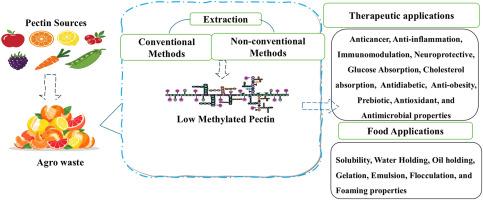
Increase in global population has led to significant rise in new diseases and bringing new challenges. The current treatment methods being employed are rather non-specific and have several side effects. There is a great need to find alternate, safe, prevention and treatment strategies to combat against various diseases. With global challenges such as food insecurity, increasing chronic diseases, and the pursuit of sustainable economic practices, the need for dietary fibres or nutraceuticals derived from plant waste is gaining importance. Recent studies performed on low methylated pectin (LMP) derived from pectin rich agro waste has displayed good functional properties in prevention and treatment of diseases. LMPs are generally recognized as safe, nontoxic and biocompatible. It was reported that LMPs bind to galactin-3 receptor to prevent cancer metastasis, exhibit anti-diabetic property by inhibiting α-glucosidase activity, promote anti-inflammatory activity by regulating TLR-2, IL-1β, and IL-6. LMPs exhibit antimicrobial activity by promoting the growth of beneficial bacteria, which neutralize toxins by producing short chain fatty acids. LMPs promote antioxidant activity by reducing the free radicles and reactive oxygen species. The functional properties of LMPs greatly depends on degree of methylation, source, structure, and sugar composition. Recently, LMPs are used in food industry as emulsifying, gelling, flocculation and foaming agent. This paper highlights the recent technological advancements in production, and functional properties of LMPs derived from pectin rich agro waste. In future, LMP based nutraceutical products can be developed by pharma and food industry.
Abstract Image

从富含果胶的农业废弃物中提取的低甲基化果胶的营养潜力
全球人口的增加导致新疾病的大量增加,带来了新的挑战。目前使用的治疗方法是非特异性的,并且有一些副作用。迫切需要找到替代的、安全的预防和治疗战略来防治各种疾病。面对粮食不安全、慢性病增加和追求可持续经济做法等全球挑战,对从植物废料中提取的膳食纤维或营养保健品的需求日益重要。近年来,从富含果胶的农业废弃物中提取的低甲基化果胶(LMP)在预防和治疗疾病方面具有良好的功能特性。LMPs通常被认为是安全、无毒和生物相容性好的。据报道,LMPs与半乳糖素-3受体结合可预防肿瘤转移,通过抑制α-葡萄糖苷酶活性发挥抗糖尿病作用,通过调节TLR-2、IL-1β和IL-6促进抗炎活性。LMPs通过促进有益细菌的生长,通过产生短链脂肪酸来中和毒素,从而表现出抗菌活性。LMPs通过减少自由基和活性氧来促进抗氧化活性。LMPs的功能特性在很大程度上取决于甲基化程度、来源、结构和糖组成。近年来,LMPs作为乳化剂、胶凝剂、絮凝剂和发泡剂在食品工业中得到广泛应用。本文重点介绍了从富含果胶的农业废弃物中提取LMPs的最新技术进展和功能特性。未来,基于LMP的营养保健品可用于制药和食品工业。
本文章由计算机程序翻译,如有差异,请以英文原文为准。
求助全文
约1分钟内获得全文 求助全文
来源期刊
Bioactive Carbohydrates and Dietary Fibre
Bioactive Carbohydrates and Dietary Fibre Agricultural and Biological Sciences-Food Science
CiteScore
6.00
自引率
0.00%
发文量
38
期刊介绍:

×
引用
GB/T 7714-2015
复制
MLA
复制
APA
复制
导出至
BibTeX EndNote RefMan NoteFirst NoteExpress
×
提示
您的信息不完整,为了账户安全,请先补充。
现在去补充
×
提示
您因"违规操作"
具体请查看互助需知
我知道了
×
提示
确定
请完成安全验证×
copy
已复制链接
快去分享给好友吧!
我知道了
右上角分享
点击右上角分享
0
联系我们:info@booksci.cn Book学术提供免费学术资源搜索服务,方便国内外学者检索中英文文献。致力于提供最便捷和优质的服务体验。 Copyright © 2023 布克学术 All rights reserved.
京ICP备2023020795号-1
ghs 京公网安备 11010802042870号
Book学术文献互助
Book学术文献互助群
群 号:604180095
Book学术官方微信
小红书


