
Bioinformatics-Guided structural characterization and immunogenicity assessment of multi-epitope vaccine candidates against Zika virus
IF 2.8
Q3 Biochemistry, Genetics and Molecular Biology
Journal of Genetic Engineering and Biotechnology
Pub Date : 2026-03-01
Epub Date: 2026-01-12
DOI:10.1016/j.jgeb.2025.100641
引用次数: 0
Abstract
The Zika virus (ZIKV) causes a significant global health threat, necessitating the development of effective vaccines. In this study, using bioinformatics and software-based vaccinology approaches, firstly we evaluated the antigenicity of all proteins of ZIKV (EU545988.1), identifying Protein Pr, E, and NS1 as the most antigenic. Subsequent investigation into the antigenic profiles of these proteins across the top 10 infectious ZIKV strains unveiled Strain Zika (USA, KU312312), Rio-U1 (Brazil, KX601166), and Zika (Brazil, KU321639) as harboring the highest antigenicity for Protein Pr (0.7194555), E (0.6559635), and NS1 (0.6115945), respectively. Next, T cell and B cell epitopes were predicted for these proteins, and their antigenicity, allergenicity, and toxicity were evaluated. Binding affinity of T cell epitopes with MHC I and II molecules was determined. Population coverage and conservancy analysis were conducted. Three B cell epitopes (ATMSYECPMLDHVQI, TMSGKAISFATTLG, and KDAHAKRQTVYVCKR) and three T cell epitopes (DLGHTCDATMSYECP, ALGGVMIFLSTAVSA, and TSVWLKYHPDSPRRL) from Protein Pr, E, and NS1 were identified as optimal vaccine candidates. Among them, ALGGVMIFLSTAVSA and TSVWLKYHPDSPRRL showed 100% conservancy and 71.88% and 95.24% Population coverage (worldwide) where DLGHTCDATMSYECP showed 95.24% Conservancy and 94.77% Population coverage. Using them, the multi-epitope vaccine (MEV) was constructed with an appropriate adjuvant (P29459) and linkers, including a His-tag for ease of isolation during in vivo procedures. Secondary and tertiary structures of the MEV were predicted, and physiochemical properties and subcellular localization were analyzed. Furthermore, allergenicity, toxicity and immune simulation of the MEV were assessed. Molecular docking analysis confirmed binding affinity with human receptor proteins TLR3 (PDB: 7C76) and stability was evaluated through Molecular Dynamics Simulation analysis. Post-translational modifications analysis was conducted, and in silico cloning in E. coli was performed to assess cloning feasibility of the MEV. This integrative approach provides insights into the development of a potential ZIKV vaccine, laying the groundwork for further wet lab validation and preclinical and clinical investigations.
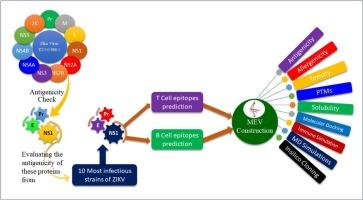
生物信息学指导下寨卡病毒多表位候选疫苗的结构表征和免疫原性评估
寨卡病毒(ZIKV)对全球健康造成重大威胁,需要开发有效的疫苗。本研究首先利用生物信息学和基于软件的疫苗学方法,对ZIKV (EU545988.1)所有蛋白的抗原性进行了评价,鉴定出蛋白Pr、E和NS1的抗原性最强。随后对10个传染性最强的寨卡病毒株的抗原谱进行调查,发现寨卡病毒株(美国,KU312312)、Rio-U1(巴西,KX601166)和寨卡病毒株(巴西,KU321639)分别对蛋白Pr(0.7194555)、E(0.6559635)和NS1(0.6115945)具有最高的抗原性。接下来,预测这些蛋白的T细胞和B细胞表位,并评估它们的抗原性、过敏原性和毒性。确定T细胞表位与MHC I和II分子的结合亲和力。进行了人口覆盖率和生态分析。来自蛋白Pr、E和NS1的3个B细胞表位(ATMSYECPMLDHVQI、TMSGKAISFATTLG和KDAHAKRQTVYVCKR)和3个T细胞表位(DLGHTCDATMSYECP、ALGGVMIFLSTAVSA和TSVWLKYHPDSPRRL)被确定为最佳候选疫苗。其中,ALGGVMIFLSTAVSA和TSVWLKYHPDSPRRL在全球范围内的保护率为100%,人口覆盖率为71.88%和95.24%,DLGHTCDATMSYECP的保护率为95.24%,人口覆盖率为94.77%。使用它们,用合适的佐剂(P29459)和连接物构建多表位疫苗(MEV),包括his标签,以便在体内过程中易于分离。预测了MEV的二级和三级结构,分析了其理化性质和亚细胞定位。此外,还对MEV的致敏性、毒性和免疫模拟进行了评估。分子对接分析证实了与人受体蛋白TLR3 (PDB: 7C76)的结合亲和力,并通过分子动力学模拟分析评估了稳定性。进行了翻译后修饰分析,并在大肠杆菌中进行了硅克隆,以评估MEV的克隆可行性。这种综合方法为开发潜在的寨卡病毒疫苗提供了见解,为进一步的湿实验室验证以及临床前和临床研究奠定了基础。
本文章由计算机程序翻译,如有差异,请以英文原文为准。
求助全文
约1分钟内获得全文
求助全文
来源期刊
Journal of Genetic Engineering and Biotechnology
Biochemistry, Genetics and Molecular Biology-Biotechnology
CiteScore
5.70
自引率
5.70%
发文量
159
审稿时长
16 weeks
期刊介绍:
Journal of genetic engineering and biotechnology is devoted to rapid publication of full-length research papers that leads to significant contribution in advancing knowledge in genetic engineering and biotechnology and provide novel perspectives in this research area. JGEB includes all major themes related to genetic engineering and recombinant DNA. The area of interest of JGEB includes but not restricted to: •Plant genetics •Animal genetics •Bacterial enzymes •Agricultural Biotechnology, •Biochemistry, •Biophysics, •Bioinformatics, •Environmental Biotechnology, •Industrial Biotechnology, •Microbial biotechnology, •Medical Biotechnology, •Bioenergy, Biosafety, •Biosecurity, •Bioethics, •GMOS, •Genomic, •Proteomic JGEB accepts
 求助内容:
求助内容: 应助结果提醒方式:

 京公网安备 11010802042870号


