
Hydrothermal source and upwelling-related sedimentary accumulation: A new model for early-stage ore forming processes of the western Neotethyan lower Jurassic Úrkút manganese ore deposit
Geosystems and Geoenvironment
Pub Date : 2026-05-01
Epub Date: 2025-12-30
DOI:10.1016/j.geogeo.2025.100489
引用次数: 0
Abstract
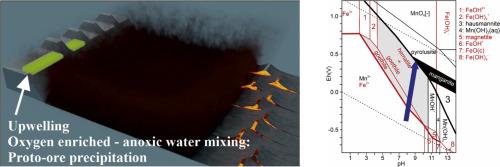
The black shale-hosted manganese ore deposit of Úrkút in Hungary formed during the globally recognized Toarcian (Early Jurassic) Jenkyns Event. Although geochemical signatures of hydrothermal processes involved in the metallogenesis of manganese ores were first recognized in the 1980s, their source and geochemical characterisation remained controversial. Here, we address two key questions: (i) why economically significant manganese ore accumulation is exclusively restricted to the Úrkút and Eplény sub-basins, despite the widespread Jenkyns Event-related sedimentation across the Transdanubian Range, and (ii) what was the source of the manganese. Based on new clay mineralogical (identification of montmorillonite and beidellite with distinct formation environments), geochemical (behaviour of Fe and Mn; Co-Ni-Zn and Fe-Mn-(Co-Ni-Cu) ternary system analysis; Cd/Mo ratio), and sedimentological data (evidence for radiolarian blooms), we propose a new early-stage ore-forming model. We suggest that dissolved Fe and Mn from hot brine pools associated with the rifting of the Neotethys Ocean were transported over long distances under anoxic conditions during the Jenkyns Event. A long-lived upwelling system (from the Late Pliensbachian to Early Toarcian) caused water mixing in the Bakony basin, which triggered the precipitation of the “proto-ore” of the Úrkút and Eplény manganese ore deposits. Our results contribute to a better understanding of the manganese enrichment in the Úrkút and Eplény sub-basins, pointing to the critical interplay between global paleoenvironmental events and local depositional settings.
热液源与上升流相关沉积成藏:新特提斯西部下侏罗统早期成矿过程新模式Úrkút锰矿床
匈牙利Úrkút黑色页岩锰矿床形成于全球公认的Toarcian(早侏罗世)Jenkyns事件。20世纪80年代,锰矿热液成矿过程的地球化学特征首次被发现,但其来源和地球化学特征仍存在争议。在这里,我们解决了两个关键问题:(i)为什么具有经济意义的锰矿聚集仅限于Úrkút和epl子盆地,尽管跨多瑙河山脉广泛存在与詹金斯事件相关的沉积,以及(ii)锰的来源是什么。基于新的粘土矿物学(不同形成环境的蒙脱土和贝德石的鉴定),地球化学(Fe和Mn的行为,Co-Ni-Zn和Fe-Mn-(Co-Ni-Cu)三元体系分析;Cd/Mo比值)和沉积学资料(放射虫华的证据),提出了一种新的早期成矿模式。我们认为,在詹金斯事件期间,与新特提斯洋裂谷有关的热盐水池中溶解的铁和锰在缺氧条件下进行了长距离运输。一个长期的上升流系统(从Pliensbachian晚期到Toarcian早期)导致了Bakony盆地的水混合,从而引发了Úrkút和eplacimny锰矿床的“原始矿石”的沉淀。我们的研究结果有助于更好地理解Úrkút和epl子盆地的锰富集,指出全球古环境事件与当地沉积背景之间的关键相互作用。
本文章由计算机程序翻译,如有差异,请以英文原文为准。
求助全文
约1分钟内获得全文
求助全文

 求助内容:
求助内容: 应助结果提醒方式:

 京公网安备 11010802042870号


