
Enhanced stability of bicontinuous bigels based on rapid in situ rapid conjugation of deacetylated chitosan and citral
IF 11
1区 农林科学
Q1 CHEMISTRY, APPLIED
引用次数: 0
Abstract
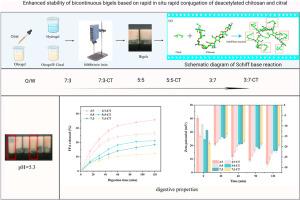
In this study, we developed a bigel system by introducing covalent cross-linking between citral (CT) and chitosan, with CT serving as a natural cross-linker. hydrogel-in-oleogel (W/O), oleogel-in-hydrogel (O/W), and bicontinuous were first prepared using chitosan and beeswax (BW). CT was then added to the oil phase, initiating a rapid in-situ chemical reaction at the oil–water interface between the aldehyde group of CT and the amine group of chitosan via Schiff base covalent interactions, yielding a cross-linked bigel. This cross-linking significantly reduced droplet size and promoted a thick, dense interfacial film. Consequently, the oil-holding capacity, water-holding capacity, and gel strength of the bigels were enhanced. CT addition also enhanced the thermodynamic stability and viscoelasticity, thereby limiting lipase access and reducing triglyceride digestibility from 25.9 ± 0.98 % to 12.32 ± 0.92 %. Notably, the higher CT concentration in W/O-type bigels enhanced the extent of the Schiff base reaction, further enhancing stability. Overall, this study presents a novel approach to constructing highly stable bigel systems through Schiff base covalent interactions.
脱乙酰壳聚糖与柠檬醛原位快速偶联增强双连续凝胶的稳定性
本研究以壳聚糖为天然交联剂,引入柠檬醛(CT)与壳聚糖共价交联,构建了一种新型的交联体系。首次以壳聚糖和蜂蜡为原料制备了水凝胶-油凝胶(W/O)、油凝胶-水凝胶(O/W)和双连续(BW)。然后将CT加入到油相中,通过希夫碱共价相互作用,在CT的醛基和壳聚糖的胺基之间的油水界面上引发快速的原位化学反应,生成交联bigel。这种交联显著减小了液滴尺寸,促进了厚而致密的界面膜的形成。从而提高了凝胶的持油能力、持水能力和凝胶强度。CT的加入也增强了热力学稳定性和粘弹性,从而限制了脂肪酶的进入,将甘油三酯的消化率从25.9±0.98%降低到12.32±0.92%。值得注意的是,W/ o型bigels中较高的CT浓度增强了Schiff碱反应的程度,进一步增强了稳定性。总的来说,本研究提出了一种通过希夫碱共价相互作用构建高稳定bigel体系的新方法。
本文章由计算机程序翻译,如有差异,请以英文原文为准。
求助全文
约1分钟内获得全文
求助全文
来源期刊
Food Hydrocolloids
工程技术-食品科技
CiteScore
19.90
自引率
14.00%
发文量
871
审稿时长
37 days
期刊介绍:
Food Hydrocolloids publishes original and innovative research focused on the characterization, functional properties, and applications of hydrocolloid materials used in food products. These hydrocolloids, defined as polysaccharides and proteins of commercial importance, are added to control aspects such as texture, stability, rheology, and sensory properties. The research's primary emphasis should be on the hydrocolloids themselves, with thorough descriptions of their source, nature, and physicochemical characteristics. Manuscripts are expected to clearly outline specific aims and objectives, include a fundamental discussion of research findings at the molecular level, and address the significance of the results. Studies on hydrocolloids in complex formulations should concentrate on their overall properties and mechanisms of action, while simple formulation development studies may not be considered for publication.
The main areas of interest are:
-Chemical and physicochemical characterisation
Thermal properties including glass transitions and conformational changes-
Rheological properties including viscosity, viscoelastic properties and gelation behaviour-
The influence on organoleptic properties-
Interfacial properties including stabilisation of dispersions, emulsions and foams-
Film forming properties with application to edible films and active packaging-
Encapsulation and controlled release of active compounds-
The influence on health including their role as dietary fibre-
Manipulation of hydrocolloid structure and functionality through chemical, biochemical and physical processes-
New hydrocolloids and hydrocolloid sources of commercial potential.
The Journal also publishes Review articles that provide an overview of the latest developments in topics of specific interest to researchers in this field of activity.
 求助内容:
求助内容: 应助结果提醒方式:

 京公网安备 11010802042870号


