
Toughening modification of bismaleimide resin with a cyano-containing thermoplastic PPENK particles
IF 4.7
2区 材料科学
Q2 ENGINEERING, CHEMICAL
引用次数: 0
Abstract
The 4,4′-bismaleimidodiphenyl-methane (BDM) resin, as one of the most important thermoset resin, exhibits poor toughness, which prevents it from adapting to high technical requirements and hinder its further development. Novel poly (phthalazinone ether nitrile ketone)s (PPENK) with twisted, non-coplanar phthalazinone units and highly polar cyano side groups into the main chain of poly (aryl ether ketone) molecules were synthesized and used to modify the blends of BDM/diallyl bisphenol A (DABPA). The thermal and mechanical properties of modified BDM resin have been investigated thoroughly. The role of cyano group content of PPENK on the mechanical properties of modified BDM resin has been recognized. The impact strength of modified BDM resin reached up to 26.25 kJ/m2, and the glass transition temperature can still maintain in a high level, in the range of 280–291 °C, indicating the excellent thermal properties of modified BDM resin. Moreover, the island-structure particles have been analyzed and the toughening mechanism of BDM resin modified by PPENK particles has been revealed. This work provides a new strategy for design of high-performance thermoplastic toughening agents for BDM resin with improved toughness and thermal properties.

含氰热塑性PPENK颗粒对双马来酰亚胺树脂的增韧改性
4,4′-双马来酰亚胺二苯基甲烷(BDM)树脂是最重要的热固性树脂之一,但其韧性较差,无法适应较高的技术要求,阻碍了其进一步发展。合成了一种新型聚酞嗪酮醚腈酮(PPENK),在聚芳醚酮分子的主链上含有扭曲的非共面酞嗪酮单元和高极性的氰基侧基,并用于改性BDM/双烯丙基双酚A (DABPA)共混物。研究了改性BDM树脂的热性能和力学性能。PPENK的氰基含量对改性BDM树脂力学性能的影响已得到认可。改性BDM树脂的冲击强度可达26.25 kJ/m2,玻璃化转变温度仍能保持在较高的水平,在280 ~ 291℃范围内,表明改性BDM树脂具有优异的热性能。此外,还对海岛结构颗粒进行了分析,揭示了PPENK颗粒改性BDM树脂的增韧机理。本研究为BDM树脂的高性能热塑性增韧剂的设计提供了新的思路。
本文章由计算机程序翻译,如有差异,请以英文原文为准。
求助全文
约1分钟内获得全文
求助全文
来源期刊
Particuology
工程技术-材料科学:综合
CiteScore
6.70
自引率
2.90%
发文量
1730
审稿时长
32 days
期刊介绍:
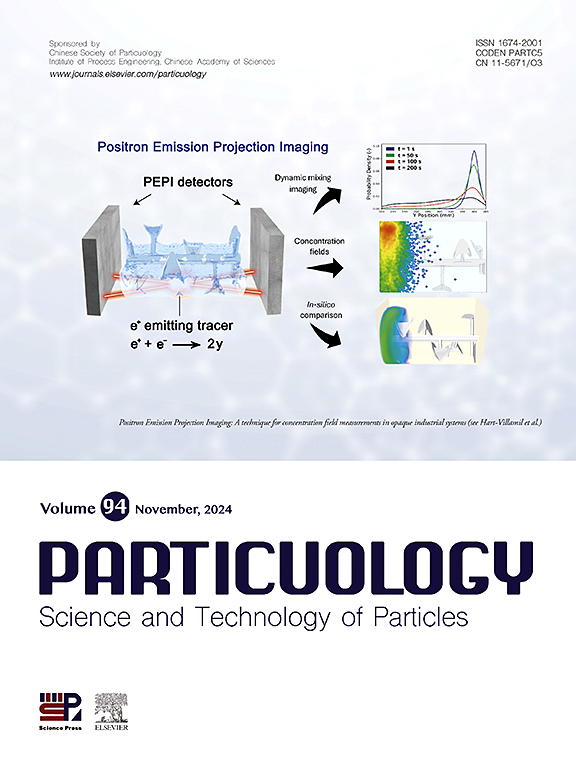
The word ‘particuology’ was coined to parallel the discipline for the science and technology of particles.
Particuology is an interdisciplinary journal that publishes frontier research articles and critical reviews on the discovery, formulation and engineering of particulate materials, processes and systems. It especially welcomes contributions utilising advanced theoretical, modelling and measurement methods to enable the discovery and creation of new particulate materials, and the manufacturing of functional particulate-based products, such as sensors.
Papers are handled by Thematic Editors who oversee contributions from specific subject fields. These fields are classified into: Particle Synthesis and Modification; Particle Characterization and Measurement; Granular Systems and Bulk Solids Technology; Fluidization and Particle-Fluid Systems; Aerosols; and Applications of Particle Technology.
Key topics concerning the creation and processing of particulates include:
-Modelling and simulation of particle formation, collective behaviour of particles and systems for particle production over a broad spectrum of length scales
-Mining of experimental data for particle synthesis and surface properties to facilitate the creation of new materials and processes
-Particle design and preparation including controlled response and sensing functionalities in formation, delivery systems and biological systems, etc.
-Experimental and computational methods for visualization and analysis of particulate system.
These topics are broadly relevant to the production of materials, pharmaceuticals and food, and to the conversion of energy resources to fuels and protection of the environment.
 求助内容:
 应助结果提醒方式:


 京公网安备 11010802042870号


