
Rational design of isatin-based quinoidal conjugated polymers for efficient organic photovoltaics with dual donor ternary strategy
IF 4.2
3区 工程技术
Q2 CHEMISTRY, APPLIED
引用次数: 0
Abstract
The quinoid strategy is regarded as a promising approach for fabricating high-performance organic semiconductor materials. However, the applications of quinoidal conjugated polymers (QCPs) are mostly limited to organic field-effect transistors (OFETs), and their photovoltaic applications remain challenging. In this study, two novel QCPs, PQ-H and PQ-F, were designed and synthesized by incorporating isomer-free deep-energy-level quinoid units. Using them as third components, ternary organic photovoltaic (OPV) devices combining the polymer donor PM6 and small-molecule acceptor Y6 were fabricated in an inverted configuration. The complementary absorption behavior of the QCPs with PM6 and Y6 enhanced light harvesting. In particular, owing to the achievement of an ideal morphology by introducing QCPs, the fill factor (FF) and open-circuit voltage (VOC) of the ternary OPVs were improved. Consequently, by incorporating 1 wt% PQ-H and 2 wt% PQ-F in the ternary films, higher average power conversion efficiencies (PCE) of 14.16 % and 14.54 %, respectively, were recorded compared to that of PM6:Y6 binary OPVs (13.63 %). This study demonstrates that with a suitable molecular design approach, QCPs can act as photoactive materials and their small amounts can significantly affect the performance of ternary OPVs to enhance all photovoltaic parameters.
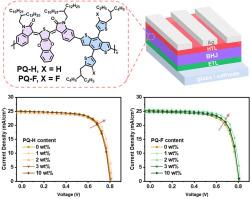
双给体三元策略下isatin基quinoidal共轭聚合物高效有机光伏的合理设计
类醌策略被认为是制造高性能有机半导体材料的一种有前途的方法。然而,quinoidal共轭聚合物(QCPs)的应用大多局限于有机场效应晶体管(ofet),其光伏应用仍然具有挑战性。在本研究中,设计并合成了两个新型QCPs, PQ-H和PQ-F,这两个QCPs是由无异构体的深能级类醌单元组成的。以它们为第三组分,制备了由聚合物给体PM6和小分子受体Y6组成的三元有机光伏(OPV)器件。QCPs与PM6和Y6的互补吸收行为增强了光收获。特别是,由于引入qcp实现了理想的形貌,三元OPVs的填充因子(FF)和开路电压(VOC)得到了改善。因此,通过在三元薄膜中加入1 wt% PQ-H和2 wt% PQ-F,与PM6:Y6二元opv(13.63%)相比,记录了更高的平均功率转换效率(PCE),分别为14.16%和14.54%。本研究表明,通过适当的分子设计方法,QCPs可以作为光活性材料,它们的少量可以显著影响三元opv的性能,从而提高所有光伏参数。
本文章由计算机程序翻译,如有差异,请以英文原文为准。
求助全文
约1分钟内获得全文
求助全文
来源期刊
Dyes and Pigments
工程技术-材料科学:纺织
CiteScore
8.20
自引率
13.30%
发文量
933
审稿时长
33 days
期刊介绍:
Dyes and Pigments covers the scientific and technical aspects of the chemistry and physics of dyes, pigments and their intermediates. Emphasis is placed on the properties of the colouring matters themselves rather than on their applications or the system in which they may be applied.
Thus the journal accepts research and review papers on the synthesis of dyes, pigments and intermediates, their physical or chemical properties, e.g. spectroscopic, surface, solution or solid state characteristics, the physical aspects of their preparation, e.g. precipitation, nucleation and growth, crystal formation, liquid crystalline characteristics, their photochemical, ecological or biological properties and the relationship between colour and chemical constitution. However, papers are considered which deal with the more fundamental aspects of colourant application and of the interactions of colourants with substrates or media.
The journal will interest a wide variety of workers in a range of disciplines whose work involves dyes, pigments and their intermediates, and provides a platform for investigators with common interests but diverse fields of activity such as cosmetics, reprographics, dye and pigment synthesis, medical research, polymers, etc.
 求助内容:
求助内容: 应助结果提醒方式:

 京公网安备 11010802042870号


