
Synergetic effect of triazolium based ionic liquid on beta-cyclodextrin encapsulated Nile blue: A fluorescence spectroscopic analysis
IF 4.3
Q2 CHEMISTRY, PHYSICAL
引用次数: 0
Abstract
The modality of photodynamic diagnosis (PDD) and photodynamic therapy (PDT) in the treatment of cancer is found to be most viable non-invasive technique. Drug molecules, photosensitizers (PS) are used in these modalities as in the identification and treatment of cancer tissues. They are hydrophobic and exhibit unique fluorescence property, leading to their advantage. The current work, focuses on using newly synthesized 1,2,4-triazolium-based protic ionic liquid (IL), 1-propyl-1,2,4-triazolium trifluoroacetate (1-prop4HTTFA), incorporated within the well-known drug delivery media β-cyclodextrin (β-CD) in the delivery of PS. A model PS molecule, Nile blue chloride (NBC) which exhibits fluorescence property is used here to understand the association between triazolium based IL and β-CD. Cytotoxicity studies on the newly synthesized triazolium based IL were evaluated using MTS assay, so that the concentration range of 1-prop4HTTFA suitable for biological media can be established. The NBC/1-prop4HTTFA/β-CD systems have been evaluated using UV–visible spectroscopy and fluorescence spectroscopy. The results reveal heterogeneous supramolecular interactions, with 1-prop4HTTFA modifying the nano-environment inside the hydrophobic β-CD core. This heterogeneity promotes enhanced entrapment of NBC, which may lead to improved cellular permeation, increased bioavailability, and greater potential for targeted drug delivery applications.
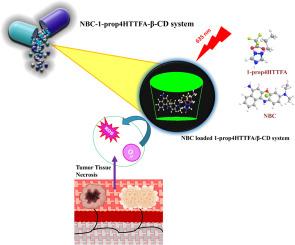
三唑基离子液体对β -环糊精包封尼罗河蓝的协同作用:荧光光谱分析
光动力诊断(PDD)和光动力治疗(PDT)是目前最可行的无创肿瘤治疗方法。药物分子,光敏剂(PS)在这些模式中用于癌症组织的识别和治疗。它们具有疏水性和独特的荧光特性,这是它们的优势。目前的工作重点是利用新合成的1,2,4-三唑基质子离子液体(IL), 1-丙基-1,2,4-三唑三氟乙酸酯(1- prop4httfa),将其与众所周知的药物递送介质β-环糊精(β-CD)结合,用于PS的递送。本文使用具有荧光特性的PS模型分子尼罗蓝氯(NBC)来了解三唑基IL与β-CD之间的关系。利用MTS法对新合成的三唑基IL进行细胞毒性研究,从而确定1-prop4HTTFA适用于生物培养基的浓度范围。利用紫外可见光谱和荧光光谱对NBC/1-prop4HTTFA/β-CD体系进行了评价。结果揭示了非均相的超分子相互作用,1-prop4HTTFA修饰了疏水β-CD核心内的纳米环境。这种异质性促进了NBC的增强包裹,这可能导致细胞渗透的改善,生物利用度的提高,以及靶向药物递送应用的更大潜力。
本文章由计算机程序翻译,如有差异,请以英文原文为准。
求助全文
约1分钟内获得全文
求助全文
来源期刊
Chemical Physics Impact
Materials Science-Materials Science (miscellaneous)
CiteScore
2.60
自引率
0.00%
发文量
65
审稿时长
46 days
 求助内容:
求助内容: 应助结果提醒方式:

 京公网安备 11010802042870号


