
Does earthworm stocking density act as an ecological lever to modulate microbial communities, phospho-lipid fatty acid signatures, and mineralization-humification dynamics?

Q1 Environmental Science
Bioresource Technology Reports Pub Date : 2026-02-01 Epub Date: 2026-01-09 DOI:10.1016/j.biteb.2026.102545
Inrikynti Mary Kharmawphlang , Anuska Saha , Grace Beirapawngia , Saibal Ghosh , Deepom Deori , Nazneen Hussain
{"title":"Does earthworm stocking density act as an ecological lever to modulate microbial communities, phospho-lipid fatty acid signatures, and mineralization-humification dynamics?","authors":"Inrikynti Mary Kharmawphlang ,&nbsp;Anuska Saha ,&nbsp;Grace Beirapawngia ,&nbsp;Saibal Ghosh ,&nbsp;Deepom Deori ,&nbsp;Nazneen Hussain","doi":"10.1016/j.biteb.2026.102545","DOIUrl":null,"url":null,"abstract":"<div><div>Stocking density emerged as the key ecological lever governing how <em>Eisenia fetida</em> and <em>Eudrilus eugeniae</em> transformed municipal solid waste. At lower density (7 worms kg<sup>−1</sup>), <em>E. fetida</em> achieved maximal carbon stabilization, N mineralization, P and K solubilization through strong humification and a bacteria-dominant microbiome, whereas overcrowding suppressed its efficiency. <em>E. eugeniae</em> performed optimally at moderate densities (10–15 worms kg<sup>−1</sup>); rapidly depleting labile carbon, increasing humic acids, and sustaining diverse aerobic microbial consortia. Detoxification pathways diverged such that <em>E. fetida</em> primarily immobilized metals via chelation and humic binding, while <em>E. eugeniae</em> stimulated microbial redox transformations that substantially reduced toxic heavy metals. PLFA profiles reinforced species-specific patterns, showing bacterial enrichment under <em>E. fetida</em> and higher fungal-actinomycete abundance under <em>E. eugeniae</em>. Integrating ANN and Sobol sensitivity analysis identified T2 (<em>E. fetida</em>, 7 worms kg<sup>−1</sup>) and T6 (<em>E. eugeniae</em>, 10 worms kg<sup>−1</sup>) as optimal regimes, providing robust predictive validation for vermicomposting optimization.</div></div>","PeriodicalId":8947,"journal":{"name":"Bioresource Technology Reports","volume":"33 ","pages":"Article 102545"},"PeriodicalIF":0.0000,"publicationDate":"2026-02-01","publicationTypes":"Journal Article","fieldsOfStudy":null,"isOpenAccess":false,"openAccessPdf":"","citationCount":"0","resultStr":null,"platform":"Semanticscholar","paperid":null,"PeriodicalName":"Bioresource Technology Reports","FirstCategoryId":"1085","ListUrlMain":"https://www.sciencedirect.com/science/article/pii/S2589014X26000034","RegionNum":0,"RegionCategory":null,"ArticlePicture":[],"TitleCN":null,"AbstractTextCN":null,"PMCID":null,"EPubDate":"2026/1/9 0:00:00","PubModel":"Epub","JCR":"Q1","JCRName":"Environmental Science","Score":null,"Total":0}
引用次数: 0

Abstract

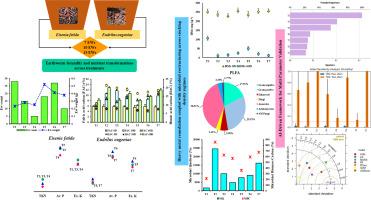
Stocking density emerged as the key ecological lever governing how Eisenia fetida and Eudrilus eugeniae transformed municipal solid waste. At lower density (7 worms kg−1), E. fetida achieved maximal carbon stabilization, N mineralization, P and K solubilization through strong humification and a bacteria-dominant microbiome, whereas overcrowding suppressed its efficiency. E. eugeniae performed optimally at moderate densities (10–15 worms kg−1); rapidly depleting labile carbon, increasing humic acids, and sustaining diverse aerobic microbial consortia. Detoxification pathways diverged such that E. fetida primarily immobilized metals via chelation and humic binding, while E. eugeniae stimulated microbial redox transformations that substantially reduced toxic heavy metals. PLFA profiles reinforced species-specific patterns, showing bacterial enrichment under E. fetida and higher fungal-actinomycete abundance under E. eugeniae. Integrating ANN and Sobol sensitivity analysis identified T2 (E. fetida, 7 worms kg−1) and T6 (E. eugeniae, 10 worms kg−1) as optimal regimes, providing robust predictive validation for vermicomposting optimization.
Abstract Image

蚯蚓放养密度是否作为调节微生物群落、磷脂脂肪酸特征和矿化-腐殖化动力学的生态杠杆?
放养密度成为控制臭Eisenia fetida和euudrilus eugenae转化城市固体废物的关键生态杠杆。在较低密度(7只虫kg−1)下,臭田蚕通过强腐殖化作用和细菌优势的微生物群实现了最大的碳稳定、氮矿化、磷和钾的增溶,而过度密集则抑制了其效率。在中等密度(10-15只虫kg - 1)下繁殖最佳;迅速消耗不稳定碳,增加腐殖酸,维持多样化的需氧微生物群落。解毒途径不同,恶臭杆菌主要通过螯合和腐殖质结合来固定金属,而原生芽孢杆菌则刺激微生物氧化还原转化,从而大大减少有毒重金属。PLFA图谱强化了物种特异性模式,显示fetida下细菌富集,eugenae下真菌-放线菌丰度更高。结合人工神经网络和Sobol敏感性分析,确定T2 (E. fetida, 7只蠕虫kg−1)和T6 (E. eugenae, 10只蠕虫kg−1)为最优方案,为蠕虫堆肥优化提供了稳健的预测验证。
本文章由计算机程序翻译,如有差异,请以英文原文为准。
求助全文
约1分钟内获得全文 求助全文
来源期刊
Bioresource Technology Reports
Bioresource Technology Reports Environmental Science-Environmental Engineering
CiteScore
7.20
自引率
0.00%
发文量
390
审稿时长
28 days

×
引用
GB/T 7714-2015
复制
MLA
复制
APA
复制
导出至
BibTeX EndNote RefMan NoteFirst NoteExpress
×
提示
您的信息不完整,为了账户安全,请先补充。
现在去补充
×
提示
您因"违规操作"
具体请查看互助需知
我知道了
×
提示
确定
请完成安全验证×
copy
已复制链接
快去分享给好友吧!
我知道了
右上角分享
点击右上角分享
0
联系我们:info@booksci.cn Book学术提供免费学术资源搜索服务,方便国内外学者检索中英文文献。致力于提供最便捷和优质的服务体验。 Copyright © 2023 布克学术 All rights reserved.
京ICP备2023020795号-1
ghs 京公网安备 11010802042870号
Book学术文献互助
Book学术文献互助群
群 号:604180095
Book学术官方微信
小红书


