
Exploring the protective mechanism of exogenous melatonin on intestine of heat-stressed chicks based on network pharmacology and intestinal microbiota analysis
IF 2.9
2区 生物学
Q2 BIOLOGY
Journal of thermal biology
Pub Date : 2026-02-01
Epub Date: 2026-01-10
DOI:10.1016/j.jtherbio.2026.104371
引用次数: 0
Abstract
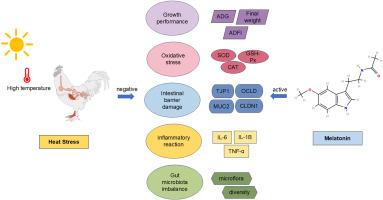
Heat stress constitutes a severe risk to the health of poultry, not only damaging intestinal health, but also reducing antioxidant defenses and weakening the immune response. Exogenous melatonin can enhance the antioxidant capacity of heat-stressed chicks through the cecal microbiota, and reduce the inflammatory response and intestinal barrier damage. 21-day-old Hy-Line brown chicks were divided into control group, heat stress group, and three groups receiving different doses of melatonin (0.5, 1.0, 2.0 mg/kg). Except for the control group (22 ± 2 °C from 00:00 to 24:00 daily), all other groups were exposed to a high-temperature environment (34 ± 2 °C, from 08:00 to 18:00 daily) for 21 consecutive days. The results showed that heat stress significantly decreased final body weight of chicks, increased serum MDA, IL-1β, IL-6, TNF-α, D-LA and DAO levels, decreased GSH-Px, CAT and SOD activities, and decreased jejunal and ileal villus height/crypt depth (VH/CD), cecal Firmicutes/Bacteroidetes (F/B) ratio and Lactobacillus abundance. Exogenous melatonin reversed these changes, and 1.0 mg/kg was the most effective. It included the recovery of antioxidant enzyme activity, the decrease of serum inflammatory factors, D-LA and DAO, the up-regulation of VH/CD and tight junction genes (CLDN1, OCLN, TJP1, MUC2) in jejunum and ileum, the increase of cecal F/B ratio and the enrichment of Lactobacillus. Network pharmacology and molecular docking identified the core targets of anti-oxidation and anti-inflammation. Melatonin reduced heat stress-induced intestinal injury by reducing inflammation and oxidative stress.
基于网络药理学和肠道菌群分析探讨外源性褪黑素对热应激雏鸡肠道的保护机制。
热应激对家禽健康构成严重威胁,不仅会损害肠道健康,还会降低抗氧化防御能力,削弱免疫反应。外源性褪黑素可以通过盲肠菌群增强热应激雏鸡的抗氧化能力,减少炎症反应和肠道屏障损伤。21日龄海兰褐鸡分为对照组、热应激组和3组,分别饲喂0.5、1.0、2.0 mg/kg褪黑素。除对照组(22±2°C,每天00:00 - 24:00)外,其余各组连续21天暴露于高温环境(34±2°C,每天08:00 - 18:00)。结果表明,热应激显著降低了雏鸡的最终体重,提高了血清MDA、IL-1β、IL-6、TNF-α、D-LA和DAO水平,降低了GSH-Px、CAT和SOD活性,降低了空肠和回肠绒毛高度/隐窝深度(VH/CD)、盲肠厚壁菌门/拟杆菌门(F/B)比和乳酸菌数量。外源性褪黑素逆转了这些变化,其中1.0 mg/kg最有效。包括抗氧化酶活性恢复,血清炎症因子、D-LA和DAO降低,空肠和回肠VH/CD和紧密连接基因(CLDN1、OCLN、TJP1、MUC2)上调,盲肠F/B比升高,乳酸菌富集。网络药理学与分子对接,确定了抗氧化、抗炎的核心靶点。褪黑素通过减少炎症和氧化应激来减少热应激引起的肠道损伤。
本文章由计算机程序翻译,如有差异,请以英文原文为准。
求助全文
约1分钟内获得全文
求助全文
来源期刊
Journal of thermal biology
生物-动物学
CiteScore
5.30
自引率
7.40%
发文量
196
审稿时长
14.5 weeks
期刊介绍:
The Journal of Thermal Biology publishes articles that advance our knowledge on the ways and mechanisms through which temperature affects man and animals. This includes studies of their responses to these effects and on the ecological consequences. Directly relevant to this theme are:
• The mechanisms of thermal limitation, heat and cold injury, and the resistance of organisms to extremes of temperature
• The mechanisms involved in acclimation, acclimatization and evolutionary adaptation to temperature
• Mechanisms underlying the patterns of hibernation, torpor, dormancy, aestivation and diapause
• Effects of temperature on reproduction and development, growth, ageing and life-span
• Studies on modelling heat transfer between organisms and their environment
• The contributions of temperature to effects of climate change on animal species and man
• Studies of conservation biology and physiology related to temperature
• Behavioural and physiological regulation of body temperature including its pathophysiology and fever
• Medical applications of hypo- and hyperthermia
Article types:
• Original articles
• Review articles
 求助内容:
求助内容: 应助结果提醒方式:

 京公网安备 11010802042870号


