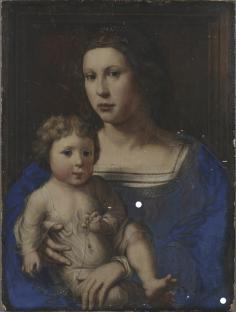
{"title":"On the Prototype of Jan Gossaert’s Painting Madonna and Child from the Collection of the State Hermitage Museum","authors":"K. B. Kalinina, N. L. Zykov, V. Yu. Brovkin","doi":"10.1134/S2635167625601202","DOIUrl":null,"url":null,"abstract":"<p>Chemical and technical studies are performed on the painting materials used for Madonna and Child, which is part of the collection of 15th–16th-century Netherlandish painting of the State Hermitage Museum. The first precise documentary records of this work date back to the Hermitage inventory of 1859, where it is mentioned as a painting of the Dutch school kept in Winter Palace at that time. Later the picture was moved to Gatchina palace, from where it was transferred back to the Hermitage after the revolution. The work was considered a copy reproducing the lost original by Jan Gossaert. The materials used in its painting and the artistic techniques involved are examined. Polarization microscopy and energy-dispersive X-ray microanalysis are employed to investigate the stratigraphy and pigment composition of the paint layers. The composition of the binder is determined by means of microchemical staining tests and pyrolysis-gas chromatography mass spectrometry. The results indicate that chalk was used as a primer with an animal glue binder. It is shown that the artist achieved the differences in shades between the blue areas by applying blue ultramarine over intermediate layers of different colors. For the lilac-blue of the Madonna’s dress, pink was used as the intermediate layer, with one of its components being a red organic pigment. The deep blue color of the Madonna’s dress was the result of applying ultramarine over a black paint layer containing carbon. Linseed oil was used as a binder for the paint layers. As a result of dendrochronological dating of the panel on which the work was executed (1494) and a comparison of various versions based on the results of conservation as well as chemical and technical studies, the hypothesis is advanced that this painting was made by Jan Gossaert himself. The material presented is highly relevant and should become the subject of scholarly discussion.</p>","PeriodicalId":716,"journal":{"name":"Nanotechnologies in Russia","volume":"20 5","pages":"639 - 646"},"PeriodicalIF":0.8000,"publicationDate":"2026-01-15","publicationTypes":"Journal Article","fieldsOfStudy":null,"isOpenAccess":false,"openAccessPdf":"","citationCount":"0","resultStr":null,"platform":"Semanticscholar","paperid":null,"PeriodicalName":"Nanotechnologies in Russia","FirstCategoryId":"1085","ListUrlMain":"https://link.springer.com/article/10.1134/S2635167625601202","RegionNum":0,"RegionCategory":null,"ArticlePicture":[],"TitleCN":null,"AbstractTextCN":null,"PMCID":null,"EPubDate":"","PubModel":"","JCR":"Q3","JCRName":"Engineering","Score":null,"Total":0}
引用次数: 0
Abstract
Chemical and technical studies are performed on the painting materials used for Madonna and Child, which is part of the collection of 15th–16th-century Netherlandish painting of the State Hermitage Museum. The first precise documentary records of this work date back to the Hermitage inventory of 1859, where it is mentioned as a painting of the Dutch school kept in Winter Palace at that time. Later the picture was moved to Gatchina palace, from where it was transferred back to the Hermitage after the revolution. The work was considered a copy reproducing the lost original by Jan Gossaert. The materials used in its painting and the artistic techniques involved are examined. Polarization microscopy and energy-dispersive X-ray microanalysis are employed to investigate the stratigraphy and pigment composition of the paint layers. The composition of the binder is determined by means of microchemical staining tests and pyrolysis-gas chromatography mass spectrometry. The results indicate that chalk was used as a primer with an animal glue binder. It is shown that the artist achieved the differences in shades between the blue areas by applying blue ultramarine over intermediate layers of different colors. For the lilac-blue of the Madonna’s dress, pink was used as the intermediate layer, with one of its components being a red organic pigment. The deep blue color of the Madonna’s dress was the result of applying ultramarine over a black paint layer containing carbon. Linseed oil was used as a binder for the paint layers. As a result of dendrochronological dating of the panel on which the work was executed (1494) and a comparison of various versions based on the results of conservation as well as chemical and technical studies, the hypothesis is advanced that this painting was made by Jan Gossaert himself. The material presented is highly relevant and should become the subject of scholarly discussion.
期刊介绍:
Nanobiotechnology Reports publishes interdisciplinary research articles on fundamental aspects of the structure and properties of nanoscale objects and nanomaterials, polymeric and bioorganic molecules, and supramolecular and biohybrid complexes, as well as articles that discuss technologies for their preparation and processing, and practical implementation of products, devices, and nature-like systems based on them. The journal publishes original articles and reviews that meet the highest scientific quality standards in the following areas of science and technology studies: self-organizing structures and nanoassemblies; nanostructures, including nanotubes; functional and structural nanomaterials; polymeric, bioorganic, and hybrid nanomaterials; devices and products based on nanomaterials and nanotechnology; nanobiology and genetics, and omics technologies; nanobiomedicine and nanopharmaceutics; nanoelectronics and neuromorphic computing systems; neurocognitive systems and technologies; nanophotonics; natural science methods in a study of cultural heritage items; metrology, standardization, and monitoring in nanotechnology.

 求助内容:
求助内容: 应助结果提醒方式:

 京公网安备 11010802042870号


