N. I. Shishlina, I. A. Blinov, A. V. Mandrykina, A. Yu. Loboda, E. Yu. Tereschenko, E. B. Yatsishina
{"title":"The Textile Collection of the State Historical Museum: Textile Fiber Identification by Scanning Electron Microscopy","authors":"N. I. Shishlina, I. A. Blinov, A. V. Mandrykina, A. Yu. Loboda, E. Yu. Tereschenko, E. B. Yatsishina","doi":"10.1134/S2635167625601111","DOIUrl":null,"url":null,"abstract":"<p>Textiles are an extremely rare find because organic matter is poorly preserved in the cultural layers of archaeological sites. Fragments of textile accessories, clothing parts, and cords are often extremely small, degraded, and mineralized due to prolonged exposure to soil. These factors make the analysis of fiber identification, determination of fiber type (plant versus animal) and technological characteristics of threads and fabric more difficult. Traditional methods used in the analysis of fibers and threads include optical (light) microscopy and macro photography; however, these methods are not always sufficient to analyze samples thoroughly. This study is devoted to the identification of the type of textile fibers from archaeological textile fragments using scanning electron microscopy (SEM). Its first results will be used in further textile analysis. Determining the type of textile fibers is also important in the context of discussions of the issues relating to resource areas and trajectories of trade routes in ancient and medieval times.</p>","PeriodicalId":716,"journal":{"name":"Nanotechnologies in Russia","volume":"20 5","pages":"604 - 611"},"PeriodicalIF":0.8000,"publicationDate":"2026-01-15","publicationTypes":"Journal Article","fieldsOfStudy":null,"isOpenAccess":false,"openAccessPdf":"","citationCount":"0","resultStr":null,"platform":"Semanticscholar","paperid":null,"PeriodicalName":"Nanotechnologies in Russia","FirstCategoryId":"1085","ListUrlMain":"https://link.springer.com/article/10.1134/S2635167625601111","RegionNum":0,"RegionCategory":null,"ArticlePicture":[],"TitleCN":null,"AbstractTextCN":null,"PMCID":null,"EPubDate":"","PubModel":"","JCR":"Q3","JCRName":"Engineering","Score":null,"Total":0}
引用次数: 0
Abstract
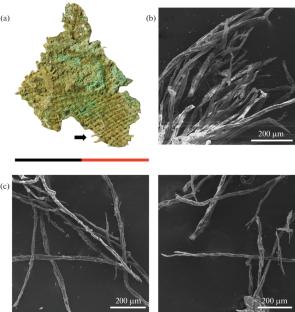
Textiles are an extremely rare find because organic matter is poorly preserved in the cultural layers of archaeological sites. Fragments of textile accessories, clothing parts, and cords are often extremely small, degraded, and mineralized due to prolonged exposure to soil. These factors make the analysis of fiber identification, determination of fiber type (plant versus animal) and technological characteristics of threads and fabric more difficult. Traditional methods used in the analysis of fibers and threads include optical (light) microscopy and macro photography; however, these methods are not always sufficient to analyze samples thoroughly. This study is devoted to the identification of the type of textile fibers from archaeological textile fragments using scanning electron microscopy (SEM). Its first results will be used in further textile analysis. Determining the type of textile fibers is also important in the context of discussions of the issues relating to resource areas and trajectories of trade routes in ancient and medieval times.
期刊介绍:
Nanobiotechnology Reports publishes interdisciplinary research articles on fundamental aspects of the structure and properties of nanoscale objects and nanomaterials, polymeric and bioorganic molecules, and supramolecular and biohybrid complexes, as well as articles that discuss technologies for their preparation and processing, and practical implementation of products, devices, and nature-like systems based on them. The journal publishes original articles and reviews that meet the highest scientific quality standards in the following areas of science and technology studies: self-organizing structures and nanoassemblies; nanostructures, including nanotubes; functional and structural nanomaterials; polymeric, bioorganic, and hybrid nanomaterials; devices and products based on nanomaterials and nanotechnology; nanobiology and genetics, and omics technologies; nanobiomedicine and nanopharmaceutics; nanoelectronics and neuromorphic computing systems; neurocognitive systems and technologies; nanophotonics; natural science methods in a study of cultural heritage items; metrology, standardization, and monitoring in nanotechnology.

 求助内容:
求助内容: 应助结果提醒方式:

 京公网安备 11010802042870号


