
Composition of the Alloy of Civilian Belt Sets of the Roman Period and the Era of the Great Migration of Peoples from Eastern Crimea
IF 0.8
Q3 Engineering
引用次数: 0
Abstract
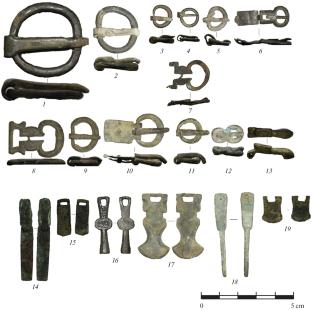
This work analyzes the elemental composition of the buckles and belt end pieces discovered in eastern Crimea by metal-detectorists and submitted for study to academic research institutions. As part of the study, the alloy composition of 13 specimens of buckles and their fragments, as well as 5 specimens of belt end pieces, is studied in detail. These items date back to the second half of the 1st century to the beginning of the 5th century. Most of the items were in use in the second half of the 2nd century and the first half of the 3rd century. The study reveals that the majority of the items are made of zinc-containing alloys, including pure brass and multicomponent alloys.
罗马时期与东克里米亚民族大迁徙时期平民带套合金的组成
这项工作分析了金属探测器在克里米亚东部发现的扣环和皮带末端件的元素组成,并提交给学术研究机构进行研究。作为研究的一部分,对13个扣片及其碎片试样和5个皮带端片试样的合金成分进行了详细的研究。这些物品可以追溯到一世纪下半叶到五世纪初。大部分物品都是在2世纪下半叶和3世纪上半叶使用的。研究表明,大多数物品是由含锌合金制成的,包括纯黄铜和多组分合金。
本文章由计算机程序翻译,如有差异,请以英文原文为准。
求助全文
约1分钟内获得全文
求助全文
来源期刊
Nanotechnologies in Russia
NANOSCIENCE & NANOTECHNOLOGY-
CiteScore
1.20
自引率
0.00%
发文量
0
期刊介绍:
Nanobiotechnology Reports publishes interdisciplinary research articles on fundamental aspects of the structure and properties of nanoscale objects and nanomaterials, polymeric and bioorganic molecules, and supramolecular and biohybrid complexes, as well as articles that discuss technologies for their preparation and processing, and practical implementation of products, devices, and nature-like systems based on them. The journal publishes original articles and reviews that meet the highest scientific quality standards in the following areas of science and technology studies: self-organizing structures and nanoassemblies; nanostructures, including nanotubes; functional and structural nanomaterials; polymeric, bioorganic, and hybrid nanomaterials; devices and products based on nanomaterials and nanotechnology; nanobiology and genetics, and omics technologies; nanobiomedicine and nanopharmaceutics; nanoelectronics and neuromorphic computing systems; neurocognitive systems and technologies; nanophotonics; natural science methods in a study of cultural heritage items; metrology, standardization, and monitoring in nanotechnology.
 求助内容:
求助内容: 应助结果提醒方式:

 京公网安备 11010802042870号


