
Small-molecule modulators of the androgen receptor N-terminal domain: Advances in medicinal chemistry for prostate cancer
IF 6.7
2区 医学
Q1 CHEMISTRY, MEDICINAL
European Journal of Medicinal Chemistry
Pub Date : 2026-03-05
Epub Date: 2026-01-13
DOI:10.1016/j.ejmech.2026.118580
引用次数: 0
Abstract
Resistance to androgen receptor (AR) therapies in prostate cancer frequently arises from ligand-binding domain (LBD) mutations or the expression of LBD-truncated splice variants such as AR-V7. As these variants retain a functional N-terminal domain (NTD) essential for transcriptional activity, the intrinsically disordered NTD has become an attractive therapeutic target. This review integrates recent advances in targeting the AR NTD, emphasizing both classical antagonists and emerging mechanistic strategies. The pioneering EPI compounds established proof of concept for small-molecule inhibition of the AR NTD, with two analogues progressing to clinical trials. Subsequent discovery efforts have yielded structurally diverse NTD antagonists from natural products and synthetic libraries. Mechanism-focused approaches have garnered increasing interest; small molecules such as UT-143 and ET-516 disrupt AR-driven condensates formed via liquid-liquid phase separation, impairing oncogenic transcription. To complement these approaches, other innovative modalities are also being developed, including bispecific antibodies delivering intracellular anti-NTD fragments, NTD-targeting degraders (e.g., PROTACs), and urea-based antagonists selective for AR splice variants. Disrupting critical protein-protein interactions, such as those between the AR NTD and coactivators, offers an additional strategy to suppress AR activity. Advances in screening platforms and the optimization of structure-activity relationships are beginning to address the challenges of targeting disordered protein domains. With agents like EPI-7386 entering clinical evaluation and others advancing through preclinical development, AR NTD-targeted therapies represent a promising avenue to overcome resistance in castration-resistant prostate cancer (CRPC), potentially in combination with existing LBD-directed treatments to achieve more durable disease control.
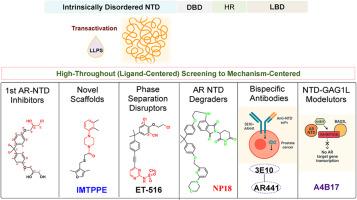
雄激素受体n端结构域的小分子调节剂:前列腺癌药物化学研究进展
前列腺癌对雄激素受体(AR)治疗的耐药性通常是由配体结合结构域(LBD)突变或LBD截断剪接变体(如AR- v7)的表达引起的。由于这些变异保留了对转录活性至关重要的功能性n端结构域(NTD),因此内在紊乱的NTD已成为一个有吸引力的治疗靶点。本文综述了针对AR NTD的最新进展,强调了经典拮抗剂和新兴的机制策略。开创性的EPI化合物建立了小分子抑制AR NTD的概念证明,其中两种类似物正在进行临床试验。随后的发现工作已经从天然产物和合成文库中获得了结构多样的NTD拮抗剂。以机制为重点的方法引起了越来越多的兴趣;UT-143和ET-516等小分子破坏液-液相分离形成的ar驱动凝聚物,损害致癌转录。为了补充这些方法,其他创新模式也在开发中,包括递送细胞内抗ntd片段的双特异性抗体、靶向ntd的降解物(如PROTACs)和选择性AR剪接变体的尿素拮抗剂。破坏关键的蛋白质-蛋白质相互作用,如AR NTD和共激活因子之间的相互作用,提供了抑制AR活性的另一种策略。筛选平台的进步和结构-活性关系的优化开始解决靶向无序蛋白质结构域的挑战。随着EPI-7386等药物进入临床评估和其他药物的临床前开发,AR - ntd靶向治疗代表了克服去势抵抗性前列腺癌(CRPC)耐药的有希望的途径,可能与现有的lbd靶向治疗相结合,以实现更持久的疾病控制。
本文章由计算机程序翻译,如有差异,请以英文原文为准。
求助全文
约1分钟内获得全文
求助全文
来源期刊
CiteScore
11.70
自引率
9.00%
发文量
863
审稿时长
29 days
期刊介绍:
The European Journal of Medicinal Chemistry is a global journal that publishes studies on all aspects of medicinal chemistry. It provides a medium for publication of original papers and also welcomes critical review papers.
A typical paper would report on the organic synthesis, characterization and pharmacological evaluation of compounds. Other topics of interest are drug design, QSAR, molecular modeling, drug-receptor interactions, molecular aspects of drug metabolism, prodrug synthesis and drug targeting. The journal expects manuscripts to present the rational for a study, provide insight into the design of compounds or understanding of mechanism, or clarify the targets.
 求助内容:
求助内容: 应助结果提醒方式:

 京公网安备 11010802042870号


