Yuhan Bi, Shitao Sun, Wendi Zhang, Zhinan Zhang, Hongguang Li
{"title":"A non-drift friction model considering non-uniform bristles of the contact surface and experimental verification","authors":"Yuhan Bi, Shitao Sun, Wendi Zhang, Zhinan Zhang, Hongguang Li","doi":"10.26599/frict.2025.9441200","DOIUrl":null,"url":null,"abstract":"<p>Friction, as a nonlinear and complex phenomenon, significantly affects the performance of mechanical systems requiring high-precision motion control and force feedback. Accurate modeling of frictional behavior is essential for effective control and compensation. The LuGre friction model is widely used due to its computational efficiency; however, it retains only the first-order displacement term, resulting in limited accuracy and noticeable drift, which restricts its use in precision applications. To address these issues, this study proposes an improved friction model based on the LuGre framework. Discrete bristles are introduced to incorporate the influence of surface topography at the contact interface. Additionally, an iterative numerical scheme is employed to enhance computational accuracy. Simulation results demonstrate that the model captures key frictional phenomena, including stick-slip transitions, hysteresis, and friction lag. It also shows clear advantages over the LuGre model in representing non-local memory and non-drift characteristics. Experimental validation was conducted using a constant-velocity reciprocating test and a micro-amplitude sinusoidal excitation test, enabling stepwise parameter identification for slipping and sticking phases. A dual-frequency sinusoidal excitation test was further designed to evaluate model performance under complex dynamic loading. The simulated friction forces agree well with experimental measurements, verifying the model’s effectiveness and robustness. The proposed model enhances both accuracy and physical realism in friction modeling and can be applied in high-precision systems to solve the friction force output under the given input conditions.</p>","PeriodicalId":12442,"journal":{"name":"Friction","volume":"15 1","pages":""},"PeriodicalIF":8.1000,"publicationDate":"2026-01-14","publicationTypes":"Journal Article","fieldsOfStudy":null,"isOpenAccess":false,"openAccessPdf":"","citationCount":"0","resultStr":null,"platform":"Semanticscholar","paperid":null,"PeriodicalName":"Friction","FirstCategoryId":"5","ListUrlMain":"https://doi.org/10.26599/frict.2025.9441200","RegionNum":1,"RegionCategory":"工程技术","ArticlePicture":[],"TitleCN":null,"AbstractTextCN":null,"PMCID":null,"EPubDate":"","PubModel":"","JCR":"Q1","JCRName":"ENGINEERING, MECHANICAL","Score":null,"Total":0}
引用次数: 0
Abstract
Friction, as a nonlinear and complex phenomenon, significantly affects the performance of mechanical systems requiring high-precision motion control and force feedback. Accurate modeling of frictional behavior is essential for effective control and compensation. The LuGre friction model is widely used due to its computational efficiency; however, it retains only the first-order displacement term, resulting in limited accuracy and noticeable drift, which restricts its use in precision applications. To address these issues, this study proposes an improved friction model based on the LuGre framework. Discrete bristles are introduced to incorporate the influence of surface topography at the contact interface. Additionally, an iterative numerical scheme is employed to enhance computational accuracy. Simulation results demonstrate that the model captures key frictional phenomena, including stick-slip transitions, hysteresis, and friction lag. It also shows clear advantages over the LuGre model in representing non-local memory and non-drift characteristics. Experimental validation was conducted using a constant-velocity reciprocating test and a micro-amplitude sinusoidal excitation test, enabling stepwise parameter identification for slipping and sticking phases. A dual-frequency sinusoidal excitation test was further designed to evaluate model performance under complex dynamic loading. The simulated friction forces agree well with experimental measurements, verifying the model’s effectiveness and robustness. The proposed model enhances both accuracy and physical realism in friction modeling and can be applied in high-precision systems to solve the friction force output under the given input conditions.
期刊介绍:
Friction is a peer-reviewed international journal for the publication of theoretical and experimental research works related to the friction, lubrication and wear. Original, high quality research papers and review articles on all aspects of tribology are welcome, including, but are not limited to, a variety of topics, such as:
Friction: Origin of friction, Friction theories, New phenomena of friction, Nano-friction, Ultra-low friction, Molecular friction, Ultra-high friction, Friction at high speed, Friction at high temperature or low temperature, Friction at solid/liquid interfaces, Bio-friction, Adhesion, etc.
Lubrication: Superlubricity, Green lubricants, Nano-lubrication, Boundary lubrication, Thin film lubrication, Elastohydrodynamic lubrication, Mixed lubrication, New lubricants, New additives, Gas lubrication, Solid lubrication, etc.
Wear: Wear materials, Wear mechanism, Wear models, Wear in severe conditions, Wear measurement, Wear monitoring, etc.
Surface Engineering: Surface texturing, Molecular films, Surface coatings, Surface modification, Bionic surfaces, etc.
Basic Sciences: Tribology system, Principles of tribology, Thermodynamics of tribo-systems, Micro-fluidics, Thermal stability of tribo-systems, etc.
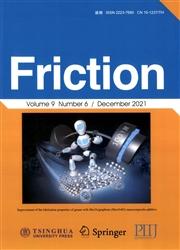
Friction is an open access journal. It is published quarterly by Tsinghua University Press and Springer, and sponsored by the State Key Laboratory of Tribology (TsinghuaUniversity) and the Tribology Institute of Chinese Mechanical Engineering Society.

 求助内容:
 应助结果提醒方式:


 京公网安备 11010802042870号


