{"title":"<i>Chrysanthemum zawadskii</i> Flower Extract Rescues Inflammatory Cognitive Impairment.","authors":"Yeongwoo Choi, Jisun Hwang, Bohee Jang, Jiwon Park, Inn-Oc Han, Eok-Soo Oh","doi":"10.5607/en25035","DOIUrl":null,"url":null,"abstract":"<p><p><i>Chrysanthemum zawadskii</i> flower ethanol extract (CZ-F) was evaluated for its neuroprotective potential against inflammation-associated cognitive impairment. To assess its anti-inflammatory properties, we first conducted <i>in vitro</i> studies using LPS-stimulated BV2 microglial cells. CZ-F demonstrated strong antioxidant activity with IC<sub>50</sub> values of 186.04 μg/ml (DPPH) and 94.56 μg/ml (ABTS), suppressed the production of reactive oxygen species and nitric oxide, and downregulated the expression of iNOS and IL-1β, likely via inhibiting the NF-κB signaling pathway. CZ-F also decreased inflammation-induced acetylcholinesterase (AChE) expression and directly inhibited AChE activity. Among the constituents of CZ-F, quercetin and luteolin exhibited the strongest anti-inflammatory and antioxidant effects, while linarin most potently inhibited AChE activity. In an <i>in vivo</i> zebrafish model, CZ-F treatment ameliorated learning and memory impairments induced by sleep deprivation. These findings suggest that CZ-F can attenuate neuroinflammation and modulate cholinergic dysfunction, providing a potential therapeutic approach for inflammation-related cognitive deficits.</p>","PeriodicalId":12263,"journal":{"name":"Experimental Neurobiology","volume":" ","pages":"29-41"},"PeriodicalIF":2.1000,"publicationDate":"2026-02-28","publicationTypes":"Journal Article","fieldsOfStudy":null,"isOpenAccess":false,"openAccessPdf":"https://www.ncbi.nlm.nih.gov/pmc/articles/PMC12977228/pdf/","citationCount":"0","resultStr":null,"platform":"Semanticscholar","paperid":null,"PeriodicalName":"Experimental Neurobiology","FirstCategoryId":"3","ListUrlMain":"https://doi.org/10.5607/en25035","RegionNum":4,"RegionCategory":"医学","ArticlePicture":[],"TitleCN":null,"AbstractTextCN":null,"PMCID":null,"EPubDate":"2026/1/13 0:00:00","PubModel":"Epub","JCR":"Q3","JCRName":"MEDICINE, RESEARCH & EXPERIMENTAL","Score":null,"Total":0}
引用次数: 0
Abstract
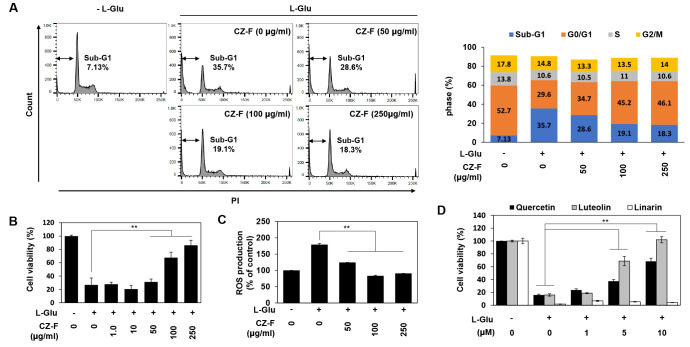
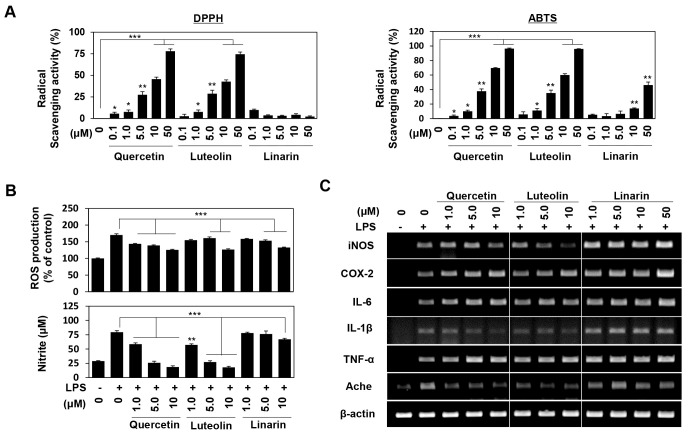
Chrysanthemum zawadskii flower ethanol extract (CZ-F) was evaluated for its neuroprotective potential against inflammation-associated cognitive impairment. To assess its anti-inflammatory properties, we first conducted in vitro studies using LPS-stimulated BV2 microglial cells. CZ-F demonstrated strong antioxidant activity with IC50 values of 186.04 μg/ml (DPPH) and 94.56 μg/ml (ABTS), suppressed the production of reactive oxygen species and nitric oxide, and downregulated the expression of iNOS and IL-1β, likely via inhibiting the NF-κB signaling pathway. CZ-F also decreased inflammation-induced acetylcholinesterase (AChE) expression and directly inhibited AChE activity. Among the constituents of CZ-F, quercetin and luteolin exhibited the strongest anti-inflammatory and antioxidant effects, while linarin most potently inhibited AChE activity. In an in vivo zebrafish model, CZ-F treatment ameliorated learning and memory impairments induced by sleep deprivation. These findings suggest that CZ-F can attenuate neuroinflammation and modulate cholinergic dysfunction, providing a potential therapeutic approach for inflammation-related cognitive deficits.
期刊介绍:
Experimental Neurobiology is an international forum for interdisciplinary investigations of the nervous system. The journal aims to publish papers that present novel observations in all fields of neuroscience, encompassing cellular & molecular neuroscience, development/differentiation/plasticity, neurobiology of disease, systems/cognitive/behavioral neuroscience, drug development & industrial application, brain-machine interface, methodologies/tools, and clinical neuroscience. It should be of interest to a broad scientific audience working on the biochemical, molecular biological, cell biological, pharmacological, physiological, psychophysical, clinical, anatomical, cognitive, and biotechnological aspects of neuroscience. The journal publishes both original research articles and review articles. Experimental Neurobiology is an open access, peer-reviewed online journal. The journal is published jointly by The Korean Society for Brain and Neural Sciences & The Korean Society for Neurodegenerative Disease.


 求助内容:
求助内容: 应助结果提醒方式:

 京公网安备 11010802042870号


