
Correlation between serological tests and radiological imaging in the diagnosis of hydatid disease
IF 1.9
4区 医学
Q3 PARASITOLOGY
Parasitology International
Pub Date : 2026-08-01
Epub Date: 2026-01-12
DOI:10.1016/j.parint.2026.103231
引用次数: 0
Abstract
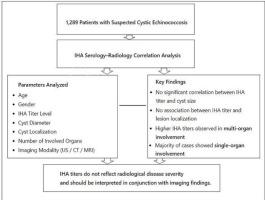
Hydatid disease (HD) is a zoonotic parasitic infection caused by the larval stage of Echinococcus granulosus. It remains a major public health issue in many countries, including Türkiye. Diagnosis relies on clinical findings, serological tests, and radiological methods. This study aimed to investigate the relationship between the indirect hemagglutination (IHA) test and radiological imaging in suspected HD cases. In this retrospective study, patients with suspected HD between July 2023 and June 2024 were included. Serum samples were tested using the IHA method, and ultrasonography (US), computed tomography (CT), or magnetic resonance imaging (MRI) was performed within 15 days for seropositive patients. The association between IHA titers and cyst size, localization, and the number of affected organs was analyzed. The study included 1289 cases, and seropositivity was detected in 147 (11.4%) of these cases. Seropositivity was higher in men (12.3%) than in women (10.7%). The majority of cases were in the 41–60 age group (43.5%). US was the most frequently used radiological imaging method, and the most common cyst location was the liver (91.95%). Although descriptive differences in cyst diameters were observed across different IHA titer levels, no statistically significant correlation was identified. These results indicate that IHA titers do not reliably reflect cyst size, disease extent, or radiological severity. Therefore, serological findings should not be interpreted as indicators of disease burden and must be evaluated strictly in conjunction with radiological imaging in the diagnosis, staging, and follow-up of hydatid disease.
血清学检查与影像学诊断包虫病的相关性研究
棘球绦虫病(HD)是一种由细粒棘球绦虫幼虫期引起的人畜共患寄生虫感染。它在许多国家仍然是一个重大的公共卫生问题,包括斯里兰卡。诊断依赖于临床表现、血清学检查和放射学方法。本研究旨在探讨间接血凝(IHA)检测与疑似HD患者影像学表现的关系。在这项回顾性研究中,纳入了2023年7月至2024年6月期间疑似HD的患者。采用IHA法检测血清样本,对血清阳性患者在15天内进行超声(US)、计算机断层扫描(CT)或磁共振成像(MRI)检查。分析了IHA滴度与囊肿大小、定位和受影响器官数量之间的关系。本研究共纳入1289例病例,其中血清阳性147例(11.4%)。男性血清阳性(12.3%)高于女性(10.7%)。以41 ~ 60岁年龄组居多(43.5%)。超声造影是最常用的影像学检查方法,最常见的囊肿部位为肝脏(91.95%)。虽然在不同的IHA滴度水平上观察到囊肿直径的描述性差异,但没有发现统计学上显著的相关性。这些结果表明IHA滴度不能可靠地反映囊肿大小、疾病程度或放射学严重程度。因此,血清学结果不应被解释为疾病负担的指标,必须在包虫病的诊断、分期和随访中与放射成像严格结合进行评估。
本文章由计算机程序翻译,如有差异,请以英文原文为准。
求助全文
约1分钟内获得全文
求助全文
来源期刊
Parasitology International
医学-寄生虫学
CiteScore
4.00
自引率
10.50%
发文量
140
审稿时长
61 days
期刊介绍:
Parasitology International provides a medium for rapid, carefully reviewed publications in the field of human and animal parasitology. Original papers, rapid communications, and original case reports from all geographical areas and covering all parasitological disciplines, including structure, immunology, cell biology, biochemistry, molecular biology, and systematics, may be submitted. Reviews on recent developments are invited regularly, but suggestions in this respect are welcome. Letters to the Editor commenting on any aspect of the Journal are also welcome.
 求助内容:
求助内容: 应助结果提醒方式:

 京公网安备 11010802042870号


