
Selective recovery of gold from electronic circuit board waste with pyrogallol-formaldehyde polymer based resin
IF 6.3
2区 材料科学
Q1 METALLURGY & METALLURGICAL ENGINEERING
引用次数: 0
Abstract
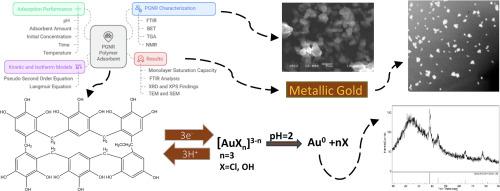
Electrical and electronic waste (e-waste) has become one of the major concerns due to its high content of valuable recyclable materials such as gold, platinum, and silver. In this study, a pyrogallol-formaldehyde-based polymer (PGNR) was synthesized and used as an adsorbent for the recovery of gold. The synthesized PGNR was characterized using BET, FTIR, TGA, and NMR analyses. The adsorption performance of PGNR was evaluated under varying conditions, including pH values, adsorbent amounts, initial Au(III) concentration, contact time, and temperature. Experimental data were analyzed through adsorption isotherms, kinetic, and thermodynamic models. The adsorption kinetics followed the pseudo-second order model, while the Langmuir isotherm best described the isotherm data. The Langmuir model revealed a maximum monolayer adsorption capacity of 2457 mg g−1 at 328 K for Au(III) ions. The FTIR analysis after adsorption indicated that polyphenolic functional groups played a crucial role in the binding of Au(III). Additionally, XRD and XPS analyses confirmed that the majority of Au(III) ions were reduced to metallic gold on the polymer surface. The resin demonstrated high efficiency in adsorbing Au(III) from real e-waste leach solutions containing high levels of base metals, making it a promising material for the selective recovery of gold from electronic waste.
邻苯二酚-甲醛聚合物基树脂选择性回收电子电路板废料中的金
电气和电子废物(电子废物)由于其高含量的有价值的可回收材料,如金、铂和银,已成为主要关注的问题之一。本研究合成了一种邻苯三酚甲醛基聚合物(PGNR),并将其作为吸附剂用于金的回收。采用BET、FTIR、TGA和NMR对合成的PGNR进行了表征。在不同的条件下,包括pH值、吸附剂量、初始Au(III)浓度、接触时间和温度,对PGNR的吸附性能进行了评价。通过吸附等温线、动力学和热力学模型对实验数据进行了分析。吸附动力学服从拟二级模型,Langmuir等温线最能描述等温线数据。Langmuir模型显示,在328 K下,Au(III)离子的最大单层吸附容量为2457 mg g−1。吸附后的FTIR分析表明,多酚官能团在Au(III)的结合中起着至关重要的作用。此外,XRD和XPS分析证实,大部分Au(III)离子在聚合物表面被还原为金属金。该树脂在从含有高水平贱金属的实际电子废物浸出液中吸附金(III)方面表现出高效率,使其成为从电子废物中选择性回收金的有前途的材料。
本文章由计算机程序翻译,如有差异,请以英文原文为准。
求助全文
约1分钟内获得全文
求助全文
来源期刊
Hydrometallurgy
工程技术-冶金工程
CiteScore
9.50
自引率
6.40%
发文量
144
审稿时长
3.4 months
期刊介绍:
Hydrometallurgy aims to compile studies on novel processes, process design, chemistry, modelling, control, economics and interfaces between unit operations, and to provide a forum for discussions on case histories and operational difficulties.
Topics covered include: leaching of metal values by chemical reagents or bacterial action at ambient or elevated pressures and temperatures; separation of solids from leach liquors; removal of impurities and recovery of metal values by precipitation, ion exchange, solvent extraction, gaseous reduction, cementation, electro-winning and electro-refining; pre-treatment of ores by roasting or chemical treatments such as halogenation or reduction; recycling of reagents and treatment of effluents.
 求助内容:
求助内容: 应助结果提醒方式:

 京公网安备 11010802042870号


