
Research on HaNRX, a potential RNAi target gene in Helicoverpa armigera
IF 4.8
1区 农林科学
Q2 BIOCHEMISTRY & MOLECULAR BIOLOGY
Pesticide Biochemistry and Physiology
Pub Date : 2026-03-01
Epub Date: 2025-12-30
DOI:10.1016/j.pestbp.2025.106936
引用次数: 0
Abstract
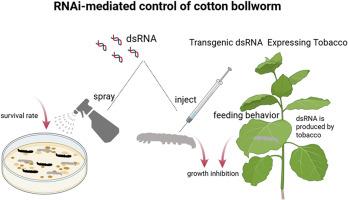
The cotton bollworm, Helicoverpa armigera, a widespread lepidopteran pest, poses a significant threat to global agricultural production. RNA interference (RNAi) technology has emerged as a promising tool for next-generation pest control; however, identifying highly effective target genes remains a critical challenge. This study focuses on Neurexin (NRX), a synaptic cell adhesion protein essential for synapse formation and function, which has been poorly characterized in lepidopteran species. The insecticidal effects of RNAi-mediated silencing of the H. armigera neurexin-4 (HaNRX) gene were evaluated in both first- and fourth-instar larvae, and the potential of plant-mediated RNAi for pest management was assessed. HaNRX knockdown, achieved through either dsRNA feeding or injection, significantly impaired larval growth and development. Furthermore, feeding on transgenic tobacco expressing dsHaNRX resulted in developmental delays in cotton bollworm larvae. In line with these results, suppression of the NRX ortholog in Spodoptera frugiperda also led to effective control of early-instar larvae. These findings highlight plant-mediated RNAi as a promising strategy for managing H. armigera and position NRX as a valuable target for future RNAi-based pest control approaches.
棉铃虫RNAi潜在靶基因HaNRX的研究
棉铃虫(Helicoverpa armigera)是一种广泛存在的鳞翅目害虫,对全球农业生产构成重大威胁。RNA干扰(RNAi)技术已成为下一代害虫防治的一种有前途的工具;然而,确定高效靶基因仍然是一个关键的挑战。这项研究的重点是Neurexin (NRX),一种突触细胞粘附蛋白,对突触的形成和功能至关重要,在鳞翅目物种中研究甚少。研究了RNAi介导的棉铃虫神经素-4 (HaNRX)基因沉默对1龄和4龄棉铃虫的杀虫效果,并评估了植物介导的RNAi在害虫防治中的潜力。通过dsRNA喂养或注射实现的HaNRX敲低显著损害了幼虫的生长和发育。此外,取食表达dsHaNRX的转基因烟草会导致棉铃虫幼虫发育迟缓。与此结果一致,抑制NRX同源基因也能有效控制夜蛾早期幼虫。这些发现强调了植物介导的RNAi是一种很有前途的管理棉蚜的策略,并将NRX定位为未来基于RNAi的害虫防治方法的有价值的目标。
本文章由计算机程序翻译,如有差异,请以英文原文为准。
求助全文
约1分钟内获得全文
求助全文
来源期刊
CiteScore
7.00
自引率
8.50%
发文量
238
审稿时长
4.2 months
期刊介绍:
Pesticide Biochemistry and Physiology publishes original scientific articles pertaining to the mode of action of plant protection agents such as insecticides, fungicides, herbicides, and similar compounds, including nonlethal pest control agents, biosynthesis of pheromones, hormones, and plant resistance agents. Manuscripts may include a biochemical, physiological, or molecular study for an understanding of comparative toxicology or selective toxicity of both target and nontarget organisms. Particular interest will be given to studies on the molecular biology of pest control, toxicology, and pesticide resistance.
Research Areas Emphasized Include the Biochemistry and Physiology of:
• Comparative toxicity
• Mode of action
• Pathophysiology
• Plant growth regulators
• Resistance
• Other effects of pesticides on both parasites and hosts.
 求助内容:
求助内容: 应助结果提醒方式:

 京公网安备 11010802042870号


