Chang-In Choi, Jae-Kyun Park, Tae Yong Jeon, Dae-Hwan Kim
{"title":"Long-term survival of gastric cancer patients with positive intraoperative frozen section margins: a single-cohort analysis.","authors":"Chang-In Choi, Jae-Kyun Park, Tae Yong Jeon, Dae-Hwan Kim","doi":"10.14216/kjco.25371","DOIUrl":null,"url":null,"abstract":"<p><strong>Purpose: </strong>To evaluate clinicopathological characteristics and long-term outcomes of patients with positive resection margins identified during intraoperative frozen section (IFS) in gastric cancer surgery.</p><p><strong>Methods: </strong>A retrospective analysis of 5,894 patients who underwent gastrectomy between May 2005 and December 2023. Among 207 patients with positive IFS margins, 121 were included after exclusion criteria. Additional resection was performed in 87 patients, while 34 received no further resection. Patients were divided into survivor group and non-survivor group for comparison. Patients' demographics, perioperative and survival outcomes were analyzed.</p><p><strong>Results: </strong>R0 resection was achieved in 100 patients (82.6%), while 21 patients (17.4%) had R1 resection. During follow-up, 76 patients survived and 45 died. Five-year overall survival rates were 95.7% for stage I, 56.6% for stage II, and 32.9% for stage III. The non-survivor group showed significantly higher rates of R1 resection (35.6% vs. 6.6%, P<0.001), advanced stage disease (82.2% vs. 40.8%, P<0.001), and pathological high-risk features. In multivariate analysis, TNM stage and R0 resection status were the most significant prognostic factors. Proximal margin length did not correlate with survival outcomes.</p><p><strong>Conclusion: </strong>TNM stage and achieving R0 resection were the most important prognostic factors in patients with positive IFS margins. R0 resection had greater survival impact in low-risk groups, while R1 resection was associated with poor outcomes regardless of stage, emphasizing the importance of complete tumor removal when technically feasible.</p>","PeriodicalId":74045,"journal":{"name":"Korean journal of clinical oncology","volume":"21 3","pages":"130-142"},"PeriodicalIF":0.0000,"publicationDate":"2025-12-01","publicationTypes":"Journal Article","fieldsOfStudy":null,"isOpenAccess":false,"openAccessPdf":"https://www.ncbi.nlm.nih.gov/pmc/articles/PMC12784152/pdf/","citationCount":"0","resultStr":null,"platform":"Semanticscholar","paperid":null,"PeriodicalName":"Korean journal of clinical oncology","FirstCategoryId":"1085","ListUrlMain":"https://doi.org/10.14216/kjco.25371","RegionNum":0,"RegionCategory":null,"ArticlePicture":[],"TitleCN":null,"AbstractTextCN":null,"PMCID":null,"EPubDate":"2025/12/31 0:00:00","PubModel":"Epub","JCR":"","JCRName":"","Score":null,"Total":0}
引用次数: 0
Abstract
Purpose: To evaluate clinicopathological characteristics and long-term outcomes of patients with positive resection margins identified during intraoperative frozen section (IFS) in gastric cancer surgery.
Methods: A retrospective analysis of 5,894 patients who underwent gastrectomy between May 2005 and December 2023. Among 207 patients with positive IFS margins, 121 were included after exclusion criteria. Additional resection was performed in 87 patients, while 34 received no further resection. Patients were divided into survivor group and non-survivor group for comparison. Patients' demographics, perioperative and survival outcomes were analyzed.
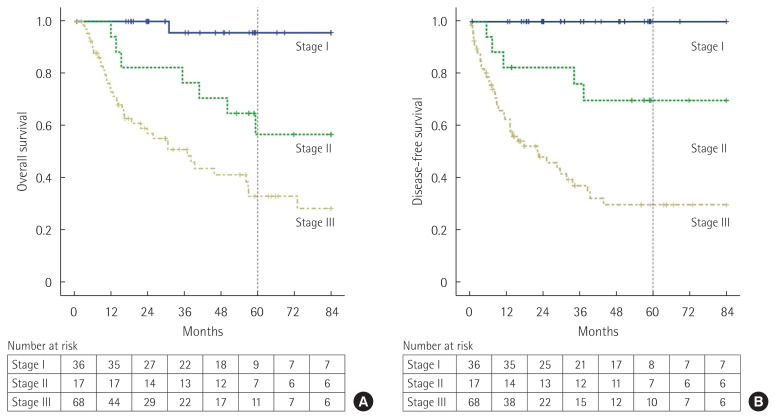
Results: R0 resection was achieved in 100 patients (82.6%), while 21 patients (17.4%) had R1 resection. During follow-up, 76 patients survived and 45 died. Five-year overall survival rates were 95.7% for stage I, 56.6% for stage II, and 32.9% for stage III. The non-survivor group showed significantly higher rates of R1 resection (35.6% vs. 6.6%, P<0.001), advanced stage disease (82.2% vs. 40.8%, P<0.001), and pathological high-risk features. In multivariate analysis, TNM stage and R0 resection status were the most significant prognostic factors. Proximal margin length did not correlate with survival outcomes.
Conclusion: TNM stage and achieving R0 resection were the most important prognostic factors in patients with positive IFS margins. R0 resection had greater survival impact in low-risk groups, while R1 resection was associated with poor outcomes regardless of stage, emphasizing the importance of complete tumor removal when technically feasible.



 求助内容:
求助内容: 应助结果提醒方式:

 京公网安备 11010802042870号


