Trend in the prevalence of metabolic phenotypes of obesity in Iranian children and adolescents: the CASPIAN (Childhood and Adolescence Surveillance and Prevention of Adult Non-communicable Disease) studies.
{"title":"Trend in the prevalence of metabolic phenotypes of obesity in Iranian children and adolescents: the CASPIAN (Childhood and Adolescence Surveillance and Prevention of Adult Non-communicable Disease) studies.","authors":"Sadegh Mazaheri-Tehrani, Motahar Heidari-Beni, Mostafa Qorbani, Maryam Yazdi, Roya Kelishadi","doi":"10.6065/apem.2550042.021","DOIUrl":null,"url":null,"abstract":"<p><strong>Purpose: </strong>Cardiometabolic risk factors can originate in childhood, especially in overweight individuals. In this study, we aimed to determine the trends in the prevalence of metabolic phenotypes among Iranian children and adolescents.</p><p><strong>Methods: </strong>We determined the trends of the data from 3 nationwide school-based studies in Iran from 2003 to 2016 (the CASPIAN [Childhood and Adolescence Surveillance and Prevention of Adult Non-communicable Disease] studies). A total of 8,711 individuals (49.6% boys) aged 10-18 years were studied. Obesity and normal weight were considered as an age- and sex-specific body mass index > 95th percentile and between the 5th to 85th percentile, respectively. Metabolic syndrome (MetS) was defined according to the modified Adult Treatment Panel III criteria for children and adolescents. Children were categorized into 4 groups: metabolically healthy obesity (MHO), metabolically unhealthy obesity (MUO), metabolically healthy normal weight, and metabolically unhealthy normal weight (MUNW).</p><p><strong>Results: </strong>Over 13 years, the prevalence of obesity increased significantly from 9.8% to 11.6% (p<0.001), whereas that of MetS did not change significantly (from 5.35% in 2003-2004 to 7.76% in 2009-2010 and 4.45% in 2015-2016, p=0.83). The prevalence of MHO increased significantly from 7.1% in 2004 to 9.6% in 2016 (p=0.005). However, the change in prevalence was not significant for MUO and MUNW.</p><p><strong>Conclusion: </strong>From 2003 to 2016, the prevalence of MetS and metabolic phenotypes except MHO did not change significantly among Iranian children. The marginal increase in MHO prevalence should be considered, as shifts from this phenotype to unhealthy phenotypes may influence the risk of developing noncommunicable diseases in adulthood.</p>","PeriodicalId":44915,"journal":{"name":"Annals of Pediatric Endocrinology & Metabolism","volume":"30 6","pages":"296-304"},"PeriodicalIF":3.3000,"publicationDate":"2025-12-01","publicationTypes":"Journal Article","fieldsOfStudy":null,"isOpenAccess":false,"openAccessPdf":"https://www.ncbi.nlm.nih.gov/pmc/articles/PMC12784092/pdf/","citationCount":"0","resultStr":null,"platform":"Semanticscholar","paperid":null,"PeriodicalName":"Annals of Pediatric Endocrinology & Metabolism","FirstCategoryId":"1085","ListUrlMain":"https://doi.org/10.6065/apem.2550042.021","RegionNum":0,"RegionCategory":null,"ArticlePicture":[],"TitleCN":null,"AbstractTextCN":null,"PMCID":null,"EPubDate":"2025/12/31 0:00:00","PubModel":"Epub","JCR":"Q3","JCRName":"ENDOCRINOLOGY & METABOLISM","Score":null,"Total":0}
引用次数: 0
Abstract
Purpose: Cardiometabolic risk factors can originate in childhood, especially in overweight individuals. In this study, we aimed to determine the trends in the prevalence of metabolic phenotypes among Iranian children and adolescents.
Methods: We determined the trends of the data from 3 nationwide school-based studies in Iran from 2003 to 2016 (the CASPIAN [Childhood and Adolescence Surveillance and Prevention of Adult Non-communicable Disease] studies). A total of 8,711 individuals (49.6% boys) aged 10-18 years were studied. Obesity and normal weight were considered as an age- and sex-specific body mass index > 95th percentile and between the 5th to 85th percentile, respectively. Metabolic syndrome (MetS) was defined according to the modified Adult Treatment Panel III criteria for children and adolescents. Children were categorized into 4 groups: metabolically healthy obesity (MHO), metabolically unhealthy obesity (MUO), metabolically healthy normal weight, and metabolically unhealthy normal weight (MUNW).
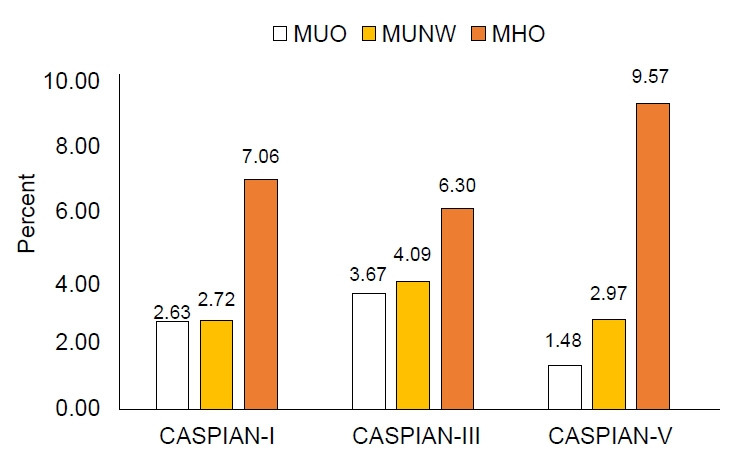
Results: Over 13 years, the prevalence of obesity increased significantly from 9.8% to 11.6% (p<0.001), whereas that of MetS did not change significantly (from 5.35% in 2003-2004 to 7.76% in 2009-2010 and 4.45% in 2015-2016, p=0.83). The prevalence of MHO increased significantly from 7.1% in 2004 to 9.6% in 2016 (p=0.005). However, the change in prevalence was not significant for MUO and MUNW.
Conclusion: From 2003 to 2016, the prevalence of MetS and metabolic phenotypes except MHO did not change significantly among Iranian children. The marginal increase in MHO prevalence should be considered, as shifts from this phenotype to unhealthy phenotypes may influence the risk of developing noncommunicable diseases in adulthood.
期刊介绍:
The Annals of Pediatric Endocrinology & Metabolism Journal is the official publication of the Korean Society of Pediatric Endocrinology. Its formal abbreviated title is “Ann Pediatr Endocrinol Metab”. It is a peer-reviewed open access journal of medicine published in English. The journal was launched in 1996 under the title of ‘Journal of Korean Society of Pediatric Endocrinology’ until 2011 (pISSN 1226-2242). Since 2012, the title is now changed to ‘Annals of Pediatric Endocrinology & Metabolism’. The Journal is published four times per year on the last day of March, June, September, and December. It is widely distributed for free to members of the Korean Society of Pediatric Endocrinology, medical schools, libraries, and academic institutions. The journal is indexed/tracked/covered by web sites of PubMed Central, PubMed, Emerging Sources Citation Index (ESCI), Scopus, EBSCO, EMBASE, KoreaMed, KoMCI, KCI, Science Central, DOI/CrossRef, Directory of Open Access Journals(DOAJ), and Google Scholar. The aims of Annals of Pediatric Endocrinology & Metabolism are to contribute to the advancements in the fields of pediatric endocrinology & metabolism through the scientific reviews and interchange of all of pediatric endocrinology and metabolism. It aims to reflect the latest clinical, translational, and basic research trends from worldwide valuable achievements. In addition, genome research, epidemiology, public education and clinical practice guidelines in each country are welcomed for publication. The Journal particularly focuses on research conducted with Asian-Pacific children whose genetic and environmental backgrounds are different from those of the Western. Area of specific interest include the following : Growth, puberty, glucose metabolism including diabetes mellitus, obesity, nutrition, disorders of sexual development, pituitary, thyroid, parathyroid, adrenal cortex, bone or other endocrine and metabolic disorders from infancy through adolescence.




 求助内容:
求助内容: 应助结果提醒方式:

 京公网安备 11010802042870号


