{"title":"Investigation of the effect of dimethyl sulfoxide on growth and biofilm formation of <i>Pseudomonas aeruginosa</i>.","authors":"Hafez Al-Momani, Safaa Mashal, Hadeel AlGhawrie","doi":"10.18502/ijm.v17i6.20362","DOIUrl":null,"url":null,"abstract":"<p><strong>Background and objectives: </strong>The antimicrobial resistance of <i>Pseudomonas aeruginosa</i> bacteria limits the spectrum of effective antibiotics. Considerable focus has been placed on the identification of more contemporary and cost-effective antimicrobial drugs. In this study, the antibacterial properties of a commonly used solvent, dimethyl sulfoxide (DMSO), against <i>P. aeruginosa</i> were investigated.</p><p><strong>Materials and methods: </strong>The microtiter broth dilution technique was employed to establish the minimum inhibitory concentration (MIC) and minimum bactericidal concentration (MBC) of DMSO. The solvent's impact on bacterial growth, biofilm formation and eradication was assessed. A quantitative polymerase chain reaction (qPCR) was carried out to assess the effect of varying DMSO concentrations ranging from 1% to 8% (v/v) on quorum sensing gene expression.</p><p><strong>Results: </strong>All <i>P. aeruginosa</i> strains exhibited a DMSO MIC of 25% v/v and MBC of 50% v/v. DMSO caused significant growth inhibition and suppression of biofilm formation in all <i>P. aeruginosa</i> strains at sub-inhibitory concentrations, i.e. 1%-8% v/v. At these concentrations, the samples showed a reduction in biomass and reduced metabolic activity. These effects were concentration-dependent. A DMSO strength of 8% v/v was associated with a statistically significant downregulation of most of the quorum sensing genes; at a DMSO titer of 1% v/v, this effect was modest with only a few genes being significantly affected.</p><p><strong>Conclusion: </strong>DMSO is a potential therapeutic agent against <i>P. aeruginosa</i> as it has been demonstrated that it exhibits antimicrobial characteristics. Moreover, the impact of DMSO on bacterial growth and biofilm formation complicates its use as a solvent in biologic and clinical research.</p>","PeriodicalId":14633,"journal":{"name":"Iranian Journal of Microbiology","volume":"17 6","pages":"942-953"},"PeriodicalIF":1.7000,"publicationDate":"2025-12-01","publicationTypes":"Journal Article","fieldsOfStudy":null,"isOpenAccess":false,"openAccessPdf":"https://www.ncbi.nlm.nih.gov/pmc/articles/PMC12777626/pdf/","citationCount":"0","resultStr":null,"platform":"Semanticscholar","paperid":null,"PeriodicalName":"Iranian Journal of Microbiology","FirstCategoryId":"1085","ListUrlMain":"https://doi.org/10.18502/ijm.v17i6.20362","RegionNum":0,"RegionCategory":null,"ArticlePicture":[],"TitleCN":null,"AbstractTextCN":null,"PMCID":null,"EPubDate":"","PubModel":"","JCR":"Q4","JCRName":"MICROBIOLOGY","Score":null,"Total":0}
引用次数: 0
Abstract
Background and objectives: The antimicrobial resistance of Pseudomonas aeruginosa bacteria limits the spectrum of effective antibiotics. Considerable focus has been placed on the identification of more contemporary and cost-effective antimicrobial drugs. In this study, the antibacterial properties of a commonly used solvent, dimethyl sulfoxide (DMSO), against P. aeruginosa were investigated.
Materials and methods: The microtiter broth dilution technique was employed to establish the minimum inhibitory concentration (MIC) and minimum bactericidal concentration (MBC) of DMSO. The solvent's impact on bacterial growth, biofilm formation and eradication was assessed. A quantitative polymerase chain reaction (qPCR) was carried out to assess the effect of varying DMSO concentrations ranging from 1% to 8% (v/v) on quorum sensing gene expression.
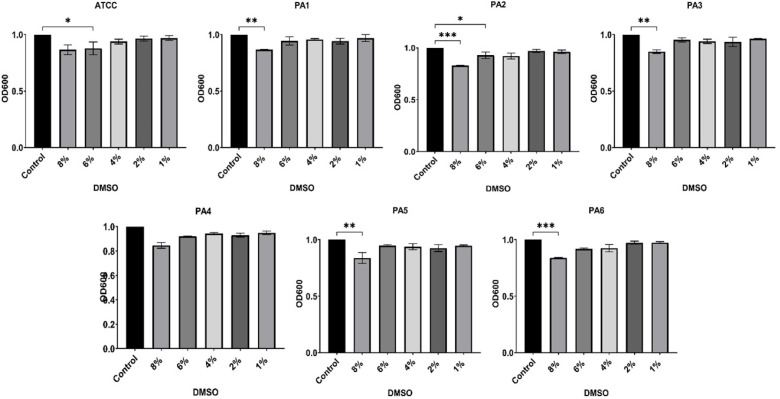
Results: All P. aeruginosa strains exhibited a DMSO MIC of 25% v/v and MBC of 50% v/v. DMSO caused significant growth inhibition and suppression of biofilm formation in all P. aeruginosa strains at sub-inhibitory concentrations, i.e. 1%-8% v/v. At these concentrations, the samples showed a reduction in biomass and reduced metabolic activity. These effects were concentration-dependent. A DMSO strength of 8% v/v was associated with a statistically significant downregulation of most of the quorum sensing genes; at a DMSO titer of 1% v/v, this effect was modest with only a few genes being significantly affected.
Conclusion: DMSO is a potential therapeutic agent against P. aeruginosa as it has been demonstrated that it exhibits antimicrobial characteristics. Moreover, the impact of DMSO on bacterial growth and biofilm formation complicates its use as a solvent in biologic and clinical research.
期刊介绍:
The Iranian Journal of Microbiology (IJM) is an international, multi-disciplinary, peer-reviewed journal that provides rapid publication of the most advanced scientific research in the areas of basic and applied research on bacteria and other micro-organisms, including bacteria, viruses, yeasts, fungi, microalgae, and protozoa concerning the development of tools for diagnosis and disease control, epidemiology, antimicrobial agents, clinical microbiology, immunology, Genetics, Genomics and Molecular Biology. Contributions may be in the form of original research papers, review articles, short communications, case reports, technical reports, and letters to the Editor. Research findings must be novel and the original data must be available for review by the Editors, if necessary. Studies that are preliminary, of weak originality or merely descriptive as well as negative results are not appropriate for the journal. Papers considered for publication must be unpublished work (except in an abstract form) that is not under consideration for publication anywhere else, and all co-authors should have agreed to the submission. Manuscripts should be written in English.




 求助内容:
求助内容: 应助结果提醒方式:

 京公网安备 11010802042870号


