
Decoding bed armoring: A predictive method for grain size distribution in sand–gravel bed rivers
IF 3.2
2区 地球科学
Q2 GEOGRAPHY, PHYSICAL
引用次数: 0
Abstract
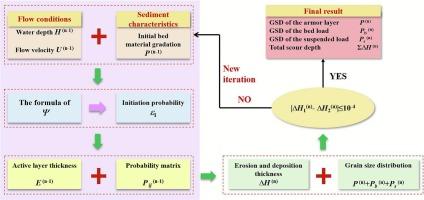
Sand–gravel riverbeds downstream of hydraulic projects frequently undergo significant bed armoring. Accurately predicting the grain-size distribution of the armored layer remains a critical yet complex challenge within the field of fluvial dynamics. This study focuses on the response mechanism that connects the progressive reduction in fine sediment content with the evolution of hiding–exposure effects, the consequent alterations in sediment state transition probability, and the subsequent adjustment of the armoring rate during the process of riverbed armoring. An expression for sediment entrainment probability is derived under dynamically varying conditions, which include armoring intensity and the hiding–exposure effects of non-uniform sediments. A three-state exchange mechanism among suspended load, bed load, and bed surface material is integrated into the armoring calculation process. A sediment mass conservation relation under depositional conditions is also formulated, leading to the proposal of a novel stability criterion for bed armoring. Building on these advancements, a predictive method for determining the grain-size distribution of armored layers is developed, explicitly considering sediment exchange processes. Application of this method to the downstream reaches of the Danjiangkou and Three Gorges Reservoirs in China reveals that the predicted grain-size distribution of the armored layer deviates from field measurements by only 2.9 % on average, and from flume experiments by 4.1 %. The findings indicate that the proposed method effectively replicates gradation trends, grain-size distributions of armor layer, and scour depths under clear-water conditions. Furthermore, within the research framework of multi-stage armoring, characterized by the cyclic “formation–destruction–reformation” of armor layers, the method demonstrates considerable potential for applicability.
解码河床盔甲:砂砾河床河流粒度分布的预测方法
水利工程下游的砂砾河床经常发生明显的河床铠装。在河流动力学领域,准确预测装甲层的粒度分布仍然是一个关键而复杂的挑战。重点研究了河床成甲过程中细沙含量的逐渐减少与隐藏-暴露效应演化的响应机制,以及由此引起的泥沙状态转变概率的变化,以及随后对成甲速率的调整。导出了动态变化条件下的挟沙概率表达式,包括装甲强度和非均匀沉积物的隐藏-暴露效应。将悬架载荷、床面载荷和床面材料的三态交换机制集成到装甲计算过程中。建立了沉积条件下的沉积物质量守恒关系,从而提出了一种新的床层装甲稳定性判据。在这些进展的基础上,开发了一种确定装甲层粒度分布的预测方法,明确考虑了沉积物交换过程。将该方法应用于丹江口和三峡水库下游,结果表明,预测的甲层粒度分布与实测平均偏差仅为2.9%,与水槽试验平均偏差为4.1%。结果表明,该方法有效地模拟了清水条件下甲壳层的级配趋势、粒度分布和冲刷深度。此外,在以装甲层形成-破坏-改造为循环特征的多级装甲研究框架中,该方法显示出相当大的适用性潜力。
本文章由计算机程序翻译,如有差异,请以英文原文为准。
求助全文
约1分钟内获得全文
求助全文
来源期刊
Geomorphology
地学-地球科学综合
CiteScore
8.00
自引率
10.30%
发文量
309
审稿时长
3.4 months
期刊介绍:
Our journal''s scope includes geomorphic themes of: tectonics and regional structure; glacial processes and landforms; fluvial sequences, Quaternary environmental change and dating; fluvial processes and landforms; mass movement, slopes and periglacial processes; hillslopes and soil erosion; weathering, karst and soils; aeolian processes and landforms, coastal dunes and arid environments; coastal and marine processes, estuaries and lakes; modelling, theoretical and quantitative geomorphology; DEM, GIS and remote sensing methods and applications; hazards, applied and planetary geomorphology; and volcanics.
 求助内容:
求助内容: 应助结果提醒方式:

 京公网安备 11010802042870号


