
Divergent responses of soil bacterial and fungal biomass carbon and phosphorus (P) to a P addition gradient
IF 2.2
3区 农林科学
Q3 ECOLOGY
引用次数: 0
Abstract
Microorganisms mediate element dynamics in soils through biomass turnover, and their activity is largely affected by nutrient inputs. However, as the two major subgroups of soil microbial community, little is known regarding how bacterial and fungal biomass carbon (C) and phosphorus (P) respond to a P addition gradient. Herein, the dynamic changes of bacterial and fungal biomass C and P from the soil in northern China were studied using the selective inhibition technique. A 20-d soil incubation experiment was set up with different P additions: 0, 20 and 60 mg kg−1 soil. The experiment selected streptomycin (10 mg g−1 soil) and cycloheximide (20 mg g−1 soil) as bacterial and fungal inhibitors, respectively. The results showed that P addition did not affect the total microbial biomass C but substantially adjusted the composition contributed by bacteria and fungi. Fungal biomass C contributed highest at the low P addition rate, but its significance tended to decrease as P addition increased, whereas the contribution of bacterial biomass C increased. P addition positively affected both bacterial and fungal biomass P, but at a higher extent for bacteria. In terms of time, bacteria showed a higher potential to release P into soil labile P pools through biomass turnover at an earlier stage after P addition, whereas fungi may have a slow effect as sources of soil labile P. These results indicate divergent responses for bacterial and fungal biomass across different P additions. Such insights should be considered at field scale and should inform C and nutrient managements planning in terms of soil C and P cycling.
土壤细菌和真菌生物量碳磷对磷添加梯度的不同响应
微生物通过生物量周转调节土壤元素动态,其活动在很大程度上受养分投入的影响。然而,作为土壤微生物群落的两大亚群,关于细菌和真菌生物量碳(C)和磷(P)如何响应磷添加梯度的研究却很少。采用选择性抑制技术研究了中国北方土壤中细菌和真菌生物量C和P的动态变化。设置不同磷添加量(0、20和60 mg kg−1土壤)的20 d土壤培养试验。实验选择链霉素(10 mg g−1土壤)和环己亚胺(20 mg g−1土壤)分别作为细菌和真菌抑制剂。结果表明,磷的添加对微生物总生物量C没有影响,但对细菌和真菌贡献的组成有较大的调节作用。真菌生物量C在磷添加量较低时贡献最大,但随着磷添加量的增加,其显著性呈降低趋势,而细菌生物量C的贡献呈增加趋势。添加磷对细菌和真菌生物量P均有显著的正向影响,但对细菌的影响更大。从时间上看,细菌在施磷后较早阶段通过生物量周转向土壤稳定磷库释放磷的潜力较大,而真菌作为土壤稳定磷来源的作用可能较慢。这些结果表明,不同施磷量对细菌和真菌生物量的响应存在差异。这些见解应在田间尺度上加以考虑,并应在土壤C和P循环方面为C和养分管理规划提供信息。
本文章由计算机程序翻译,如有差异,请以英文原文为准。
求助全文
约1分钟内获得全文
求助全文
来源期刊
Pedobiologia
环境科学-生态学
CiteScore
4.20
自引率
8.70%
发文量
38
审稿时长
64 days
期刊介绍:
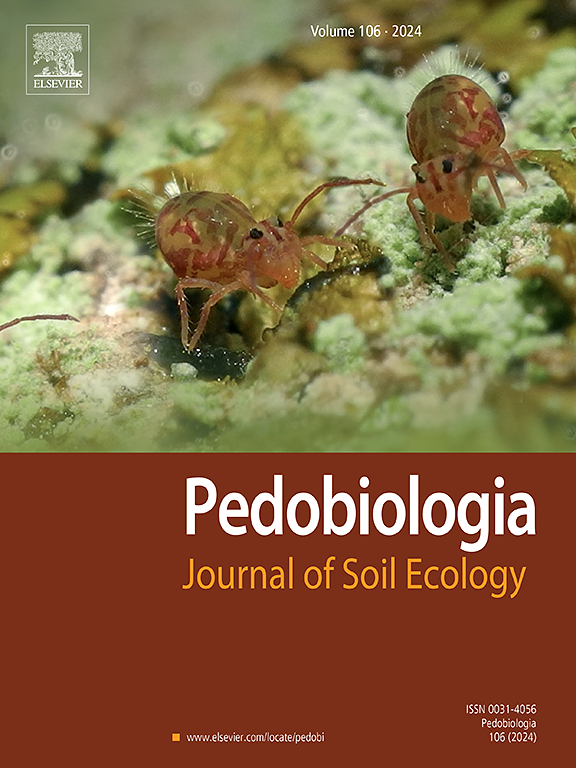
Pedobiologia publishes peer reviewed articles describing original work in the field of soil ecology, which includes the study of soil organisms and their interactions with factors in their biotic and abiotic environments.
Analysis of biological structures, interactions, functions, and processes in soil is fundamental for understanding the dynamical nature of terrestrial ecosystems, a prerequisite for appropriate soil management. The scope of this journal consists of fundamental and applied aspects of soil ecology; key focal points include interactions among organisms in soil, organismal controls on soil processes, causes and consequences of soil biodiversity, and aboveground-belowground interactions.
We publish:
original research that tests clearly defined hypotheses addressing topics of current interest in soil ecology (including studies demonstrating nonsignificant effects);
descriptions of novel methodological approaches, or evaluations of current approaches, that address a clear need in soil ecology research;
innovative syntheses of the soil ecology literature, including metaanalyses, topical in depth reviews and short opinion/perspective pieces, and descriptions of original conceptual frameworks; and
short notes reporting novel observations of ecological significance.
 求助内容:
求助内容: 应助结果提醒方式:

 京公网安备 11010802042870号


