
Keratin-derived bio-adsorbents for water remediation: Current and future trends
Q1 Environmental Science
Bioresource Technology Reports
Pub Date : 2026-02-01
Epub Date: 2026-01-04
DOI:10.1016/j.biteb.2025.102508
引用次数: 0
Abstract
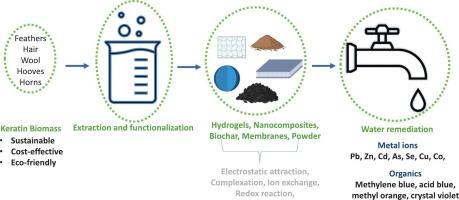
Keratin-derived bio-adsorbents have become a highly effective solution for water remediation applications, owing to their sustainable and environmentally friendly properties. Keratin, which is naturally abundant, exhibits unique physicochemical properties and is environmentally benign. It can be extracted from many biomass sources such as feathers, hooves, wool, and hair, and is characterized by a fibrous protein structure rich in functional groups such as disulfide, amino, and carboxyl groups. These attributes enable the effective binding of metal ions and organic pollutants simultaneously from the polluted water. The review highlights recent progress in keratin-based bio-adsorbents adsorbing both metal cations and oxyanions such as Pb2+, Ni2+, Co2+, Zn2+, Cr3+/CrO₄2−, Cd2+, AsO₃3−/AsO₄3−, and SeO₃2−/SeO₄2−, alongside organic pollutants like methylene blue, reactive blue 19, crystal violet, methyl orange, and phenolic compounds for sustainable water purification. The review also examines chemical modifications and composite materials that enhance keratin's adsorption capacity, selectivity, and regeneration potential. Additionally, it identifies significant research gaps, such as limited scalability and challenges in regeneration and reuse. Ion exchange, complexation, electrostatic interactions, and hydrogen bonding are identified as crucial mechanisms in the adsorption processes of keratin-based materials. Future research should focus on developing innovative keratin composites, employing environmentally friendly processing methods, creating mechanistic models, and conducting large-scale testing to bridge laboratory findings with industrial applications.
用于水修复的角蛋白生物吸附剂:当前和未来趋势
角蛋白衍生的生物吸附剂由于其可持续和环境友好的特性,已成为水修复应用的高效解决方案。天然丰富的角蛋白具有独特的物理化学性质,对环境无害。它可以从许多生物质来源中提取,如羽毛、蹄、羊毛和头发,其特点是纤维蛋白结构富含功能基团,如二硫、氨基和羧基。这些特性使金属离子和有机污染物同时从污染的水有效结合。该综述重点介绍了基于角蛋白的生物吸附剂的最新进展,该吸附剂吸附金属阳离子和氧阴离子,如Pb2+、Ni2+、Co2+、Zn2+、Cr3+/CrO₄2−、Cd2+、AsO₃3−/AsO₄3−和SeO₃2−/SeO₄2−,以及亚甲基蓝、活性蓝19、结晶紫、甲基橙和酚类化合物等有机污染物,用于可持续的水净化。综述还探讨了提高角蛋白吸附能力、选择性和再生潜力的化学修饰和复合材料。此外,它还指出了重大的研究差距,例如有限的可扩展性以及再生和重用方面的挑战。离子交换、络合、静电相互作用和氢键被认为是角蛋白基材料吸附过程中的关键机制。未来的研究应侧重于开发创新的角蛋白复合材料,采用环保的加工方法,建立机理模型,并进行大规模测试,以将实验室研究结果与工业应用相结合。
本文章由计算机程序翻译,如有差异,请以英文原文为准。
求助全文
约1分钟内获得全文
求助全文
来源期刊

Bioresource Technology Reports
Environmental Science-Environmental Engineering
CiteScore
7.20
自引率
0.00%
发文量
390
审稿时长
28 days
 求助内容:
求助内容: 应助结果提醒方式:

 京公网安备 11010802042870号


