
Inflammatory and genetic mechanisms mediate the association between frailty and incident atopic dermatitis in middle-aged and elderly adults
IF 5.1
3区 医学
Q2 CELL BIOLOGY
Mechanisms of Ageing and Development
Pub Date : 2026-04-01
Epub Date: 2026-01-05
DOI:10.1016/j.mad.2025.112148
引用次数: 0
Abstract
Frailty is linked to many chronic conditions, but its relationship with atopic dermatitis (AD) remains insufficiently defined. We assessed whether frailty predisposes to incident AD and explored inflammatory and genetic mechanisms. Baseline frailty was ascertained using both the physical frailty phenotype and a multidimensional frailty index, classifying participants as non-frail, pre-frail, or frail. Cox proportional hazards models with stratified analyses quantified associations with AD onset. To probe causality, we performed two-sample Mendelian randomization (TSMR) and generalized summary-data-based MR (GSMR). We further integrated circulating inflammatory markers and plasma proteomic data to illuminate biological pathways. Compared with non-frail participants, pre-frail and frail individuals had higher risks of incident AD after adjustment for established confounders; associations were stronger in adults < 65 years. TSMR and GSMR supported a potential causal effect of frailty on AD. Neutrophil count, eosinophil count, and C-reactive protein partially mediated the frailty-AD relationship. Proteomic analyses highlighted MMP12 as a promising AD-specific biomarker in frail individuals. Overall, frailty confers an elevated long-term risk of AD, with middle-aged adults displaying the greatest vulnerability. Several inflammatory cell measures and circulating proteins-including MMP12-may serve as early indicators of AD risk, informing earlier diagnosis and targeted monitoring in pre-frail and frail populations.
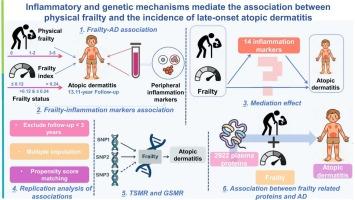
炎症和遗传机制介导虚弱和中老年人特应性皮炎之间的关联
虚弱与许多慢性疾病有关,但其与特应性皮炎(AD)的关系尚不明确。我们评估了虚弱是否易患AD,并探讨了炎症和遗传机制。基线虚弱是通过身体虚弱表型和多维虚弱指数来确定的,将参与者分为非虚弱、虚弱前或虚弱。分层分析的Cox比例风险模型量化了与AD发病的关联。为了探究因果关系,我们进行了两样本孟德尔随机化(TSMR)和基于广义汇总数据的MR (GSMR)。我们进一步整合循环炎症标志物和血浆蛋白质组学数据来阐明生物学途径。与非虚弱的参与者相比,在调整了确定的混杂因素后,虚弱前和虚弱的个体发生AD的风险更高;在65岁的成年人中,相关性更强<; 。TSMR和GSMR支持虚弱对AD的潜在因果效应。中性粒细胞计数、嗜酸性粒细胞计数和c反应蛋白部分介导虚弱与ad的关系。蛋白质组学分析强调了MMP12在虚弱个体中是一种有希望的ad特异性生物标志物。总的来说,虚弱会增加患阿尔茨海默病的长期风险,中年人表现出最大的脆弱性。几种炎症细胞测量和循环蛋白(包括mmp12)可能作为阿尔茨海默病风险的早期指标,为体弱和体弱人群的早期诊断和靶向监测提供信息。
本文章由计算机程序翻译,如有差异,请以英文原文为准。
求助全文
约1分钟内获得全文
求助全文
来源期刊
CiteScore
11.10
自引率
1.90%
发文量
79
审稿时长
32 days
期刊介绍:
Mechanisms of Ageing and Development is a multidisciplinary journal aimed at revealing the molecular, biochemical and biological mechanisms that underlie the processes of aging and development in various species as well as of age-associated diseases. Emphasis is placed on investigations that delineate the contribution of macromolecular damage and cytotoxicity, genetic programs, epigenetics and genetic instability, mitochondrial function, alterations of metabolism and innovative anti-aging approaches. For all of the mentioned studies it is necessary to address the underlying mechanisms.
Mechanisms of Ageing and Development publishes original research, review and mini-review articles. The journal also publishes Special Issues that focus on emerging research areas. Special issues may include all types of articles following peered review. Proposals should be sent directly to the Editor-in-Chief.
 求助内容:
求助内容: 应助结果提醒方式:

 京公网安备 11010802042870号


